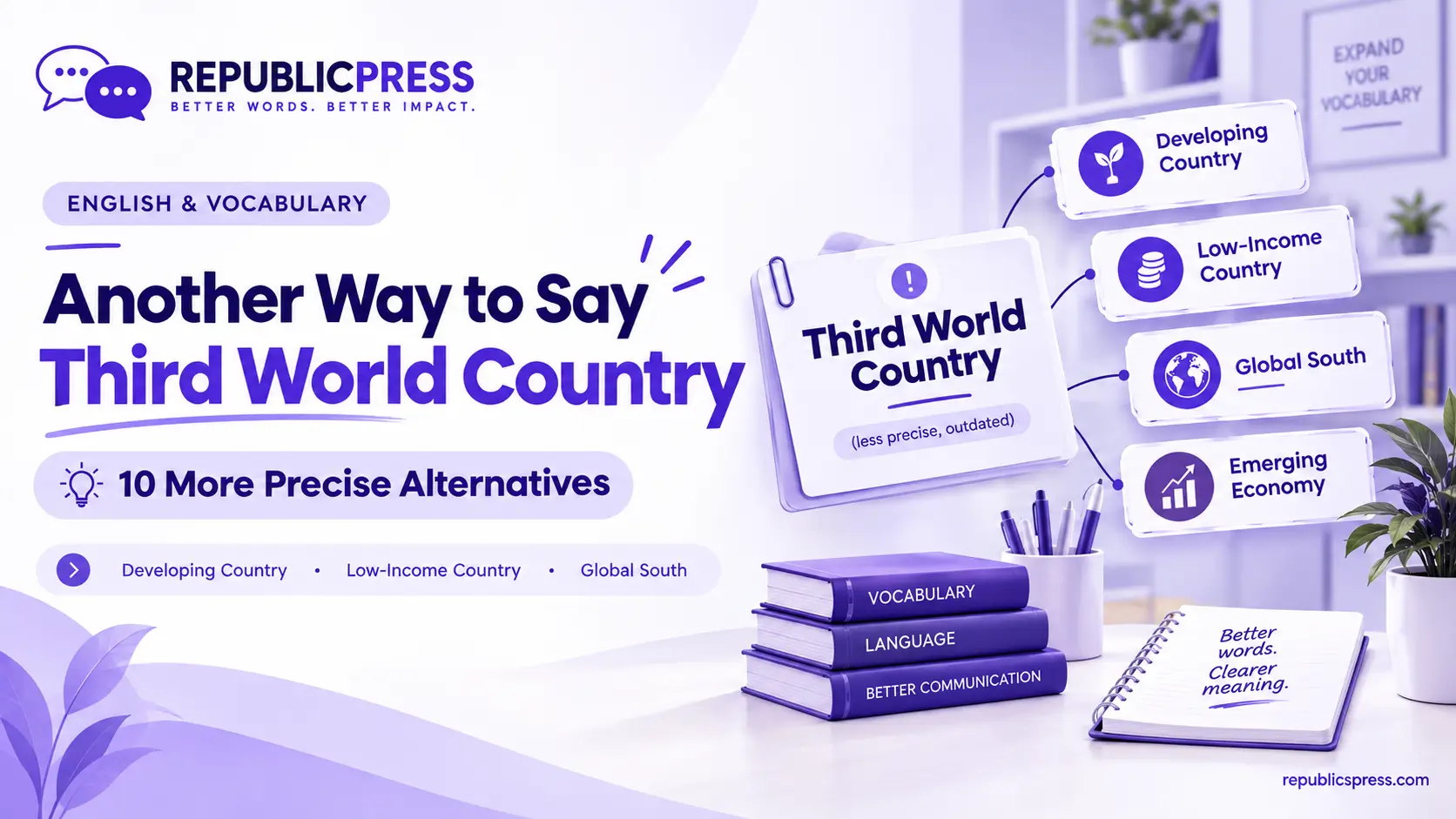
Another Way to Say Third World Country: 10 More Precise Alternatives
Direct answer: If you want another way to say “Third World country,” the best choice depends on what you mean. In modern American English, options such as developing country, low-income country, lower-middle-income country, low- and middle-income country, Global South country, or a specific World Bank income classification can be more precise. “Third World” is generally considered outdated and can be unclear because its original meaning was political, not simply economic.
Key Takeaways
- “Third World” originally referred to countries that were not aligned with either major Cold War bloc.
- Today, the phrase is often used to mean countries with lower levels of income or development, but that usage is broad and imprecise.
- “Developing country” is common but can still be too general for formal writing.
- “Low-income country” is more precise when income is the specific issue.
- “Low- and middle-income country” is useful when referring to a broad economic group.
- For academic or professional writing, naming the country or using a recognized classification is often clearer.
What Does “Third World Country” Mean?
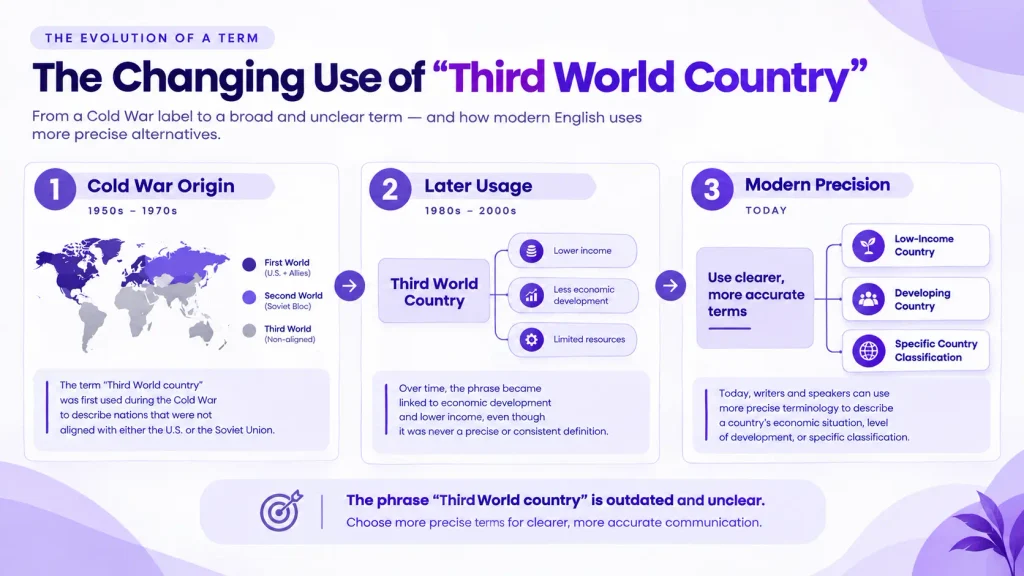
“Third World country” is an older expression that has taken on several meanings over time.
The term originally developed during the Cold War. It referred to countries that were not formally aligned with either the U.S.-led Western bloc or the Soviet-led Eastern bloc. Over time, however, people increasingly used “Third World” to describe countries considered economically poorer or less industrialized.
That shift created a problem: the political meaning and the economic meaning are not the same.
Today, someone might use “Third World country” to mean a country with low income, limited infrastructure, widespread poverty, or fewer economic opportunities. But the phrase does not provide a clear or standardized definition for any of those conditions.
For precise writing, it is better to describe the specific characteristic you mean.
Why Use an Alternative to “Third World Country”?
You may want a different expression because “Third World” can be outdated, vague, or overly broad.
The World Bank, for example, currently groups economies into four income categories: low income, lower-middle income, upper-middle income, and high income. These classifications are based on GNI per capita and are updated each year.
Using a more specific term can make your writing clearer.
For example:
- If you mean low national income, say low-income country.
- If you mean a broader economic group, say low- and middle-income countries.
- If you mean a particular region or geopolitical concept, Global South may fit.
- If you mean limited infrastructure, describe the infrastructure issue directly.
- If you mean poverty, use countries with high poverty rates when that is what the evidence shows.
The most accurate alternative depends on the sentence and the idea you are trying to communicate.
10 Alternatives to “Third World Country”
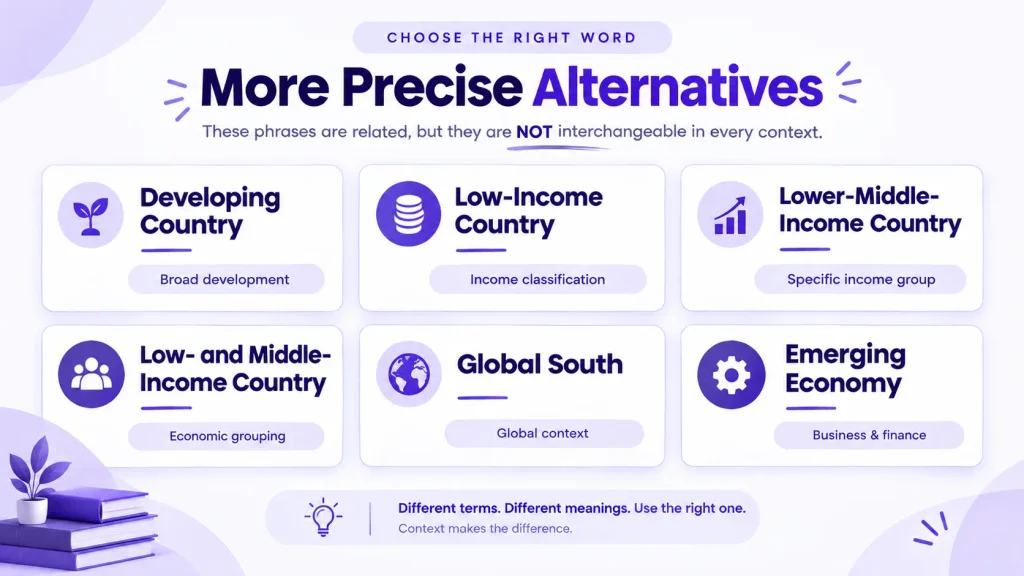
1. Developing Country
“Developing country” is one of the most familiar alternatives in everyday and general-purpose writing.
It is often used for countries that are undergoing economic, social, or institutional development. However, it is a broad term rather than a precise classification.
Example:
The organization works with developing countries to improve access to education.
Best for: General informational writing, news-style discussions, and broad development topics.
Usage tip: Use this term carefully when precision matters. Countries grouped under “developing” can differ greatly in income, infrastructure, health outcomes, and economic structure. The World Bank has also discussed moving away from broad “developing world” terminology because it can hide important differences between countries.
2. Low-Income Country
“Low-income country” is a more specific choice when you are talking about national income.
The World Bank uses “low income” as one of its official income groups. For fiscal year 2027, its threshold is a GNI per capita of $1,175 or less, based on 2025 data.
Example:
The program provides financial assistance to low-income countries.
Best for: Economic reports, development research, policy writing, and data-based discussions.
Usage tip: Do not use “low-income” simply as a replacement for “Third World.” A country can face development challenges without belonging to the World Bank’s low-income category.
3. Lower-Middle-Income Country
“Lower-middle-income country” is useful when the country falls within that specific World Bank income group.
For fiscal year 2027, the World Bank defines lower-middle-income economies as those with GNI per capita between $1,176 and $4,635.
Example:
The report examines economic growth in several lower-middle-income countries.
Best for: Research papers, economic analysis, international development reports, and statistics.
Usage tip: This is much more precise than “Third World,” but it should only be used when the country’s current classification supports it.
4. Low- and Middle-Income Country
“Low- and middle-income country” is useful when discussing a broad group that includes low-income, lower-middle-income, and upper-middle-income economies.
The World Bank uses the broader category low- and middle-income for these three groups.
Example:
The study analyzed healthcare access across low- and middle-income countries.
Best for: Global health, development studies, economics, research, and international policy.
Usage tip: This phrase covers a wide range of economies, so it should not be treated as a synonym for “poor country.”
5. Upper-Middle-Income Country
This phrase is appropriate when the country belongs to the World Bank’s upper-middle-income category.
For fiscal year 2027, the World Bank defines this group as economies with GNI per capita between $4,636 and $14,375.
Example:
The company is expanding its services in several upper-middle-income countries.
Best for: Economic analysis, business research, international development, and statistical writing.
Usage tip: This is a classification, not a judgment about a country’s overall quality of life or development.
6. Global South Country
“Global South country” can work when the discussion is about broad global economic, political, or historical relationships.
The term is not simply another name for “poor country.” The Global South includes countries with very different economies and levels of development.
Example:
The conference brought together researchers from several Global South countries.
Best for: International affairs, global development, politics, history, and academic discussions.
Usage tip: Avoid using “Global South” as though it were an exact economic classification. It describes a broad geopolitical and historical grouping rather than a single income level.
7. Emerging Economy
“Emerging economy” is often used for an economy that is developing and becoming more integrated into global markets.
Example:
The company sees strong growth opportunities in several emerging economies.
Best for: Business, finance, investment, economics, and international markets.
Usage tip: “Emerging economy” does not mean exactly the same thing as “Third World country.” It emphasizes economic growth and market development rather than poverty or low income.
8. Economically Developing Country
“Economically developing country” can make the intended meaning clearer when the discussion specifically concerns economic development.
Example:
The program supports infrastructure projects in economically developing countries.
Best for: General explanatory writing where the economic context needs to be explicit.
Usage tip: This phrase is understandable, but it is less precise than an established classification such as “low-income country” or “lower-middle-income country.”
9. Country With a Lower Income Level
“Country with a lower income level” is a useful descriptive phrase when you want neutral wording without assigning a broad label.
Example:
The policy provides additional support to countries with lower income levels.
Best for: General audiences, explanatory articles, and writing where a softer descriptive approach is appropriate.
Usage tip: This wording is intentionally broad. If you have reliable data, a recognized income classification is usually more informative.
10. Country Facing Development Challenges
“Country facing development challenges” is useful when the point is not simply income but specific difficulties such as infrastructure, healthcare access, education, poverty, or economic opportunity.
Example:
The organization partners with countries facing development challenges to improve access to clean water.
Best for: Humanitarian writing, nonprofit communications, development topics, and general audiences.
Usage tip: This is a descriptive phrase rather than a formal economic category. It is especially useful when the article is discussing a specific challenge rather than labeling an entire country.
Which Alternative Is Most Appropriate?
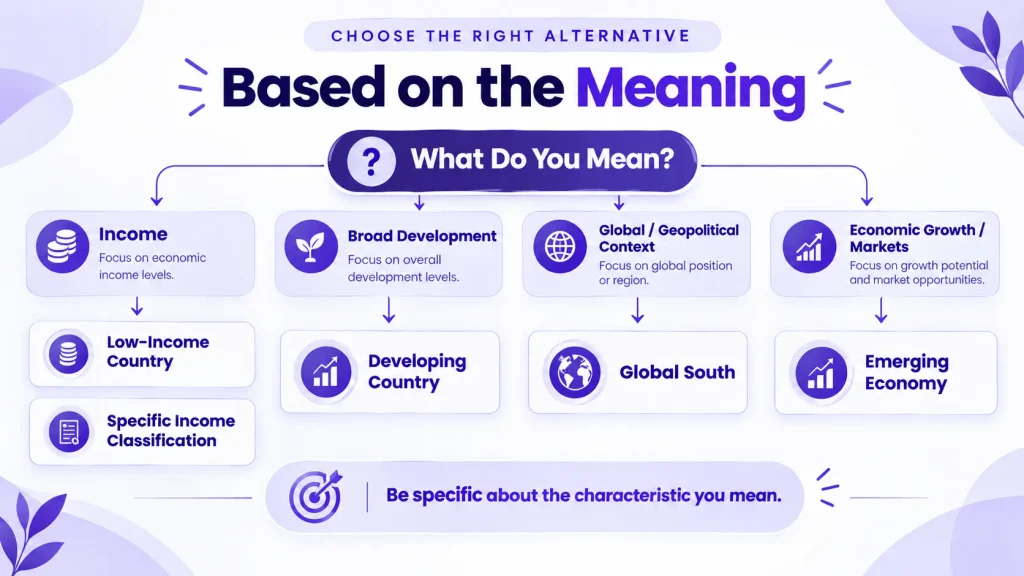
There is no single replacement for “Third World country” that works in every sentence. The right choice depends on what you actually mean.
| Alternative | Main meaning | Tone | Best context |
| Developing country | Broad development context | Neutral | General writing |
| Low-income country | Specific income category | Formal | Economics and research |
| Lower-middle-income country | Specific income group | Formal | Statistics and reports |
| Low- and middle-income country | Broad income grouping | Formal | Health and development |
| Upper-middle-income country | Specific income group | Formal | Economic analysis |
| Global South country | Broad geopolitical concept | Neutral/Formal | Global affairs |
| Emerging economy | Growing or changing economy | Professional | Business and finance |
| Economically developing country | Economic development | Neutral/Formal | General explanatory writing |
| Country with a lower income level | Descriptive income wording | Neutral | General audiences |
| Country facing development challenges | Specific development difficulties | Neutral | Development and humanitarian topics |
“Third World” vs. More Precise Alternatives
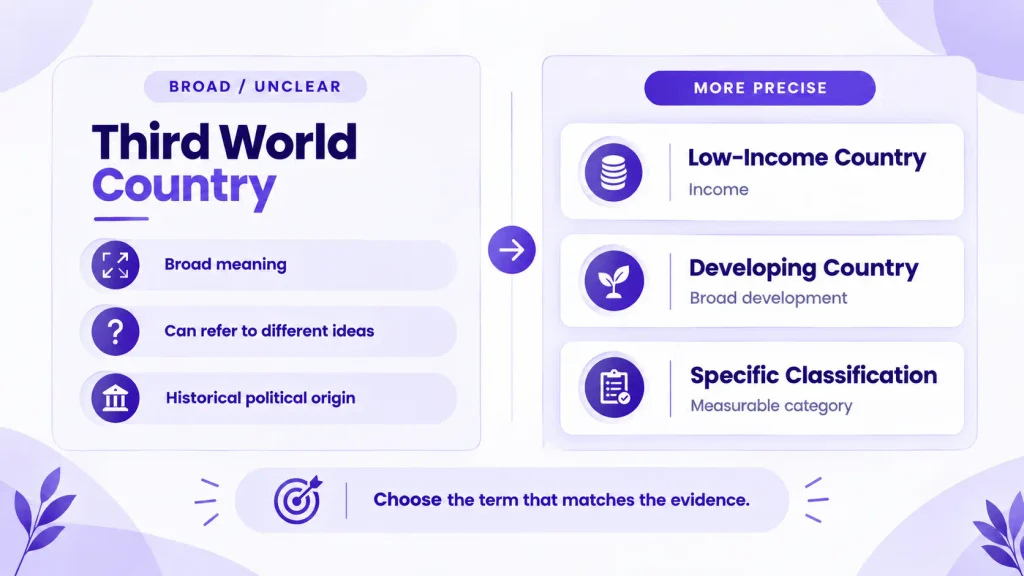
The biggest difference is specificity.
“Third World country” can leave readers wondering what characteristic is actually being discussed. Does the writer mean low income? Poverty? Infrastructure? Economic development? Political alignment? Access to healthcare?
Modern classifications can answer that question more directly.
For example:
Less precise: The program operates in Third World countries.
More specific: The program operates in low-income countries.
Or:
Less precise: The company is expanding into Third World markets.
More specific: The company is expanding into emerging markets.
The second version in each example gives readers more information about what the writer means.
Is “Developing Country” Better Than “Third World Country”?
“Developing country” is generally more current in everyday usage, but it is still a broad term.
The World Bank has noted that broad labels such as “developing world” can group together countries with very different economic circumstances. Its data systems instead use more specific income categories, including low, lower-middle, upper-middle, and high income.
So, if you are writing casually, “developing country” may be understandable. If you are writing a report or academic article, a more specific description may communicate your meaning better.
Common Mistakes to Avoid
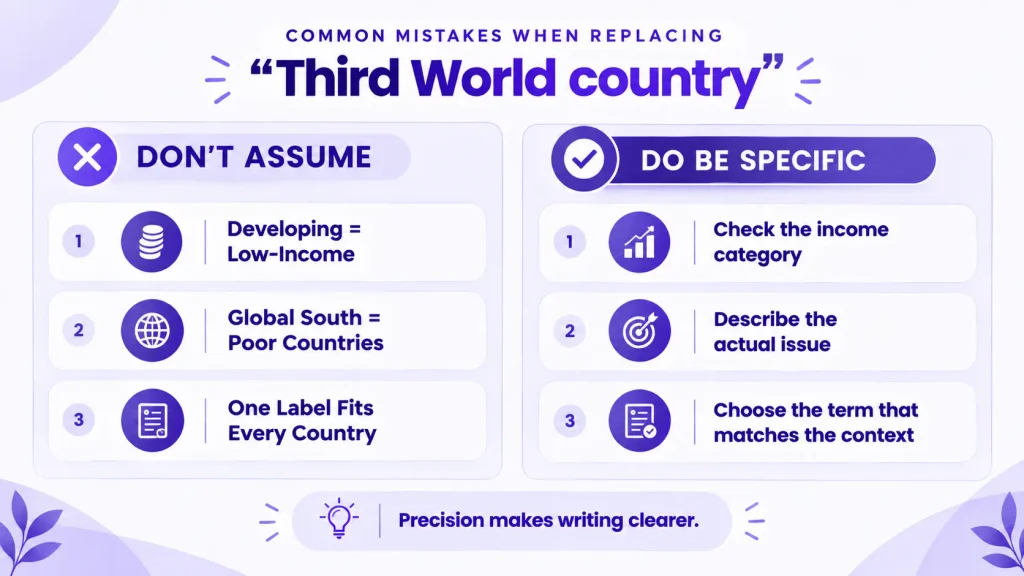
1. Treating “Third World” as a precise economic category
It is not a current standardized income classification. The original term had a Cold War political meaning, while its later popular usage often became economic.
2. Using “poor country” as an automatic replacement
“Poor country” can be too broad and can reduce a complex economy to one characteristic.
If income is what you mean, use a specific income classification when reliable data is available.
3. Assuming “Global South” means “low-income”
These terms are not interchangeable. Global South is a broader geopolitical and historical concept.
4. Calling every developing country “low-income”
Countries classified as developing can fall across several income groups. The World Bank currently distinguishes low, lower-middle, upper-middle, and high-income economies.
5. Using labels instead of describing the actual issue
If your point is about roads, healthcare, education, poverty, or internet access, say that directly.
For example:
The region has limited access to reliable electricity.
is more informative than:
The region is Third World.
The first sentence tells the reader what the actual problem is.
How to Choose the Right Phrase
A simple rule can make your writing more precise:
If you mean income: use an appropriate income classification.
If you mean economic growth: consider “emerging economy” when it accurately describes the situation.
If you mean broad development: “developing country” may fit, but recognize that it is a general term.
If you mean global political or historical relationships: “Global South” may be appropriate.
If you mean a specific problem: describe that problem directly instead of applying a broad label.
This approach avoids treating very different countries as though they all have the same circumstances.
Frequently Asked Questions
What is a polite way to say “Third World country”?
There is no single replacement that fits every situation. “Developing country,” “low-income country,” or “low- and middle-income country” may work depending on the intended meaning. For the most neutral wording, describe the specific economic or social condition you are discussing.
Is “Third World” still an appropriate term?
It can appear in historical discussions or when quoting older language, but it is generally not a precise modern classification. Its original meaning was related to Cold War political alignment, while its later usage often referred broadly to economic development.
What is the professional term for a Third World country?
The professional term depends on the subject. In economic writing, terms such as “low-income country,” “lower-middle-income country,” or “upper-middle-income country” can be more precise. In broader development writing, “developing country” may be used.
Is “developing country” politically correct?
“Developing country” is widely understood, but it is also a broad category. The World Bank has discussed the limitations of grouping diverse countries under a single “developing world” label. More specific terminology can be preferable when accuracy matters.
What is the difference between “Global South” and “Third World”?
“Third World” originated as a Cold War political term associated with countries outside the main Western and Soviet blocs. “Global South” is a broader modern term used in discussions of global economic, political, and historical relationships. They should not automatically be treated as exact synonyms.
What should I use instead of “Third World” in an academic essay?
Choose a term that matches the evidence. “Low-income country,” “lower-middle-income country,” “low- and middle-income countries,” or another specific classification can be appropriate when supported by the subject and data. If the discussion is historical, “Third World” may still be appropriate when explaining its original context.
What is the best alternative to “Third World country”?
The best alternative depends on the intended meaning. For economic classification, a specific income group is usually more informative. For broad development discussions, “developing country” may fit. For global geopolitical discussions, “Global South” may be more appropriate.
Final Thoughts
“Third World country” is a familiar phrase, but it does not communicate one clear idea in modern English. Its original Cold War meaning was political, while its later popular meaning became associated with economic development.
For clearer writing, identify the characteristic you actually mean. If the subject is income, use an income classification. If it is economic growth, “emerging economy” may fit. If it is a particular development issue, describe that issue directly.
More precise language gives readers better information and avoids treating countries with very different circumstances as one group.

Role: Editorial Contributor
Graham Ellis contributes practical English and communication guides to RepublicsPress. His content focuses on vocabulary, writing techniques, word usage, and clear communication, with an emphasis on straightforward explanations and real-world examples.