Another Way to Say “In Conclusion” in a College Essay
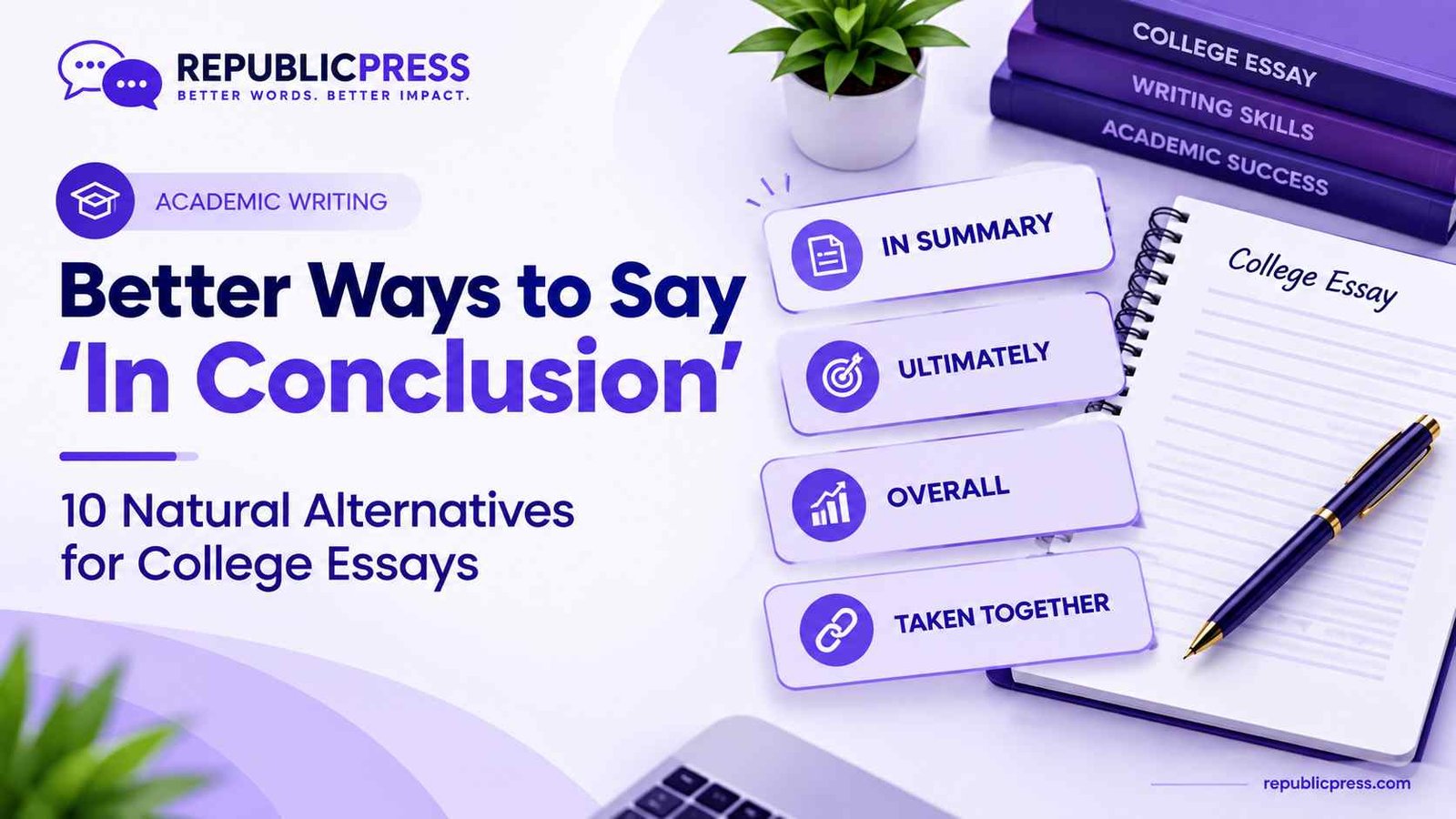
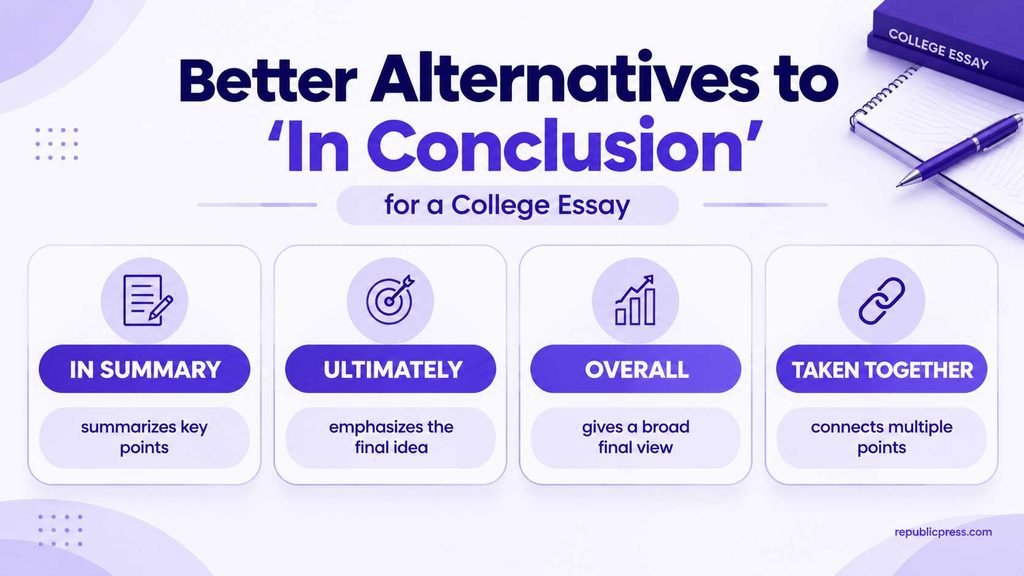
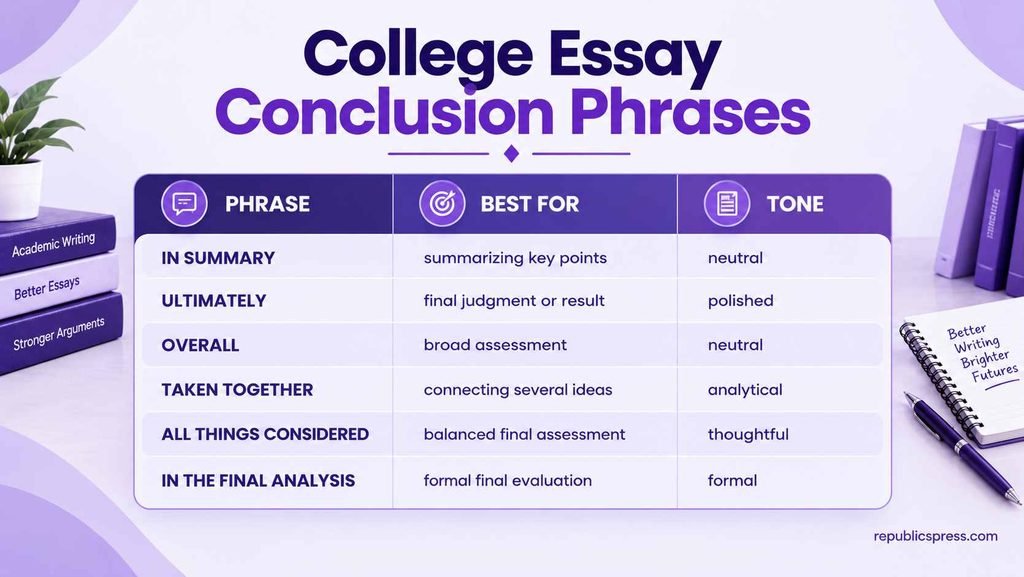
If you want another way to say “in conclusion” in a college essay, natural options include “in summary,” “ultimately,” “overall,” “taken together,” “all things considered,” and “in the final analysis.” The best choice depends on what your conclusion is doing. In many college essays, you can also skip a transition and move directly into your final insight.
Key Takeaways
- “In summary” is a clear choice when you are reviewing your main points.
- “Ultimately” works well for a final judgment, result, or insight.
- “Taken together” is useful when connecting several pieces of evidence.
- “Overall” works for a broad assessment of the topic.
- “All things considered” fits conclusions that weigh several factors.
- You do not always need a transition phrase at the beginning of your conclusion.
What Does “In Conclusion” Mean in a College Essay?
“In conclusion” is a transition phrase that signals that the writer is moving toward the final part of an essay, argument, or discussion. It often introduces a summary of the main points, a final judgment, or the central takeaway.
For example:
In conclusion, social media has changed how college students communicate, study, and build relationships.
The phrase is grammatically correct and acceptable in academic writing. However, college students sometimes use it automatically, even when another phrase—or no transition at all—would create a stronger ending.
The most effective alternative depends on the purpose of your final paragraph. A conclusion that summarizes evidence may need different wording from one that presents a personal insight or final judgment.
Best Alternatives to “In Conclusion” for a College Essay
1. In Summary
“In summary” is one of the closest alternatives to “in conclusion.” It works when the final paragraph briefly brings together the main ideas discussed throughout the essay.
Example:
In summary, access to affordable education can benefit students, families, and communities.
Best for:
- Summarizing an argument
- Reviewing major points
- General academic essays
This is one of the safest alternatives if your main goal is to tell the reader that you are summarizing the discussion.
2. To Sum Up
“To sum up” clearly signals that you are condensing the main ideas of the essay. It is natural and easy to understand, although it can sound slightly less formal than “in summary.”
Example:
To sum up, the evidence shows that early intervention can improve students’ academic outcomes.
Best for:
- Straightforward college writing
- Short summaries
- Essays with a clear argument
It is grammatically correct, but if your professor expects a highly formal academic style, “in summary” may be a better choice.
3. Ultimately
“Ultimately” is useful when your conclusion presents a final judgment, result, or deeper insight. It does not simply mean that the essay is ending; it emphasizes the final point.
Example:
Ultimately, the experience taught me that leadership depends as much on listening as it does on making decisions.
Best for:
- Reflective essays
- Personal essays
- Argumentative essays
- College admissions essays
“Ultimately” can be particularly effective when the final sentence explains what the discussion means rather than simply repeating earlier points.
4. Overall
“Overall” introduces a broad assessment of the topic. It is simple, natural, and flexible.
Example:
Overall, the research suggests that flexible learning can provide important benefits when students receive adequate support.
Best for:
- Analytical essays
- Research assignments
- General academic writing
Because “overall” is relatively simple, it usually sounds more natural than an unnecessarily complicated transition.
5. Taken Together
“Taken together” is a strong academic alternative when your essay discusses multiple examples, arguments, studies, or pieces of evidence.
Example:
Taken together, these findings suggest that community programs can play an important role in improving access to education.
Best for:
- Research papers
- Evidence-based essays
- Analytical writing
This phrase is especially useful because it tells the reader that several individual points should now be considered as one larger argument.
6. All Things Considered
“All things considered” introduces a final judgment after considering several factors or perspectives.
Example:
All things considered, the benefits of expanding public transportation outweigh the potential costs.
Best for:
- Balanced arguments
- Compare-and-contrast essays
- Discussions involving advantages and disadvantages
The phrase can sound slightly more conversational than some academic transitions, so consider the overall tone of your essay before using it.
7. In the Final Analysis
“In the final analysis” is a formal expression used to introduce a final assessment after considering the available arguments or evidence.
Example:
In the final analysis, economic growth alone cannot guarantee a higher quality of life.
Best for:
- Formal academic writing
- Argumentative essays
- Analytical essays
It is a legitimate expression, but it may sound more formal than necessary in a personal college essay.
8. In Essence
“In essence” means that you are reducing a complex discussion to its most important or basic idea.
Example:
In essence, the debate is not simply about technology but about how society chooses to use it.
Best for:
- Explanatory essays
- Analytical writing
- Essays discussing complex ideas
This phrase is not an exact replacement for “in conclusion.” Use it when your final point focuses on the core meaning of the discussion.
9. On the Whole
“On the whole” means that you are considering the subject as a complete picture rather than focusing on individual details.
Example:
On the whole, the evidence supports the argument that community involvement strengthens educational outcomes.
Best for:
- Broad evaluations
- Analytical essays
- Balanced discussions
It works best when your conclusion gives an overall assessment rather than introducing a completely new point.
10. Considering the Evidence
“Considering the evidence” is a useful alternative when your conclusion is directly based on information or arguments presented earlier in the essay.
Example:
Considering the evidence, schools should provide students with greater access to academic support.
Best for:
- Research papers
- Argumentative essays
- Evidence-based writing
Unlike “in conclusion,” this phrase tells the reader why the final statement follows: it is based on the evidence discussed in the essay.
Comparison of Alternatives to “In Conclusion”
| Alternative | Main Purpose | Tone | Best Context |
| In summary | Reviews the main points | Formal/neutral | Academic essays |
| To sum up | Condenses the argument | Neutral | General college writing |
| Ultimately | Gives a final judgment or insight | Polished | Reflective and argumentative essays |
| Overall | Gives a broad assessment | Neutral | Analytical essays |
| Taken together | Connects multiple pieces of evidence | Academic | Research-based essays |
| All things considered | Weighs several factors | Neutral/formal | Balanced arguments |
| In the final analysis | Gives a final assessment | Formal | Analytical writing |
| In essence | States the central idea | Formal/neutral | Explanatory essays |
| On the whole | Evaluates the topic broadly | Formal/neutral | Academic discussions |
| Considering the evidence | Draws a conclusion from evidence | Academic | Research and argumentative essays |
Which Alternative Should You Use?
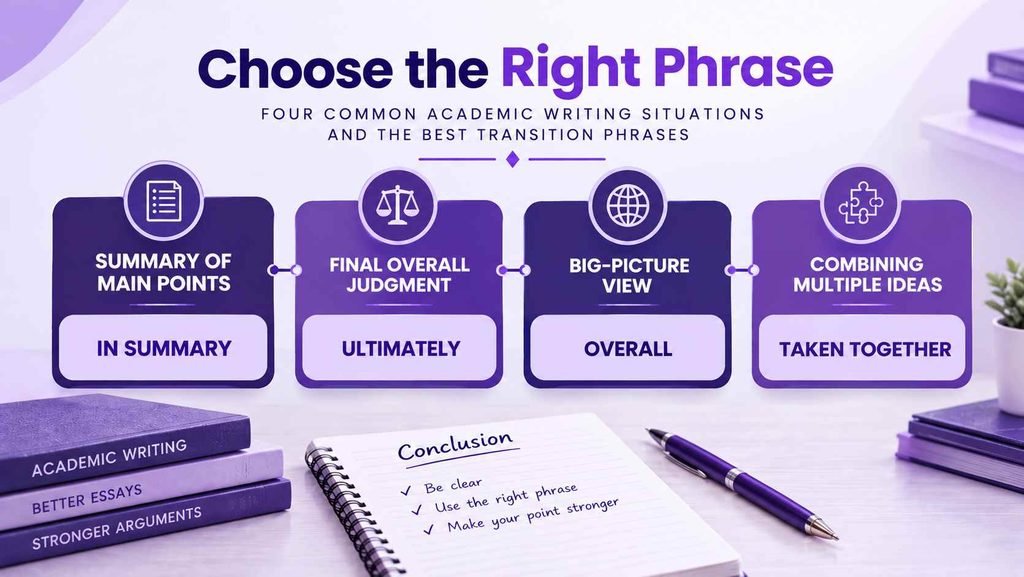
There is no single replacement that is best for every college essay. The right phrase depends on what you want the conclusion to accomplish.
If You Are Summarizing Your Main Points
Choose:
- In summary
- To sum up
- Overall
- On the whole
Example:
Overall, the three examples demonstrate how education can influence both individual opportunity and community development.
These expressions work when the conclusion brings together information that has already been discussed.
If You Are Giving a Final Judgment
Choose:
- Ultimately
- All things considered
- In the final analysis
Example:
Ultimately, the policy’s benefits outweigh its disadvantages because it provides greater access to essential services.
These options are useful when your conclusion goes beyond summary and makes a clear judgment.
If You Are Connecting Evidence
Choose:
- Taken together
- Considering the evidence
Example:
Taken together, these examples demonstrate that access to education is influenced by more than financial resources alone.
These phrases work particularly well in essays where the argument depends on several facts, examples, or research findings.
If You Are Stating the Core Idea
Choose:
- In essence
- On the whole
- Or no transition at all
Example:
At its core, the issue is about giving students an equal opportunity to succeed.
Sometimes stating the central idea directly is more effective than adding a formal transition.
Do You Have to Say “In Conclusion” in a College Essay?
No. A college essay does not have to begin its final paragraph with “in conclusion.”
The phrase is acceptable, but it is not required. In many cases, a conclusion can sound stronger when the writer moves directly into the final insight.
For example:
In conclusion, volunteering taught me the importance of helping others.
A more natural version might be:
Volunteering taught me that meaningful change often begins with small acts of service.
The second version does not announce that the essay is ending. Instead, it gives the reader a specific final thought.
This approach can work especially well in personal essays and college admissions essays, where the ending should feel connected to the writer’s experience.
How to End a College Essay Without Saying “In Conclusion”
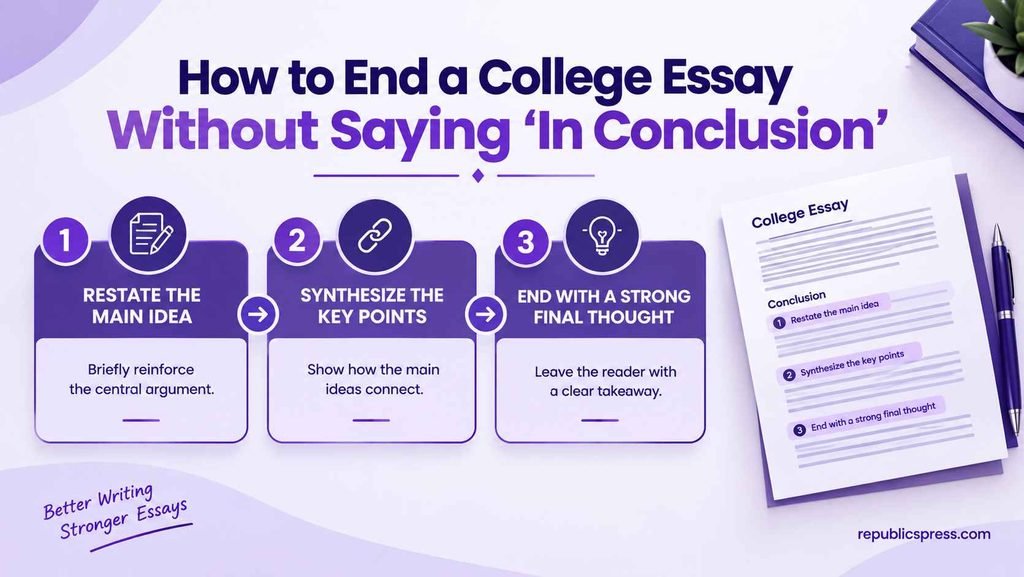
You can create a strong conclusion without using a traditional transition phrase.
One approach is to state the final lesson:
The experience changed my understanding of leadership. I no longer see leadership as simply telling people what to do; I see it as listening, adapting, and helping others move forward.
Another approach is to highlight the main implication of your argument:
The evidence points to a simple lesson: meaningful educational change requires both opportunity and support.
You can also connect the conclusion to a personal experience:
What began as a challenge ultimately changed the way I approach unfamiliar situations.
These endings work because they provide a meaningful final thought instead of simply telling the reader that the essay has ended.
“Ultimately” vs. “In Conclusion”
“Ultimately” and “in conclusion” can sometimes appear in similar positions, but they have different functions.
“In conclusion” primarily signals that the discussion is ending.
“Ultimately” usually introduces a final result, judgment, or important insight.
Compare these examples:
In conclusion, the policy has several advantages and disadvantages.
Ultimately, the policy’s benefits outweigh its disadvantages because it provides greater access to essential services.
The second sentence makes a clearer argument. Instead of merely announcing the conclusion, it presents the writer’s final position.
Is “Finally” the Same as “In Conclusion”?
Not always.
“Finally” usually introduces the last item in a sequence.
For example:
First, the study examined cost. Next, it considered accessibility. Finally, it evaluated long-term effects.
Here, “finally” means that the writer is discussing the last item in a series.
If you want to summarize the entire essay, “in summary,” “overall,” or “ultimately” may be more appropriate.
You can use “finally” in a conclusion when it genuinely introduces the final point, but it should not be treated as an exact synonym for “in conclusion.”
Is “Therefore” a Replacement for “In Conclusion”?
“Therefore” is also different.
“Therefore” expresses a logical result or consequence.
Example:
The program reduced transportation costs for students. Therefore, more students were able to attend evening classes.
The word connects the first statement to the result that follows.
You can use “therefore” in a conclusion when your final point logically follows from the preceding argument, but it does not simply mean “the essay is ending.”
Common Mistakes When Replacing “In Conclusion”
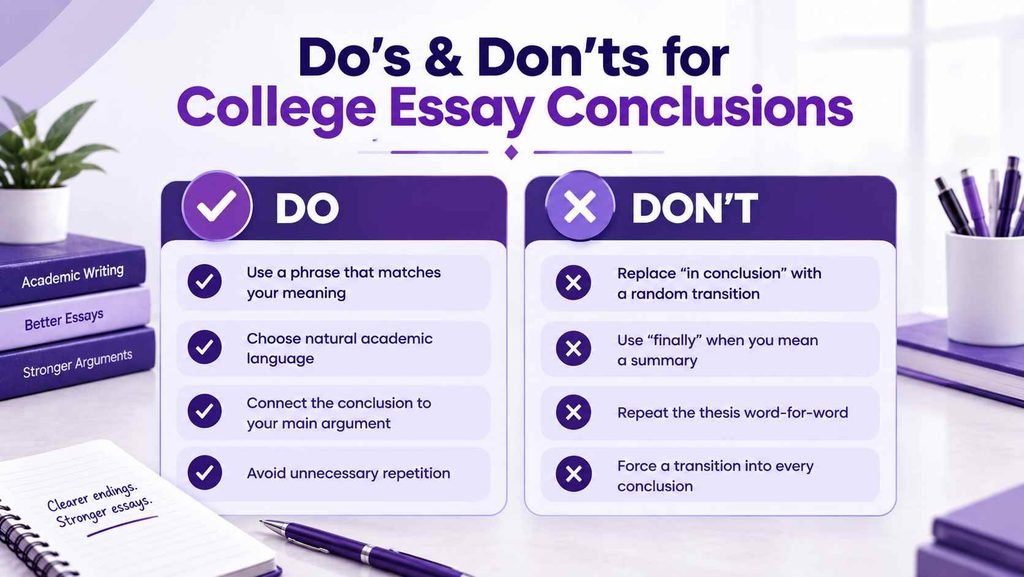
Using a Transition Automatically
There is nothing wrong with “in conclusion,” but using it simply because you think every essay requires it can make your writing sound formulaic.
Choose a transition based on what your final paragraph actually does.
Treating Every Alternative as an Exact Synonym
“Ultimately,” “therefore,” “finally,” and “in essence” do not have exactly the same meaning as “in conclusion.”
For example, “therefore” emphasizes a result, while “ultimately” emphasizes a final judgment or outcome.
Repeating the Introduction
A conclusion should reinforce your main argument without copying the introduction word for word.
Instead of repeating your thesis exactly, explain what the discussion demonstrates or why the argument matters.
Introducing a Completely New Argument
Your conclusion should generally bring your existing discussion together. Introducing a major new argument at the very end can make the essay feel unfinished.
A brief implication or final thought can be appropriate, but it should connect naturally to the argument you have already developed.
Using an Overly Formal Phrase
College writing does not have to sound complicated.
For example:
Overall, the experience changed how I understand leadership.
This can be more effective than using an unnecessarily elaborate phrase simply to sound academic.
Alternatives for Different Types of College Essays
The best choice can also depend on the type of essay you are writing.
Argumentative Essay
For an argumentative essay, useful choices include:
- Ultimately
- Considering the evidence
- Taken together
- In the final analysis
- Overall
Example:
Considering the evidence, colleges should expand access to affordable mental health resources.
Research Essay
For a research-based essay, consider:
- Taken together
- In summary
- Overall
- Considering the evidence
Example:
Taken together, the findings suggest that early academic support can improve long-term student outcomes.
Personal Essay
For a personal essay, consider:
- Ultimately
- Overall
- In the end
- Or no transition at all
Example:
Ultimately, the experience taught me that asking for help is not a sign of weakness but a step toward growth.
Compare-and-Contrast Essay
For an essay that weighs two or more perspectives, consider:
- All things considered
- Overall
- On the whole
- Ultimately
Example:
All things considered, both approaches have advantages, but the second method offers greater flexibility for students.
FAQs
What is another way to say “in conclusion” in a college essay?
Natural alternatives include “in summary,” “ultimately,” “overall,” “taken together,” “all things considered,” and “in the final analysis.” The best choice depends on whether you are summarizing, evaluating, or presenting a final judgment.
What is the best alternative to “in conclusion” for an academic essay?
“In summary” is one of the safest choices when you want to review the main points of an essay. “Taken together” is especially useful when your conclusion combines several pieces of evidence.
Can I use “ultimately” instead of “in conclusion”?
Yes, when you are making a final judgment, identifying an outcome, or expressing the most important point. However, “ultimately” is not an exact synonym because it adds the idea of a final result or judgment.
Is “in conclusion” bad in a college essay?
No. “In conclusion” is grammatically correct and acceptable in academic writing. You may choose another transition to avoid repetition or to make your conclusion more precise, but there is no general rule that makes the phrase incorrect.
Should I use “finally” in my conclusion?
You can use “finally” when you are introducing the last point in a sequence. However, it does not always mean that you are summarizing the entire essay. For an overall conclusion, “in summary,” “overall,” or “ultimately” may be clearer.
Can I start a college essay conclusion without a transition?
Yes. You can begin with your final interpretation, insight, implication, or takeaway. This can create a more natural ending, especially in personal and reflective essays.
What is a more sophisticated way to say “in conclusion”?
There is no single phrase that is automatically more sophisticated. “Taken together,” “ultimately,” “considering the evidence,” and “in the final analysis” can sound more precise when they match the purpose of the conclusion. Clear and accurate wording is more important than using complicated language.
What should I use instead of “in conclusion” in a college admissions essay?
For a personal college admissions essay, “ultimately,” “overall,” or no transition at all can work well. A specific final insight connected to your experience often creates a stronger ending than a formulaic phrase.
Conclusion
There is no single replacement for “in conclusion” that works for every college essay. Use “in summary” when you are reviewing your main points, “ultimately” when making a final judgment, “taken together” when connecting evidence, and “overall” when giving a broad assessment. In a personal or college admissions essay, you may not need a transition at all. A thoughtful final insight can make the ending feel more natural and memorable.

Role: Language & Content Specialist
Tessa Holloway creates language-focused content covering phrases, idioms, expressions, vocabulary, and natural American English. Her work helps readers choose words and expressions that fit different everyday, academic, and professional situations.