What Is Another Way to Say Chronological Order?
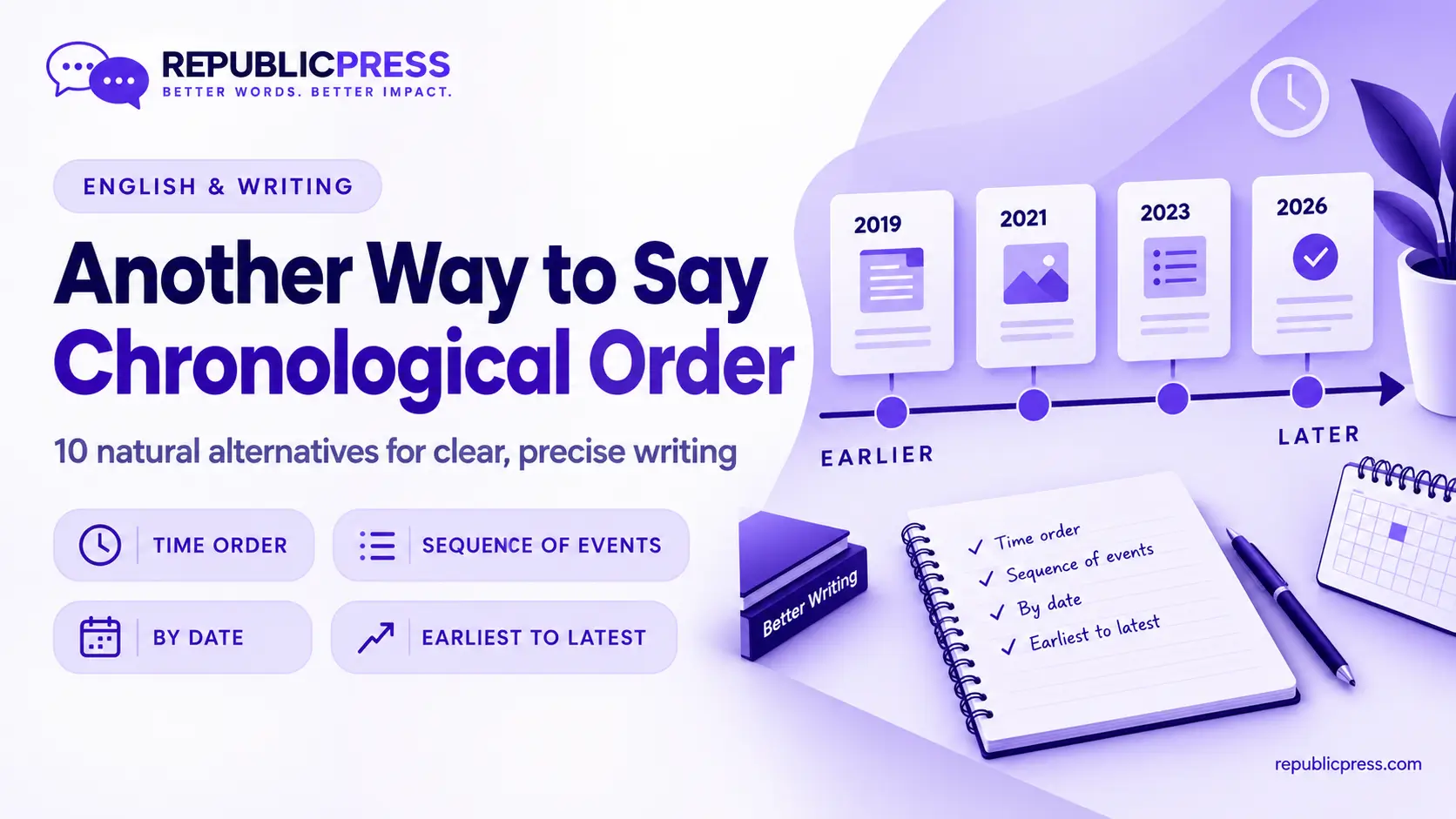
Another way to say “chronological order” is “time order.” Other useful alternatives include temporal order, in order of occurrence, sequence of events, in time order, and by date, depending on the context. Some related phrases, such as from earliest to latest and according to when they happened, describe chronological organization without being exact synonyms.
Key Takeaways
- Chronological order organizes events according to when they happened.
- Time order is a simple, clear alternative for general writing.
- In order of occurrence works well when describing events or incidents.
- By date is useful when dates are the main organizing factor.
- Sequence of events emphasizes how events happened one after another.
- Some alternatives are context-specific rather than exact synonyms.
What Does “Chronological Order” Mean?
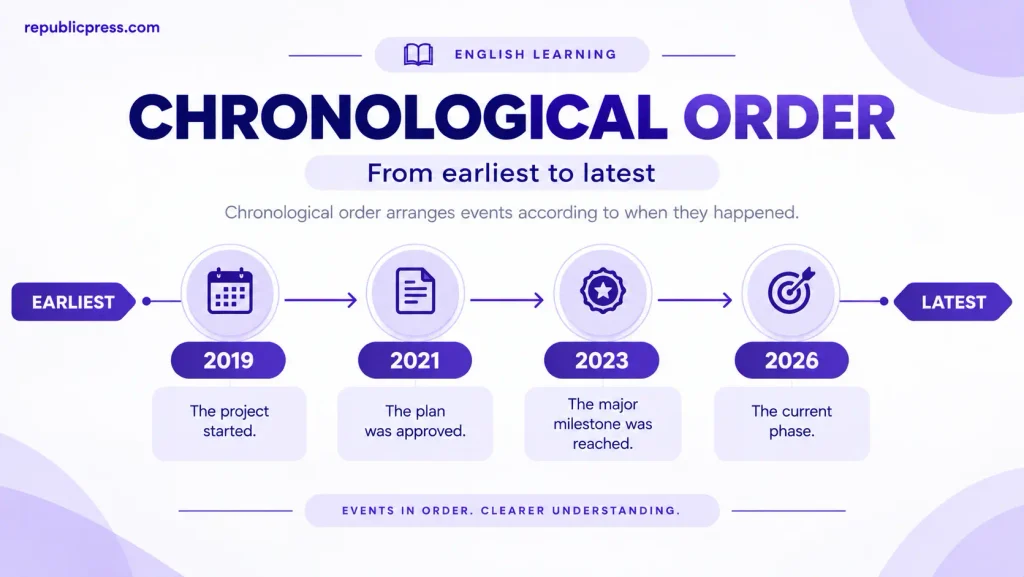
When something is presented in chronological order, the information follows a timeline. The earliest event comes first, followed by later events.
For example:
2019 → 2021 → 2023 → 2026
You might use chronological order when describing a person’s career, explaining historical events, writing a biography, or listing the steps in a process.
Chronological order usually moves from past to present, although a writer can also present information in reverse chronological order, starting with the most recent event.
6 Other Ways to Say “Chronological Order”
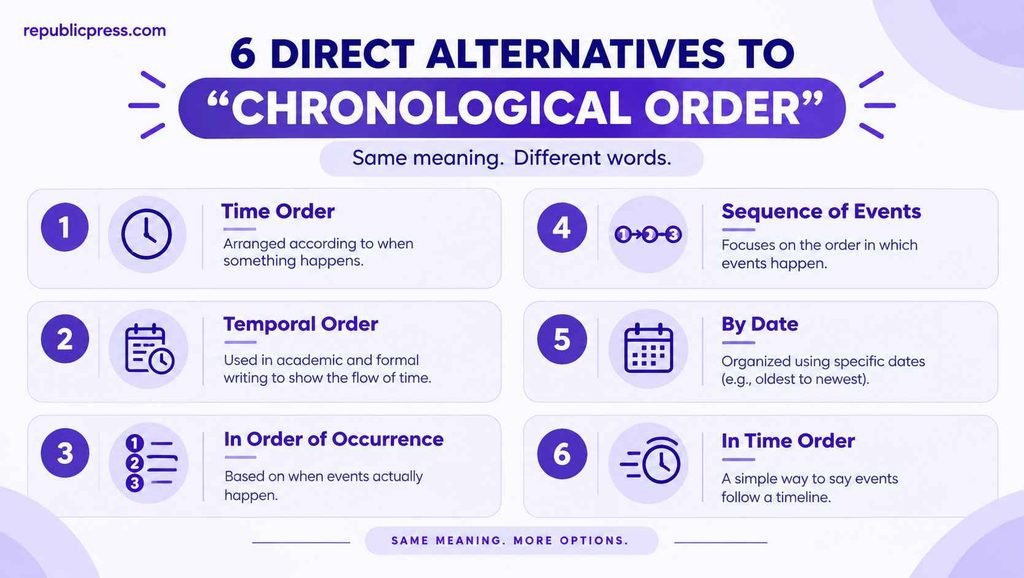
1. Time Order
Time order is one of the simplest alternatives to chronological order. It means arranging information according to when it happened.
Best for: General, educational, and everyday writing.
Example:
The teacher asked students to put the events in time order.
This phrase is especially useful when you want your writing to be easy for a broad audience to understand.
2. Temporal Order
Ye article mein zaroor hona chahiye.
Temporal order chronological order ka formal/academic alternative hai.
Example:
The events are presented in temporal order.
Best for: academic writing, research, history, formal analysis.
3. Sequence of Events
Sequence of events focuses on the order in which events occurred.
Best for: Stories, essays, reports, and explanations.
Example:
The report describes the sequence of events leading up to the accident.
Unlike “chronological order,” this phrase can emphasize the relationship between one event and the next.
4. In Order of Occurrence
In order of occurrence means arranging things according to when they actually happened.
Best for: Formal, academic, legal, and professional writing.
Example:
The witness described the incidents in order of occurrence.
This is a good choice when accuracy about the timing of events matters.
5. By Date
By date is a concise way to describe information arranged according to specific dates.
Best for: Records, schedules, documents, timelines, and lists.
Example:
The files are organized by date, starting with the oldest documents.
“By date” is not always a perfect replacement for “chronological order,” but it works when dates are the primary basis for organization.
6. In Time Order
In time order has essentially the same basic meaning as chronological order. It tells the reader that information follows the timeline of events.
Best for: Simple explanations and instructional writing.
Example:
Read the paragraphs and arrange them in time order.
It sounds natural when explaining a task to students or general readers.
Related Phrases
In Historical Order
In historical order refers to arranging events according to when they occurred in history.
Best for: History, biographies, historical essays, and educational content.
Example:
The museum displays the artifacts in historical order.
This phrase is more specific than “chronological order” because it usually relates to historical events or periods.
According to When They Happened
This is a plain-English way to explain chronological order without using a technical term.
Best for: Conversational, instructional, and beginner-friendly writing.
Example:
The events are listed according to when they happened.
It is longer than “chronological order,” but it can be clearer for readers who may not know the original phrase.
From Earliest to Latest
From earliest to latest directly describes the direction of a chronological list.
Best for: Dates, records, timelines, and instructions.
Example:
Sort the appointments from earliest to latest.
This expression is particularly useful when you need to make the ordering direction completely clear.
In Sequence
In sequence means arranged in a particular order, often following the order in which things happen.
Best for: Processes, instructions, events, and procedures.
Example:
The steps should be completed in sequence.
Keep in mind that “sequence” does not always mean chronological order. A sequence can follow a logical or procedural order rather than a time-based one.
Which Alternative Should You Use?
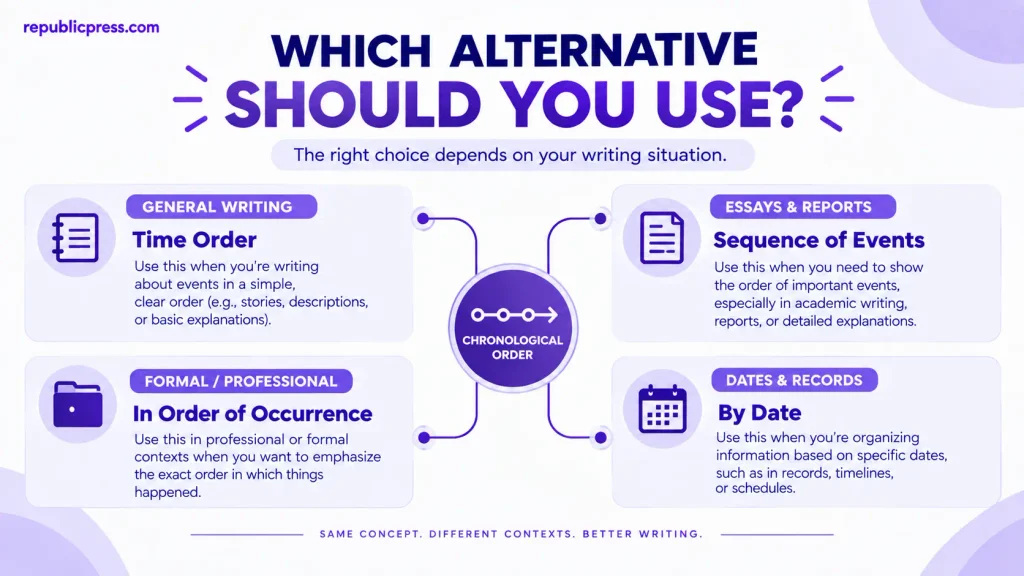
The best replacement depends on what you’re writing.
| Alternative | Tone | Best Context |
| Time order | Simple | General and educational writing |
| Sequence of events | Neutral | Reports, stories, and essays |
| In order of occurrence | Formal | Legal, academic, and professional writing |
| By date | Concise | Records, files, and lists |
| In time order | Simple | Instructions and general writing |
| In historical order | Formal | History and biographies |
| According to when they happened | Conversational | Plain-English explanations |
| From earliest to latest | Clear | Dates and timelines |
| In sequence | Neutral | Processes and procedures |
| Along a timeline | Descriptive | Presentations and historical content |
Chronological Order vs. Reverse Chronological Order
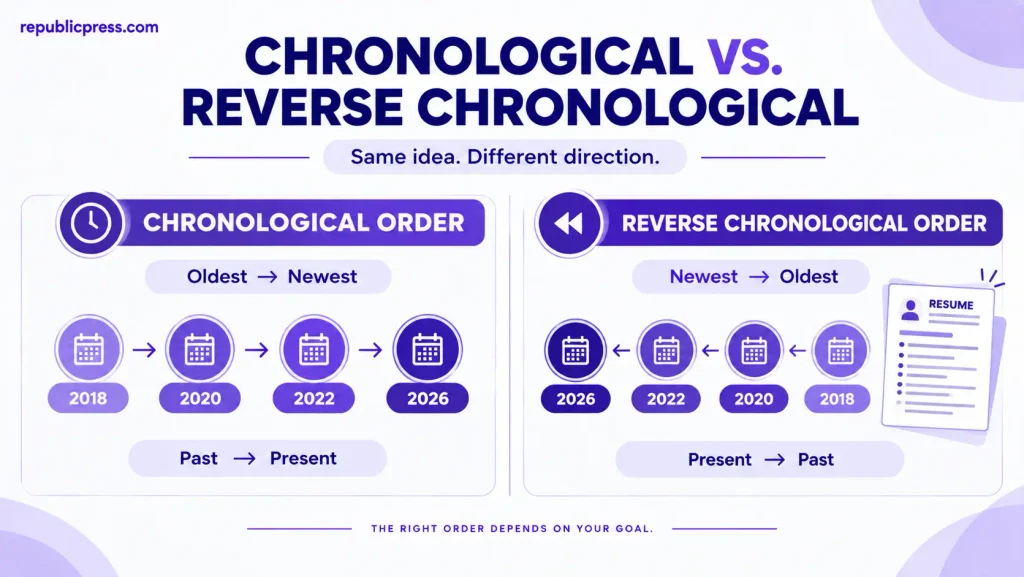
Chronological order and reverse chronological order organize information in opposite directions.
Chronological order generally starts with the oldest event and moves toward the newest:
2018 → 2020 → 2022 → 2026
Reverse chronological order starts with the most recent event and moves backward:
2026 → 2022 → 2020 → 2018
Reverse chronological order is common in resumes because the most recent job or educational experience is usually the most relevant to an employer.
When Should You Use “Chronological Order”?
“Chronological order” is a strong choice when you want to be precise and the reader is comfortable with standard academic or professional vocabulary.
For example:
The essay presents the major events in chronological order.
It works especially well for:
- Historical essays
- Biographies
- Research papers
- Project timelines
- Incident reports
- Career histories
- Event summaries
- Personal narratives
If your audience prefers simpler language, time order or from earliest to latest may be easier to understand.
Common Mistakes to Avoid
Treating Every Alternative as an Exact Synonym
Not every phrase above has exactly the same meaning.
For example, in sequence can describe a logical or procedural sequence, while chronological order specifically refers to time.
Confusing Chronological and Reverse Chronological Order
Make sure you know which direction your information should follow. If the newest event comes first, you’re using reverse chronological order.
Using “By Date” When No Dates Are Available
“By date” works best when the information has specific dates. If you’re describing events without exact dates, sequence of events or in order of occurrence may be more natural.
Choosing a Formal Phrase for Casual Writing
A phrase such as in order of occurrence may sound unnecessarily formal in everyday conversation. In a casual context, time order or when they happened is often clearer.
Frequently Asked Questions
What is the simplest way to say chronological order?
Time order is one of the simplest alternatives. You can also say from earliest to latest when you want to make the direction clear.
Is “sequence of events” the same as chronological order?
They can mean the same thing when the sequence follows time, but they aren’t always identical. A sequence can sometimes follow a logical or procedural order rather than a timeline.
What is another formal way to say chronological order?
In order of occurrence is a useful formal alternative, especially for reports, academic writing, and descriptions of incidents.
What is the opposite of chronological order?
If you mean starting with the most recent event and moving backward, the term is reverse chronological order.
Can I say “by date” instead of chronological order?
Yes, when information is organized according to specific dates. However, “by date” is more specific and does not always cover situations where events are ordered by time without exact dates.
Is “time order” grammatically correct?
Yes. Time order is a natural phrase and is commonly used when explaining that events or information are arranged according to when they happened.
What is another way to say chronological order in an essay?
Depending on the sentence, you could use sequence of events, in order of occurrence, in time order, or from earliest to latest.
Final Choice
If you need a direct replacement for chronological order, time order is probably the easiest general option. For a formal report, in order of occurrence can work well. For dates and records, by date is concise, while sequence of events is useful when explaining how events unfolded.

Role: Editorial Contributor
Graham Ellis contributes practical English and communication guides to RepublicsPress. His content focuses on vocabulary, writing techniques, word usage, and clear communication, with an emphasis on straightforward explanations and real-world examples.