Another Way to Say Has Been: 10 Natural Alternatives
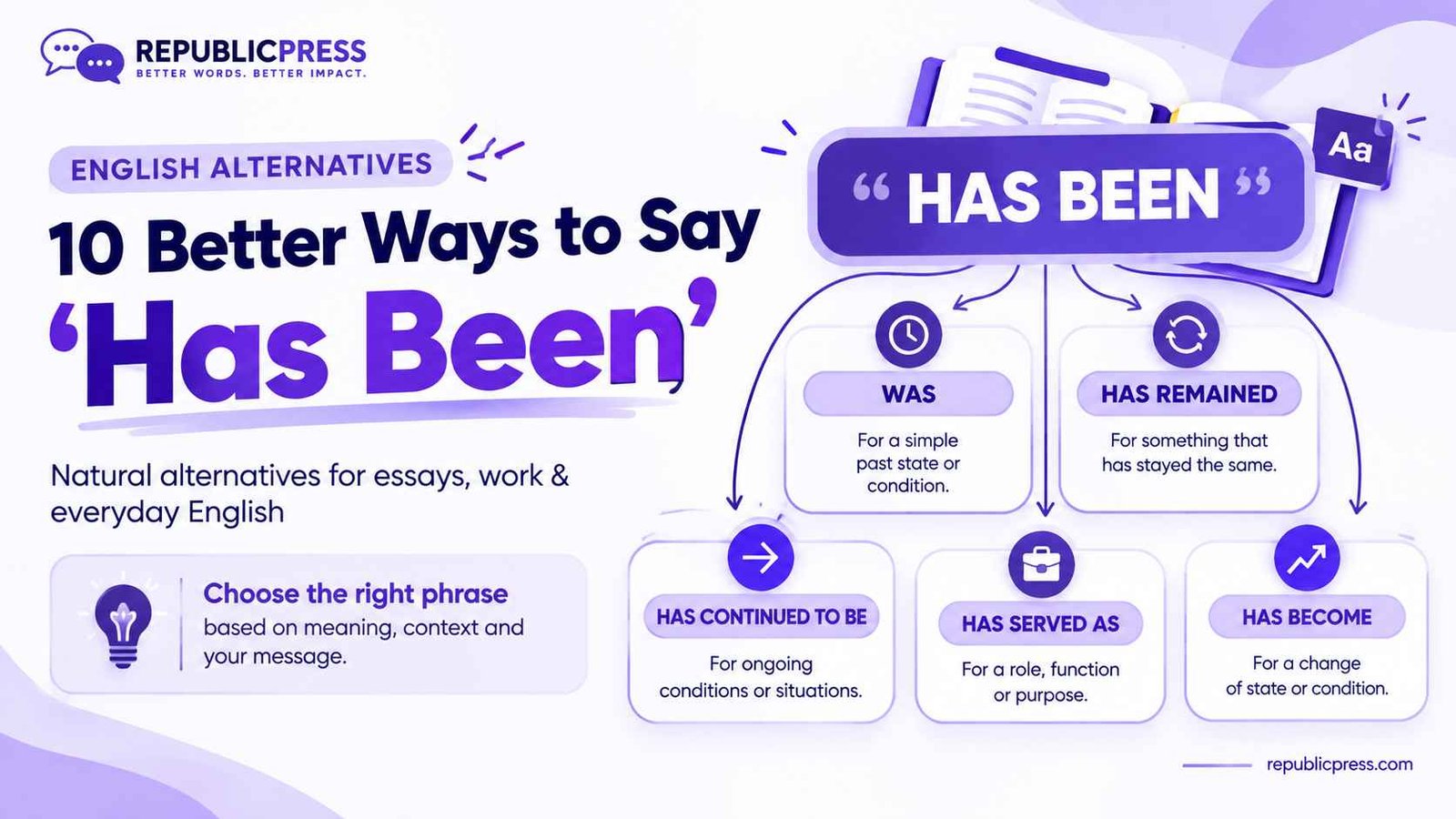
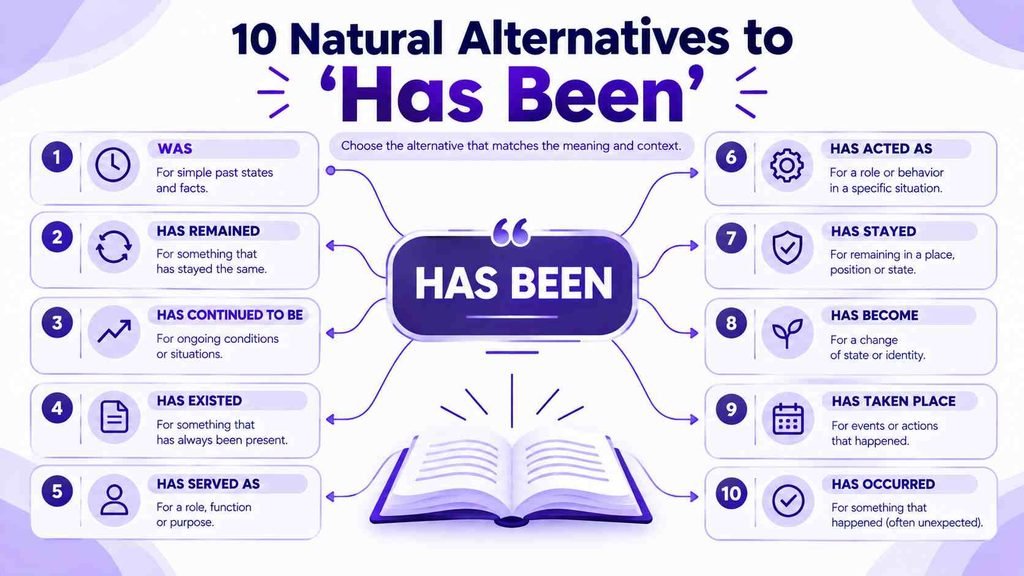
Another way to say “has been” depends on the sentence and what you mean. Natural alternatives include was, has remained, has continued to be, has existed, has served as, has acted as, has stayed, has occurred, has become, and has taken place. Some are direct replacements, while others work only in specific contexts.
Key Takeaways
- “Has been” is not a single synonym with one universal replacement.
- The best alternative depends on the verb, tense, and meaning of the sentence.
- “Was” is often the simplest replacement when past time is clear.
- “Has remained” works well when something continues in the same state.
- “Has continued to be” emphasizes that a condition is still true.
- In formal or professional writing, a more specific verb is often better than simply replacing “has been.”
What Does “Has Been” Mean?
“Has been” is usually part of the present perfect or present perfect progressive construction.
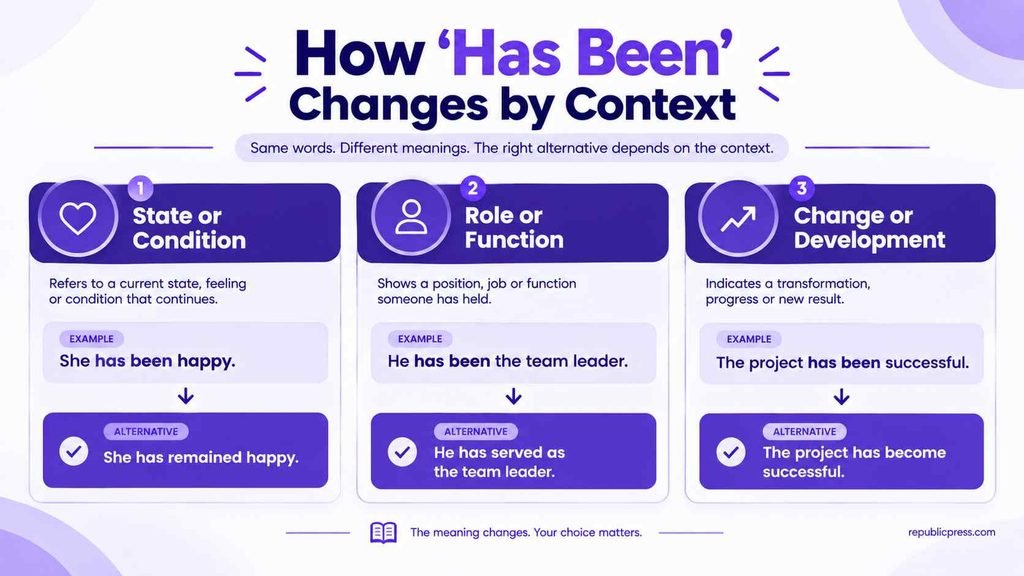
It can describe a state that started in the past and continues into the present:
The company has been successful for several years.
It can also describe something that happened or existed at an unspecified time before now:
She has been a teacher since 2018.
The phrase can also appear in the passive voice:
The report has been completed.
Because “has been” can serve different grammatical purposes, replacing it requires attention to the rest of the sentence.
For example, “has remained” can replace “has been” in some sentences, but not all:
The policy has been effective.
The policy has remained effective.
The second version emphasizes that the policy continues to be effective.
10 Natural Ways to Say “Has Been”
1. Was
“Was” is often the simplest alternative when you’re talking about a completed past situation.
Example:
The restaurant has been popular for years.
If you’re referring to a specific completed period:
The restaurant was popular in the early 2000s.
Best for: Simple past situations
Important: “Was” does not always preserve the present connection of “has been.” Changing the tense can change the meaning.
2. Has Remained
“Has remained” means that something has continued in the same condition or position.
The neighborhood has been quiet for decades.
The neighborhood has remained quiet for decades.
The second sentence highlights continuity.
Best for: Ongoing conditions, positions, or states
Example:
The museum has remained open despite the renovations.
3. Has Continued to Be
This phrase clearly emphasizes that something started earlier and is still true.
The program has been successful.
The program has continued to be successful.
It is especially useful when you want to stress persistence over time.
Best for: Professional, academic, and formal writing
Example:
The strategy has continued to be effective throughout the year.
4. Has Existed
When “has been” means that something has existed over a period of time, “has existed” can be more precise.
The organization has been around for 50 years.
A more formal version is:
The organization has existed for 50 years.
Best for: Organizations, systems, traditions, institutions, and conditions
Example:
This tradition has existed in the region for generations.
5. Has Served As
When “has been” describes someone’s role or function, “has served as” can be more specific.
Maria has been the team’s director since 2022.
You could write:
Maria has served as the team’s director since 2022.
This emphasizes her role rather than simply stating what she has been.
Best for: Professional and academic writing
Example:
He has served as president of the organization since 2024.
6. Has Acted As
“Has acted as” works when a person, object, or organization has performed a particular role or function.
The building has been a community center.
Depending on the intended meaning:
The building has acted as a community center for local residents.
This emphasizes its function.
Best for: Roles and functions
Example:
The temporary office has acted as a meeting space for the team.
Usage note: “Has acted as” is not a universal replacement for “has been.” Use it when something has actually performed a role or function.
7. Has Stayed
“Has stayed” is a more conversational alternative when the meaning is that something has remained unchanged.
The weather has been warm all week.
In some contexts:
The weather has stayed warm all week.
It sounds natural in everyday conversation but may be less suitable for formal writing.
Best for: Casual and conversational English
Example:
The price has stayed the same since January.
8. Has Become
Sometimes “has been” describes a condition that developed over time. In that situation, “has become” may communicate the change more clearly.
Online learning has been popular.
If the intended meaning is that online learning developed into something popular:
Online learning has become increasingly popular.
Best for: Changes, developments, and transitions
Example:
Remote work has become common in many industries.
Important: “Has become” changes the meaning by emphasizing a transition. It is not a direct synonym for every use of “has been.”
9. Has Taken Place
When “has been” appears in a sentence describing an event, “has taken place” may be a more precise alternative.
Several meetings have been this week.
If the intended meaning is that meetings occurred:
Several meetings have taken place this week.
This works particularly well in formal writing.
Best for: Events, meetings, ceremonies, discussions, and activities
Example:
Several important discussions have taken place since the announcement.
10. Has Occurred
“Has occurred” can replace “has been” when the phrase refers to something that has happened.
A major change has been in the system.
If the intended meaning is that a change happened:
A major change has occurred in the system.
It is more formal and precise than some everyday alternatives.
Best for: Academic, technical, professional, and formal writing
Example:
A significant shift has occurred in consumer behavior.
Quick Comparison
| Alternative | Main Use | Tone | Example |
| Was | Completed past state | Neutral | The store was busy. |
| Has remained | Continued state | Formal/neutral | The store has remained busy. |
| Has continued to be | Ongoing condition | Formal | The method has continued to be effective. |
| Has existed | Existence over time | Neutral/formal | The organization has existed for years. |
| Has served as | Role or position | Professional | She has served as director. |
| Has acted as | Function or role | Neutral/formal | The room has acted as an office. |
| Has stayed | Unchanged condition | Casual/neutral | Prices have stayed low. |
| Has become | Change into a state | Neutral | It has become popular. |
| Has taken place | Event occurring | Formal | The meeting has taken place. |
| Has occurred | Something happening | Formal | A change has occurred. |
How to Choose the Right Alternative
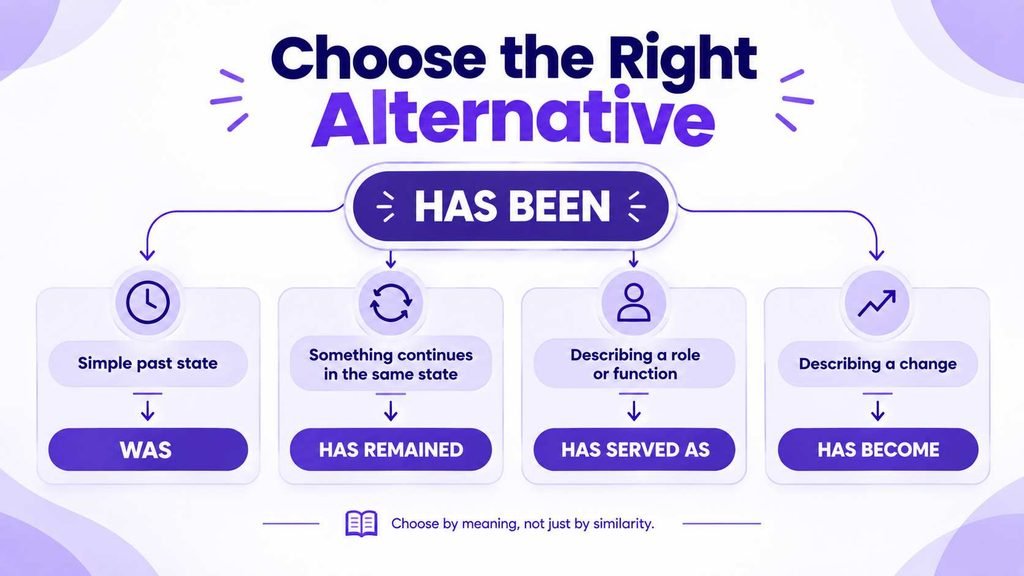
The easiest way to choose an alternative is to ask what “has been” means in your sentence.
If you mean “was true in the past”
Use was when the situation is finished or clearly belongs to a completed past period.
The company was successful in 2019.
If you mean “is still true”
Use has remained or has continued to be.
The company has remained successful.
The company has continued to be successful.
If you mean “has existed”
Use has existed.
The organization has existed for more than 20 years.
If you mean “has had a role”
Use has served as or has acted as.
She has served as the department chair since 2023.
If you mean “has changed into something”
Use has become.
The small business has become a major employer.
If you mean “has happened”
Use has occurred or has taken place.
Several changes have occurred since the policy was introduced.
“Has Been” vs. “Was”
This is one of the most important distinctions.
“Has been” often connects a past situation to the present:
The store has been busy all week.
The week is not necessarily finished.
“Was” normally places the situation in the past:
The store was busy yesterday.
So replacing “has been” with “was” can change the tense and meaning.
“Has Been” vs. “Has Remained”
These phrases are similar but not identical.
The city has been peaceful.
This simply describes its condition.
The city has remained peaceful.
This emphasizes that the peaceful condition has continued despite the passage of time or possible changes.
Use “has remained” when continuity is important.
“Has Been” vs. “Has Become”
These expressions describe different ideas.
The area has been popular with tourists.
This describes its state.
The area has become popular with tourists.
This suggests that it developed into a popular destination.
If you’re describing a change, “has become” is usually more precise.
Common Mistakes
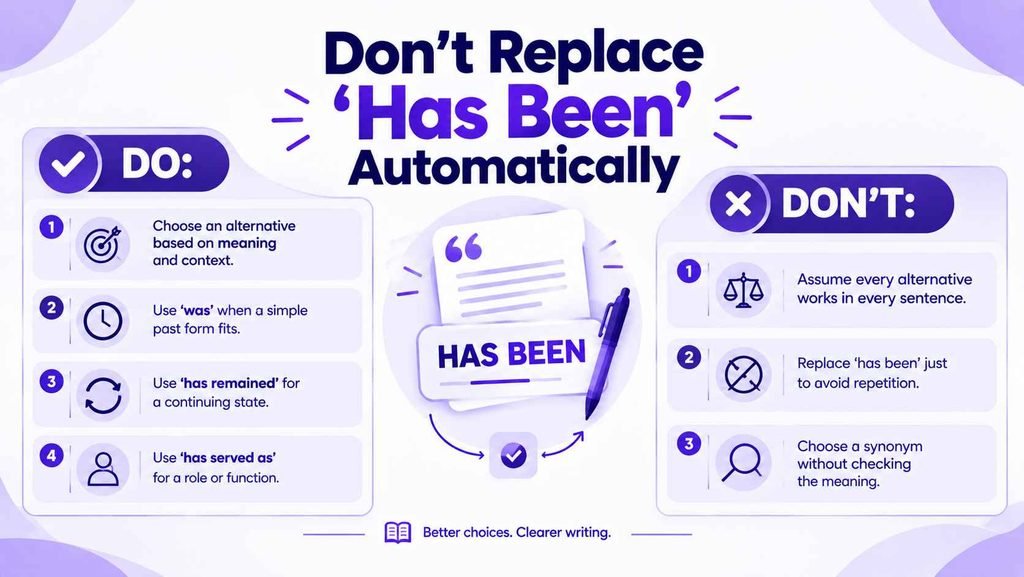
1. Treating every alternative as an exact synonym
There is no single replacement that works in every sentence.
The project has been successful.
You cannot automatically replace it with:
The project has occurred successful.
The grammar and meaning don’t work.
Choose the alternative based on the role of “has been” in the sentence.
2. Changing the tense without realizing it
She has been a manager since 2022.
This indicates a connection between the past and present.
She was a manager since 2022.
This is incorrect in standard English for that intended meaning.
3. Using “has become” when no change occurred
The building has been a library since 1990.
If the building has remained a library the entire time, “has become” would suggest a change that may not have happened.
4. Using overly formal language unnecessarily
Words such as “has occurred” and “has taken place” are useful, but they can sound formal in casual conversation.
For everyday writing, a simpler construction is often better.
What Is the Best Alternative for Formal Writing?
For formal or academic writing, there isn’t one universal replacement. The best choice depends on the meaning.
- Ongoing state: has remained
- Ongoing condition: has continued to be
- Role: has served as
- Existence: has existed
- Event: has taken place
- Change: has become
- Something that happened: has occurred
In many cases, replacing “has been” with a more specific verb makes the sentence clearer rather than simply more formal.
Frequently Asked Questions
What is another way to say “has been” in an essay?
Good options include has remained, has continued to be, has existed, has served as, has become, and has occurred, depending on the sentence. Don’t replace “has been” automatically; choose a phrase that preserves the intended meaning.
What is a simple synonym for “has been”?
There is no perfect one-word synonym in every situation. “Was” can work when you’re describing a completed past situation, while “has remained” works when the condition continues.
Can I use “was” instead of “has been”?
Sometimes, but not always. “Was” uses the simple past, while “has been” usually connects a past situation to the present. Changing between them can change the meaning or make the sentence grammatically incorrect.
What is a formal way to say “has been”?
Depending on the context, has remained, has continued to be, has existed, has served as, has occurred, or has taken place may sound more precise in formal writing.
What is another way to say “has been used”?
Possible alternatives include has served, has functioned as, has been utilized, or has played a role, depending on what is being described. In many cases, “has been used” is already the clearest choice.
What is another way to say “has been shown”?
Depending on the context, you might use has demonstrated, has revealed, has indicated, or has illustrated. These alternatives are not interchangeable in every sentence, so the evidence or action being described matters.
What is another way to say “has been found”?
Depending on the meaning, alternatives can include has been discovered, has been identified, has been observed, or has revealed. Choose the phrase that accurately describes how the information was obtained.
How do I choose the best replacement for “has been”?
First determine what the phrase means in your sentence. Ask whether it describes a past state, continuing condition, role, existence, event, or change. Then choose the alternative that expresses that specific idea.
Final Thoughts
The best alternative to “has been” is not necessarily a more complicated phrase. Because “has been” can perform several grammatical functions, the right replacement depends on the sentence.
Use “was” for a completed past state, “has remained” for continuity, “has served as” for a role, “has existed” for existence, “has become” for change, and “has occurred” or “has taken place” for events. When none of these adds useful meaning, keeping “has been” may actually be the strongest choice.

Role: Editorial Contributor
Graham Ellis contributes practical English and communication guides to RepublicsPress. His content focuses on vocabulary, writing techniques, word usage, and clear communication, with an emphasis on straightforward explanations and real-world examples.