What Is Another Way to Say Compare and Contrast?
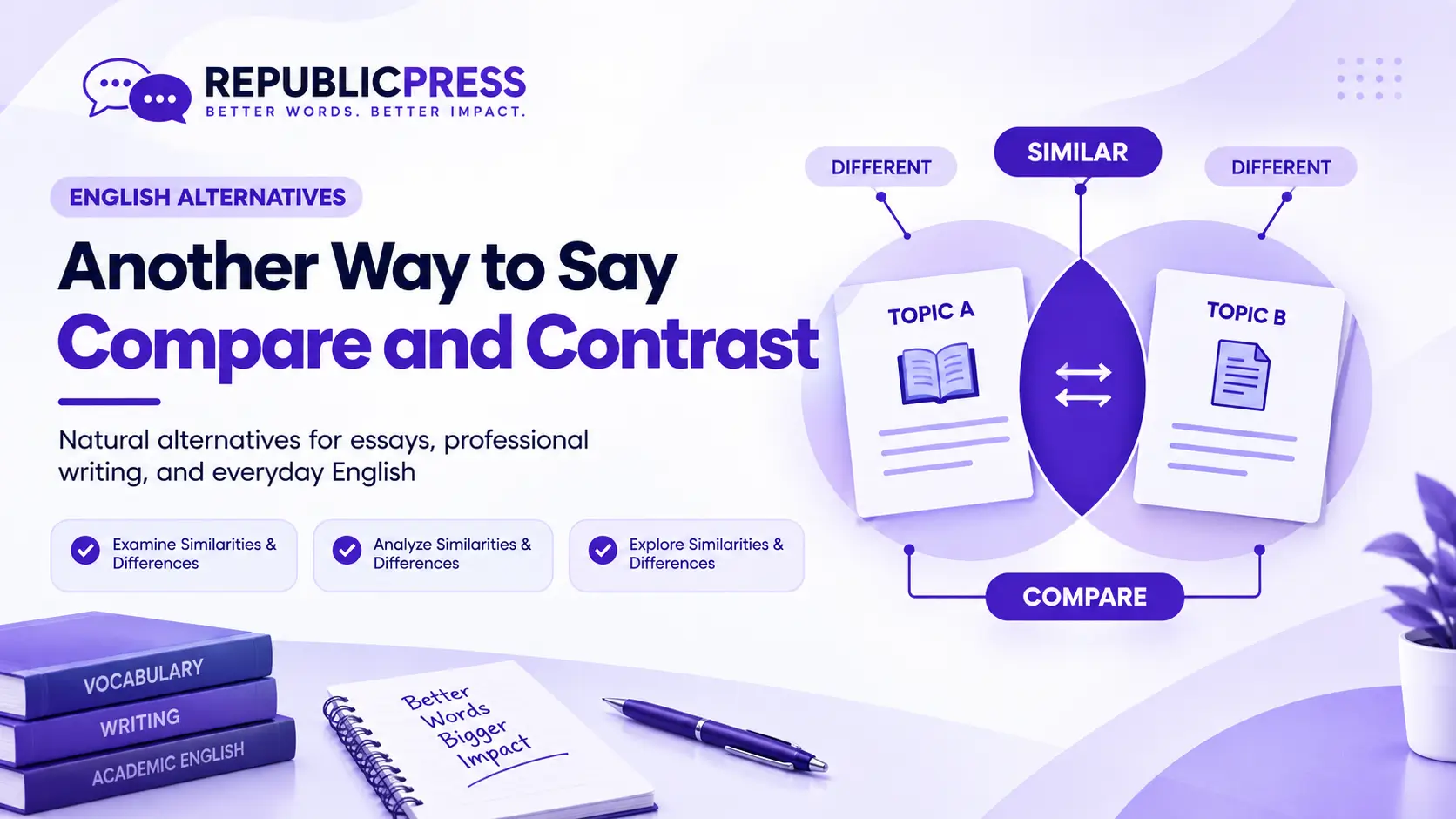
If you want another way to say “compare and contrast,” you can use phrases such as “examine the similarities and differences,” “analyze the similarities and differences,” “compare the two,” “draw comparisons,” or “look at how they are alike and different.” The best choice depends on whether you are writing an essay, giving an explanation, or speaking conversationally.
Key Takeaways
- “Compare and contrast” means examining two or more things for both similarities and differences.
- “Examine the similarities and differences” is a clear and neutral alternative.
- “Analyze the similarities and differences” works especially well in academic writing.
- “Draw comparisons” is useful when focusing mainly on relationships between subjects.
- “Look at how they are alike and different” is more conversational.
- Not every synonym for “compare” includes the idea of contrast, so context matters.
What Does “Compare and Contrast” Mean?
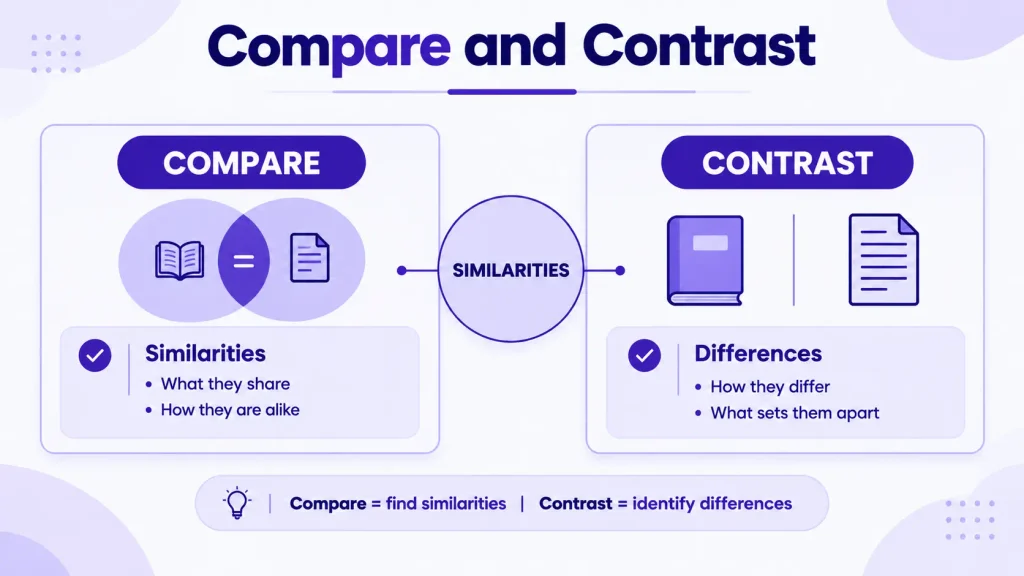
“Compare and contrast” asks you to examine two or more subjects by identifying both what they have in common and how they differ.
For example:
Compare and contrast city life and rural life.
This means you should discuss similarities between city and rural life as well as important differences.
The phrase is especially common in academic assignments, essays, presentations, and analytical writing. However, you may want a different expression to avoid repetition or to make your writing sound more natural.
Another Way to Say “Compare and Contrast”
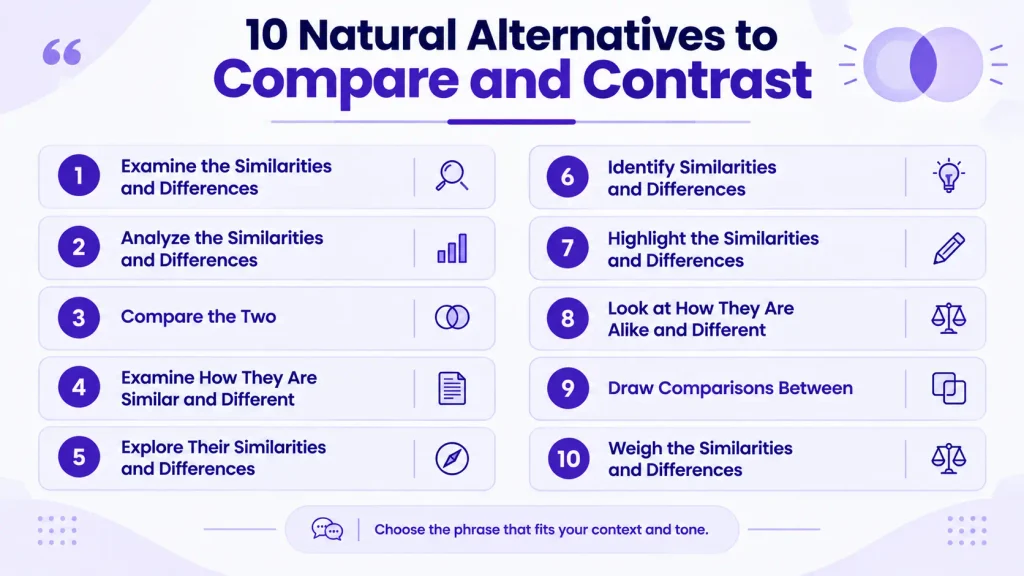
Here are several natural alternatives, with the context in which each works best.
1. Examine the Similarities and Differences
This is one of the clearest alternatives to “compare and contrast.” It directly explains what the reader should look for.
Example:
The essay examines the similarities and differences between traditional and online education.
Best for: Academic, professional, and formal writing.
2. Analyze the Similarities and Differences
“Analyze” suggests a deeper examination rather than simply listing similarities and differences. It works particularly well when the writer is expected to explain why those similarities and differences matter.
Example:
Students were asked to analyze the similarities and differences between the two political systems.
Best for: Academic essays, research writing, and analytical assignments.
3. Compare the Two
If the context already makes it clear that differences will also be discussed, “compare the two” can be a simple and natural alternative.
Example:
In the next section, we compare the two approaches to employee training.
Best for: Academic and professional writing.
Usage tip: “Compare” can sometimes focus on similarities, differences, or both. If you specifically need to emphasize differences, make that clear elsewhere in the sentence.
4. Examine How They Are Similar and Different
This phrase clearly communicates both parts of the original expression without sounding overly formal.
Example:
The assignment asks students to examine how the two novels are similar and different.
Best for: Academic instructions and educational writing.
5. Explore Their Similarities and Differences
“Explore” gives the sentence a slightly more open and less rigid tone. It suggests that the writer will investigate the relationship between the subjects.
Example:
The article explores the similarities and differences between American and British English.
Best for: Articles, educational content, presentations, and general explanatory writing.
6. Identify Similarities and Differences
This option works when the main goal is to find or list specific similarities and differences.
Example:
Read the two passages and identify their similarities and differences.
Best for: Classroom instructions, worksheets, reports, and straightforward explanations.
Usage tip: “Identify” focuses more on finding the similarities and differences than on analyzing them in depth.
7. Highlight the Similarities and Differences
“Highlight” suggests drawing attention to the most important points rather than discussing every possible similarity or difference.
Example:
The presentation highlights the similarities and differences between the two marketing strategies.
Best for: Presentations, reports, articles, and professional communication.
8. Look at How They Are Alike and Different
This is a more conversational version of “compare and contrast.”
Example:
Let’s look at how the two options are alike and different before making a decision.
Best for: Conversations, informal explanations, teaching, and accessible writing.
9. Draw Comparisons Between
“Draw comparisons between” emphasizes the relationship between two or more subjects. It can be useful when the similarities are especially important.
Example:
The author draws comparisons between modern workplaces and traditional offices.
Best for: Essays, articles, literary analysis, and formal discussions.
Usage tip: This phrase does not always emphasize differences as strongly as “compare and contrast,” so add a reference to differences when both are essential.
10. Weigh the Similarities and Differences
“Weigh” suggests considering different aspects carefully before reaching a conclusion.
Example:
The report weighs the similarities and differences between the two proposals.
Best for: Evaluations, reports, decision-making, and analytical writing.
Choosing the Right Alternative
The best replacement depends on what you actually want the reader to do.
| Alternative | Main Focus | Tone | Best Context |
| Examine the similarities and differences | Both similarities and differences | Neutral | Academic and formal |
| Analyze the similarities and differences | Detailed analysis | Formal | Essays and research |
| Compare the two | General comparison | Neutral | Academic and professional |
| Examine how they are similar and different | Both sides clearly | Neutral | Education |
| Explore their similarities and differences | Investigation | Neutral | Articles and explanations |
| Identify similarities and differences | Finding key points | Direct | Assignments and worksheets |
| Highlight the similarities and differences | Important points | Professional | Reports and presentations |
| Look at how they are alike and different | Both sides | Conversational | Informal writing |
| Draw comparisons between | Relationships and similarities | Formal | Essays and analysis |
| Weigh the similarities and differences | Careful evaluation | Formal | Reports and decisions |
“Compare” vs. “Compare and Contrast”
Although “compare” can include both similarities and differences, “compare and contrast” makes the two-part task especially explicit.
For example:
Compare the two products.
This could mean discussing their similarities, differences, or overall relationship.
Compare and contrast the two products.
This clearly asks you to discuss both what the products have in common and how they differ.
For that reason, you should not automatically replace “compare and contrast” with “compare” when the distinction between similarities and differences is important.
Alternatives for Academic Writing
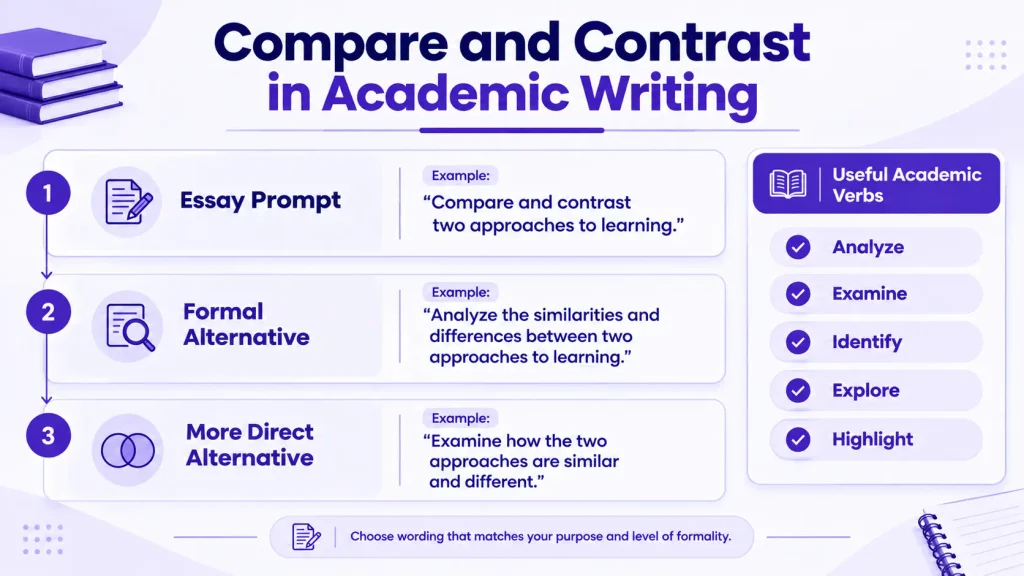
If you are writing an essay or completing an academic assignment, these phrases are particularly useful:
- Examine the similarities and differences
- Analyze the similarities and differences
- Examine how the subjects are similar and different
- Explore the similarities and differences
- Identify key similarities and differences
- Draw comparisons between the two subjects
- Highlight important similarities and differences
For example, instead of writing:
Compare and contrast the two characters.
You could write:
Analyze the similarities and differences between the two characters.
Or:
Examine how the two characters are similar and different.
Both versions make the assignment clear without repeating the exact phrase “compare and contrast.”
Alternatives for Professional Writing
In workplace writing, “compare and contrast” can sometimes sound academic. Depending on the situation, you may prefer more direct language.
For example:
The report compares the two proposals.
Or:
The report highlights the key similarities and differences between the proposals.
For decision-making:
The team will weigh the similarities and differences between the two options.
For a presentation:
This section highlights the key differences between the two strategies.
The best wording depends on whether you are describing a neutral comparison, identifying differences, or evaluating alternatives.
Common Mistakes to Avoid
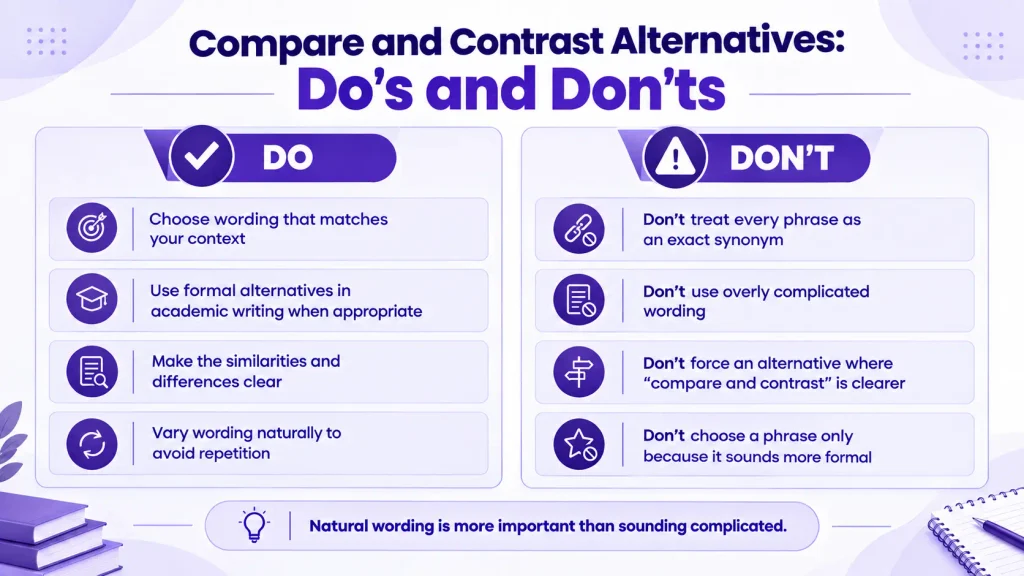
Using “compare” when differences are essential
“Compare” can be broad. If you specifically want the reader to discuss differences, state that directly.
Instead of:
Compare the two plans.
You could write:
Compare the two plans and identify their key differences.
Treating “compare and contrast” as only a search for differences
The phrase includes both similarities and differences. If you only want differences, use phrases such as “differentiate between,” “identify the differences,” or “examine the distinctions.”
Using “differentiate” as a complete replacement
“Differentiate” usually focuses on distinguishing one thing from another. It does not naturally communicate the full idea of examining both similarities and differences.
For example:
Differentiate between the two theories.
This mainly asks you to explain how they differ.
Choosing overly formal wording
Phrases such as “analyze the similarities and differences” work well in academic writing, but they may sound unnecessary in a casual conversation.
For everyday communication, something like this is more natural:
Let’s look at how the two are alike and different.
Frequently Asked Questions
What is a simple way to say “compare and contrast”?
A simple alternative is “examine the similarities and differences.” In casual speech, you can also say “look at how they are alike and different.”
What is another word for “compare and contrast” in an essay?
For an essay, “analyze the similarities and differences” is a strong alternative. “Examine the similarities and differences” is another clear academic option.
Is “compare” the same as “compare and contrast”?
Not always. “Compare” can refer broadly to examining two or more things, while “compare and contrast” explicitly signals that both similarities and differences should be considered.
Can I say “analyze” instead of “compare and contrast”?
Sometimes. “Analyze” generally suggests examining something in detail, but it does not automatically mean that you must discuss both similarities and differences. The surrounding sentence should make the intended task clear.
What is a casual way to say “compare and contrast”?
You can say “look at how they are alike and different.” This sounds more conversational and is easy to understand.
What is a formal way to say “compare and contrast”?
“Examine the similarities and differences” and “analyze the similarities and differences” are both suitable formal alternatives.
What phrase should I use when comparing two choices?
If you are carefully considering both options, “weigh the similarities and differences” can work well. If you are simply presenting information, “compare the two options” may be more appropriate.
Final Thoughts
“Compare and contrast” is already a clear and useful phrase, but you can replace it when you want a different tone or more precise wording. “Examine the similarities and differences” is a direct all-purpose alternative, while “analyze the similarities and differences” fits deeper academic discussion. For a more conversational style, “look at how they are alike and different” sounds natural and easy to understand.
The key is to choose a phrase that matches your purpose. If you need to discuss both similarities and differences, make sure your alternative communicates both ideas rather than focusing on only one.

Role: Language & Content Specialist
Tessa Holloway creates language-focused content covering phrases, idioms, expressions, vocabulary, and natural American English. Her work helps readers choose words and expressions that fit different everyday, academic, and professional situations.