
Another Way to Say Very: 25 Natural Alternatives for Every Context
Another way to say very depends on what you want to express. Words such as extremely, really, highly, incredibly, and particularly can add emphasis, but they don’t all fit every sentence. Choosing the right alternative makes your writing clearer, more natural, and more precise.
Key Takeaways
- Extremely and incredibly emphasize a high degree or intensity.
- Really and so work well in casual conversations.
- Highly is common in professional and formal writing.
- Particularly highlights something specific rather than simply increasing intensity.
- Absolutely works with certain adjectives, such as essential and necessary.
- Sometimes, replacing very with a stronger adjective creates a more concise sentence.
What Does Very Mean?
The word very is an adverb used to emphasize the degree or intensity of an adjective or another adverb. It can make a description stronger without changing its basic meaning.
For example:
- The room is very cold.
- She speaks very clearly.
- That was a very difficult decision.
Although very is common in everyday English, repeating it too often can make writing feel less precise. Using a suitable alternative can add variety and help communicate the exact level of emphasis you intend.
25 Best Alternatives to Very
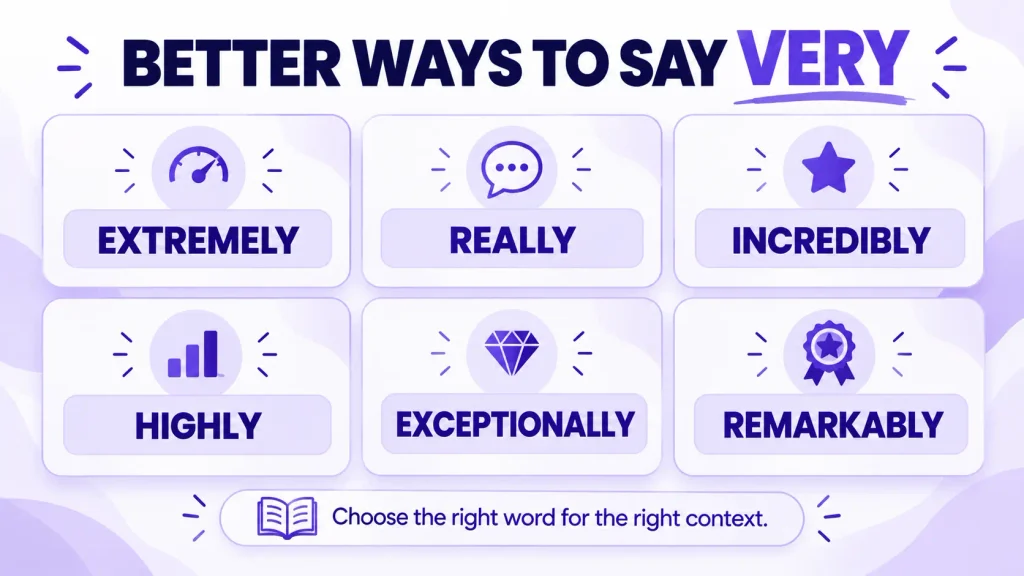
These alternatives are useful in different situations, from casual conversations to professional writing. The best choice depends on the adjective or adverb you want to emphasize.
1. Extremely
Best for: Strong emphasis in everyday, academic, and professional English.
Extremely emphasizes a high degree of something and often sounds stronger than very.
Example: The instructions were extremely helpful.
2. Really
Best for: Casual conversations and informal writing.
Really is a natural substitute for very in everyday American English.
Example: I’m really happy with the results.
3. Incredibly
Best for: Strong emphasis, enthusiasm, or surprise.
Incredibly highlights something remarkable or unusually strong.
Example: The new restaurant is incredibly popular.
4. Highly
Best for: Professional, academic, and formal contexts.
Highly commonly appears with adjectives such as effective, recommended, successful, and unlikely.
Example: This method is highly effective for beginners.
5. Exceptionally
Best for: Describing something that stands out from the usual level.
Exceptionally suggests an unusually high degree or quality.
Example: She delivered an exceptionally clear presentation.
6. Remarkably
Best for: Highlighting something surprising or worthy of attention.
This alternative often draws attention to an unexpected quality.
Example: The team completed the project remarkably quickly.
7. Particularly
Best for: Highlighting a specific quality or situation.
Particularly means especially or more than usual in a particular respect. It is not always as strong as very.
Example: This chapter is particularly useful for new students.
8. Especially
Best for: Emphasizing one person, thing, or quality above others.
Especially works well when you want to single something out.
Example: I enjoy outdoor activities, especially hiking.
9. So
Best for: Informal speech, friendly messages, and emotional emphasis.
So can make an adjective sound more expressive or personal.
Example: That movie was so funny!
10. Quite
Best for: Moderate emphasis in neutral or formal English.
The strength of quite varies by context and dialect. In American English, it often means fairly or rather, although it can be stronger in some expressions.
Example: The instructions are quite simple.
11. Truly
Best for: Sincere statements and emotional emphasis.
Truly can emphasize the genuine nature of a quality rather than simply its degree.
Example: She is a truly talented artist.
12. Deeply
Best for: Feelings, beliefs, and personal convictions.
Deeply emphasizes the intensity of an emotion or belief.
Example: We are deeply grateful for your support.
13. Thoroughly
Best for: Describing a complete experience, action, or state.
Thoroughly emphasizes completeness rather than simply a high degree.
Example: I thoroughly enjoyed the concert.
14. Absolutely
Best for: Strong emphasis with suitable adjectives and expressions.
Absolutely works naturally with words such as essential, certain, delighted, and necessary.
Example: Your feedback is absolutely essential.
15. Totally
Best for: Informal conversations and emphatic statements.
Totally often communicates a strong degree of agreement, completeness, or emphasis.
Example: I’m totally ready for the weekend.
16. Completely
Best for: Emphasizing a full state or complete condition.
Unlike very, completely often suggests that nothing remains incomplete.
Example: The instructions were completely clear.
17. Especially so
Best for: Connecting emphasis to a previously mentioned point.
This expression is useful when explaining why one aspect deserves special attention.
Example: The course is useful for beginners, especially so for students learning independently.
Especially so is less conversational than simply using especially in a direct sentence.
18. Intensely
Best for: Strong feelings, sensations, and concentrated activity.
Intensely describes something experienced or felt with great force.
Example: He was intensely focused on the assignment.
19. Immensely
Best for: Strong appreciation, benefit, or enjoyment.
Immensely suggests a very great degree, particularly with words related to pleasure, value, or benefit.
Example: Your advice helped me immensely.
20. Profoundly
Best for: Serious, thoughtful, or formal writing.
Profoundly emphasizes a deep effect, feeling, or change.
Example: The experience profoundly changed her outlook.
21. Awfully
Best for: Informal emphasis, particularly with feelings or conditions.
In casual American English, awfully can mean very, although it may sound old-fashioned or overly familiar in some contexts.
Example: It’s awfully nice of you to help.
22. Terribly
Best for: Conversational emphasis, often with feelings or conditions.
Terribly can mean very in expressions such as terribly sorry or terribly important.
Example: I’m terribly sorry for the delay.
23. Greatly
Best for: Formal writing and describing effects or changes.
Greatly is especially natural with verbs such as appreciate, improve, influence, and benefit.
Example: We greatly appreciate your patience.
24. Noticeably
Best for: Describing an observable difference or change.
Noticeably means that something is clear enough to be observed. It is a contextual alternative, not a direct synonym in every sentence.
Example: The revised design is noticeably easier to use.
25. Extraordinarily
Best for: Formal descriptions of something unusual or exceptional.
Extraordinarily highlights a quality that goes far beyond what is ordinary.
Example: The researcher presented an extraordinarily detailed analysis.
Comparison Table: Which Alternative Should You Use?
| Alternative | Tone | Best context |
|---|---|---|
| Extremely | Strong, neutral | General writing |
| Really | Casual | Everyday conversation |
| Incredibly | Expressive | Strong reactions |
| Highly | Professional | Business and academic writing |
| Exceptionally | Polished | Quality and performance |
| Particularly | Neutral | Specific emphasis |
| So | Casual, emotional | Speech and messages |
| Quite | Neutral | Moderate emphasis |
| Deeply | Emotional | Feelings and beliefs |
| Absolutely | Strong | Certainty and importance |
| Completely | Direct | Full or complete states |
| Profoundly | Formal | Deep effects and changes |
| Greatly | Formal | Effects and appreciation |
| Extraordinarily | Formal | Unusual qualities |
Stronger Adjectives You Can Use Instead of Very

Sometimes, the best way to improve a sentence is to replace very and the adjective that follows it with one stronger word. These alternatives can make your writing shorter and more vivid.
| Instead of | Try | Example |
|---|---|---|
| Very happy | Delighted | She was delighted with the news. |
| Very sad | Miserable | He felt miserable after the loss. |
| Very angry | Furious | The customer was furious about the mistake. |
| Very tired | Exhausted | I was exhausted after work. |
| Very hungry | Starving | We’re starving after the hike. |
| Very cold | Freezing | It’s freezing outside. |
| Very hot | Scorching | It was scorching in the afternoon. |
| Very beautiful | Gorgeous | The garden looks gorgeous. |
| Very big | Huge | They live in a huge house. |
| Very small | Tiny | The kitten was tiny. |
| Very smart | Brilliant | She came up with a brilliant solution. |
| Very easy | Effortless | The process felt effortless. |
| Very difficult | Challenging | The final exam was challenging. |
| Very important | Crucial | Clear communication is crucial. |
| Very funny | Hilarious | That story was hilarious. |
These stronger adjectives are not always exact substitutes. For example, delighted suggests happiness, while very happy is a more general description. Choose the word that matches your intended meaning.
How to Choose the Right Alternative to Very

The most natural replacement depends on the sentence, the audience, and the strength of the message.
For Everyday Conversations
Use really, so, or totally when speaking with friends or writing casual messages.
- Very nice → Really nice
- Very exciting → So exciting
- Very different → Totally different
Example: “That was really nice of you!”
For Professional Emails
Choose highly, extremely, greatly, or particularly when they fit the sentence.
- Very effective → Highly effective
- Very important → Extremely important
- We very much appreciate → We greatly appreciate
- Very useful → Particularly useful, when highlighting a specific benefit
Example: “We greatly appreciate your time and consideration.”
For Academic Writing
Use precise language rather than repeatedly intensifying adjectives.
- Very significant → Highly significant, when appropriate to the intended meaning
- Very clear → Clear or exceptionally clear
- Very important → Essential or crucial
- Very different → Substantially different
Example: “The findings reveal a substantial difference between the two groups.”
In research writing, terms such as statistically significant have specific meanings. Do not replace them casually with very significant.
For Emotional or Personal Messages
Words such as deeply, truly, incredibly, and absolutely can express stronger feelings.
- Very grateful → Deeply grateful
- Very happy → Absolutely thrilled
- Very sorry → Truly sorry
- Very proud → Incredibly proud
Example: “I’m deeply grateful for everything you’ve done.”
Common Mistakes When Replacing Very
Using highly with every adjective.
Highly effective and highly successful are natural, but highly cold is not. Use extremely cold instead.
Treating quite as an exact synonym.
Quite good may communicate moderate praise rather than the strong emphasis of very good. Consider the context before choosing it.
Using absolutely with unsuitable adjectives.
Absolutely essential sounds natural, but absolutely warm is less common than very warm or extremely warm.
Choosing a stronger adjective that changes the meaning.
Very hungry and starving are related, but starving is more dramatic and may be an exaggeration.
Replacing every instance of very.
Sometimes, very is the clearest and most natural word. You do not need to replace it when the sentence already communicates your meaning well.
Frequently Asked Questions
What is the best synonym for very?
Extremely is one of the most useful general alternatives because it emphasizes a high degree of a quality. Really is often better for casual conversation, while highly fits certain professional expressions.
What is a more formal word for very?
Depending on the sentence, use extremely, exceptionally, remarkably, or profoundly. For example, “The report was exceptionally detailed” sounds polished and professional.
What is a casual way to say very?
Really, so, and totally are common informal alternatives. For example, “I’m really excited about the trip” sounds natural in everyday American English.
What can I say instead of very good?
You can say excellent, outstanding, impressive, or exceptional. Each word adds a slightly different meaning: excellent expresses high quality, while outstanding suggests something stands out from others.
What can I use instead of very important?
Try essential, crucial, critical, or vital. These words often communicate importance more directly, but they can imply that something is necessary rather than merely significant.
How can I avoid using very too often?
Replace some instances with precise adjectives, such as exhausted instead of very tired. Elsewhere, use a suitable adverb or remove very if the sentence remains clear.
Is very informal or formal?
Very is acceptable in both formal and informal English. The issue is not that the word is incorrect, but that repeated use can make writing less precise or expressive.
Conclusion
The best alternative to very is the one that communicates your intended meaning naturally. Use extremely for strong emphasis, really for casual conversation, highly in suitable professional expressions, and stronger adjectives such as exhausted, crucial, or gorgeous when they express the idea more precisely. Clear, accurate wording matters more than using an impressive synonym.

The Republics Press Editorial Team researches, writes and reviews every article on this site, checks facts against reliable sources and updates pages when readers point out errors.