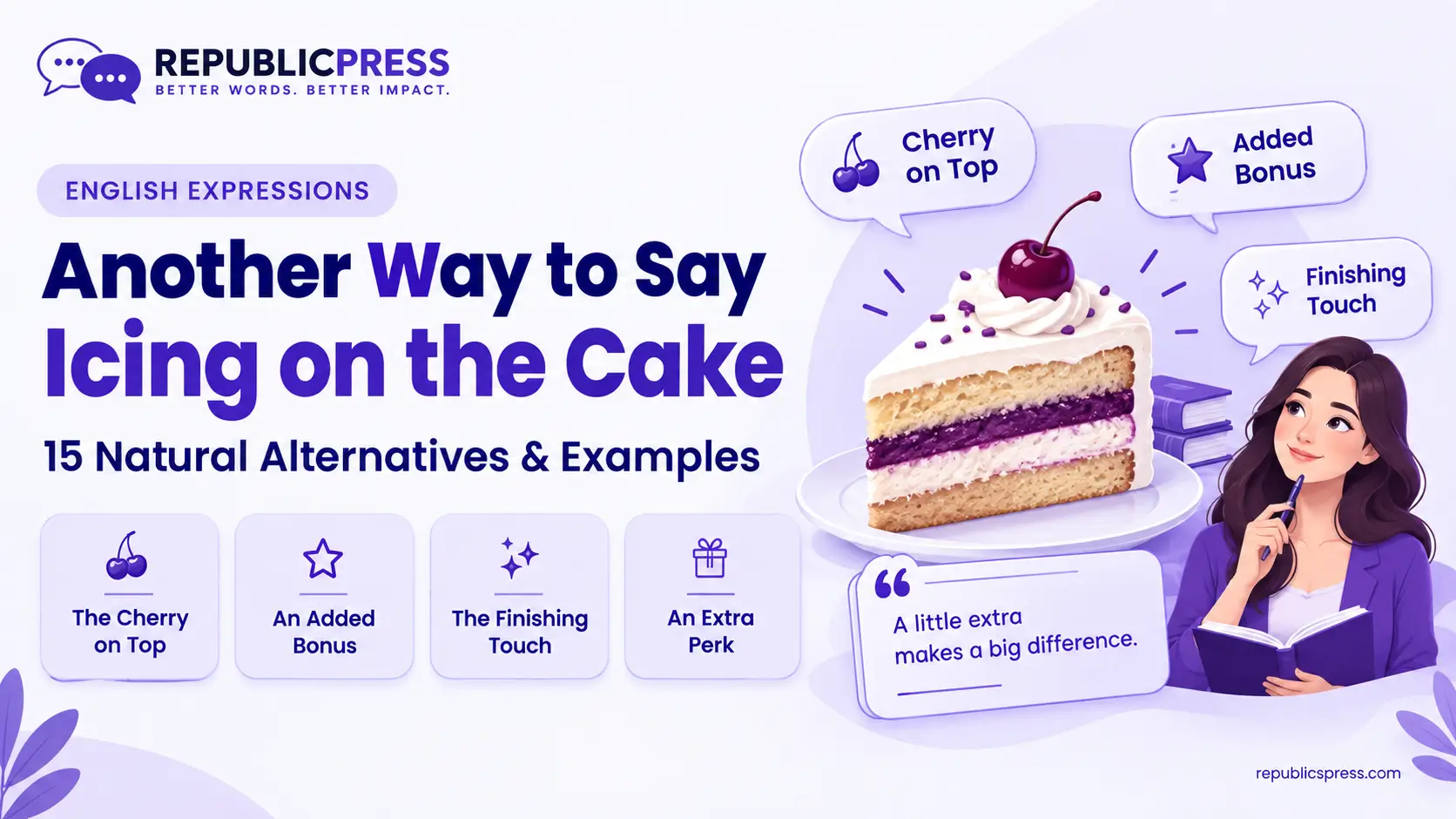
Another Way to Say Icing on the Cake: 15 Alternatives
If you’re looking for another way to say “icing on the cake,” useful alternatives include “the finishing touch,” “an added bonus,” “the cherry on top,” “the perfect addition,” “an extra perk,” and “the final touch.” The best choice depends on whether you mean an especially pleasing final detail, an unexpected benefit, or something that makes an already good situation even better.
Key Takeaways
- “Icing on the cake” describes something that makes an already good situation even better.
- “The cherry on top” is the closest casual alternative.
- “The finishing touch” works well when the final detail completes something.
- “An added bonus” is useful when emphasizing an extra benefit.
- “The perfect addition” works well in neutral and professional writing.
- Not every alternative has exactly the same meaning, so context matters.
What Does “Icing on the Cake” Mean?
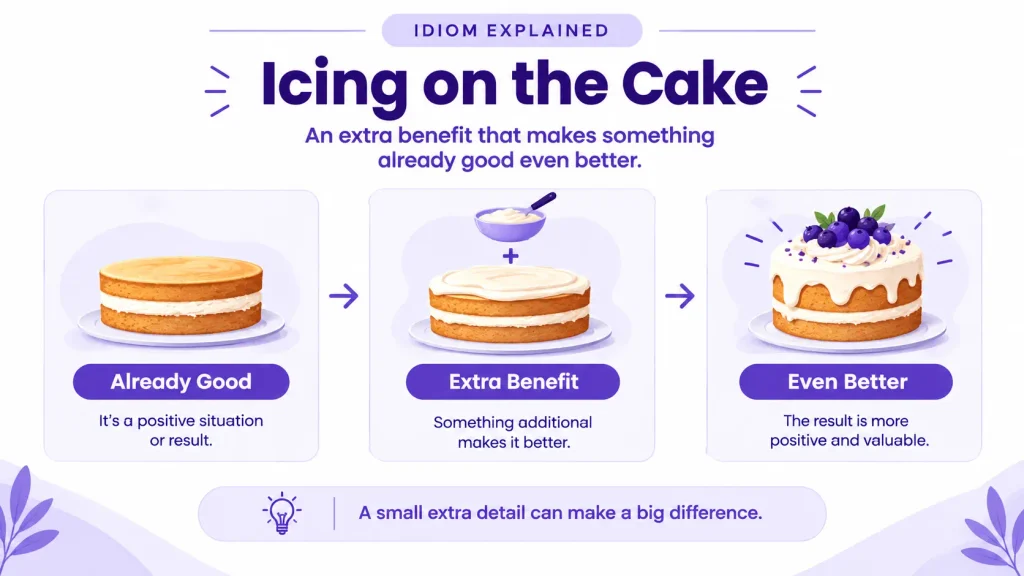
“Icing on the cake” is an idiomatic expression for an additional positive detail that makes an already good situation even more enjoyable, successful, or satisfying.
For example:
Getting the job was exciting, and receiving a higher salary than expected was the icing on the cake.
The job itself was already a positive outcome. The higher salary was an extra benefit that made the situation even better.
The expression comes from the literal idea of cake: a cake can be enjoyable by itself, but icing adds an attractive and often desirable finishing layer.
15 Natural Ways to Say “Icing on the Cake”
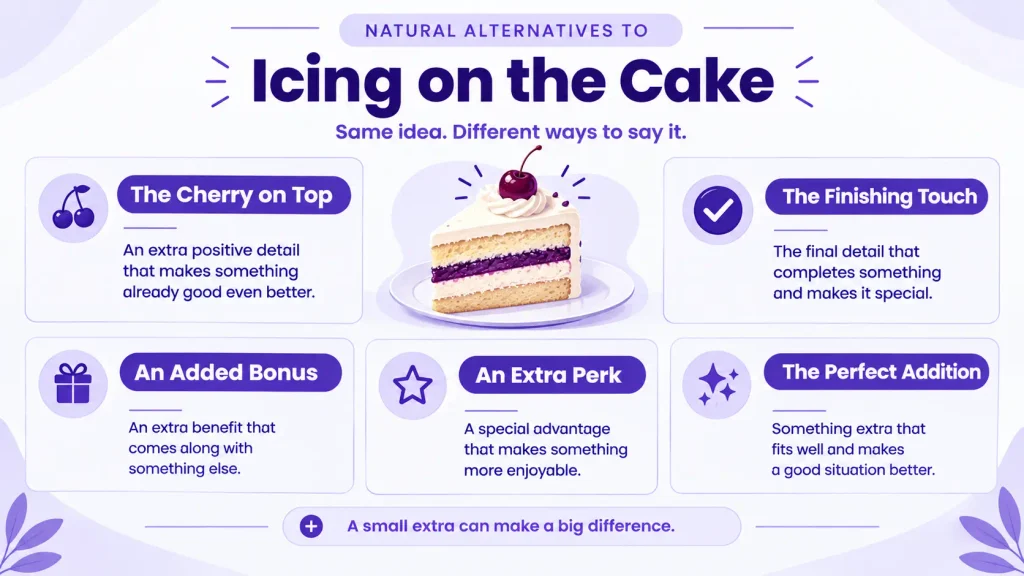
1. The Cherry on Top
“The cherry on top” is one of the closest alternatives to “icing on the cake.” It describes an extra detail that makes an already good situation even better.
Example:
The hotel had a beautiful view, and the free breakfast was the cherry on top.
Best for: Casual, conversational, and friendly writing.
2. The Finishing Touch
“The finishing touch” refers to the final detail that completes or improves something.
Example:
Adding fresh flowers to the table was the finishing touch.
Unlike “icing on the cake,” this phrase can describe something that completes an object, design, project, or appearance, even when the overall situation is not necessarily about an unexpected benefit.
Best for: Design, projects, presentations, appearance, and general writing.
3. An Added Bonus
“An added bonus” emphasizes an extra benefit that comes in addition to something already valuable.
Example:
The apartment is affordable, and having a parking space is an added bonus.
This is especially useful when the extra benefit is practical rather than simply enjoyable.
Best for: Professional, everyday, and practical contexts.
4. An Extra Perk
“An extra perk” describes an additional advantage or benefit.
Example:
Working remotely is great, and flexible hours are an extra perk.
“Perk” is especially common when discussing jobs, memberships, services, and benefits.
Best for: Workplace and everyday conversations.
5. The Perfect Addition
“The perfect addition” describes something that fits well with an existing situation, plan, collection, or result.
Example:
The new outdoor seating area was the perfect addition to the restaurant.
It sounds more neutral and less idiomatic than “icing on the cake.”
Best for: Professional, descriptive, and general writing.
6. The Final Touch
“The final touch” is another natural option when a last detail improves or completes something.
Example:
The new lighting provided the final touch to the renovated room.
“The final touch” and “the finishing touch” are closely related, but both focus more on completion than on receiving an unexpected benefit.
Best for: Projects, design, events, presentations, and creative work.
7. An Added Advantage
“An added advantage” highlights an additional benefit.
Example:
The course is affordable, and its flexible schedule is an added advantage.
This phrase is more formal than “icing on the cake.”
Best for: Professional, academic, and formal writing.
8. A Welcome Bonus
“A welcome bonus” describes an extra benefit that is particularly appreciated.
Example:
The hotel upgrade was a welcome bonus after a long day of traveling.
The phrase works well when the extra benefit is pleasant but not necessarily expected.
Best for: Customer service, travel, promotions, and everyday situations.
9. An Extra Benefit
“An extra benefit” is a straightforward alternative that clearly communicates the idea of an additional positive feature.
Example:
Free technical support is an extra benefit of the membership.
It is less colorful than “icing on the cake,” but it is clear and easy to understand.
Best for: Business, workplace, product, and service descriptions.
10. A Pleasant Surprise
“A pleasant surprise” works when the additional positive detail was unexpected.
Example:
Finding out that the tickets included dinner was a pleasant surprise.
This phrase focuses more strongly on the unexpected nature of the benefit.
Best for: Personal stories, travel, events, and everyday conversation.
11. An Unexpected Bonus
“An unexpected bonus” is useful when something positive happens beyond what was originally expected.
Example:
The conference was informative, and meeting several potential clients was an unexpected bonus.
Best for: Professional situations, events, travel, and everyday experiences.
12. A Welcome Extra
“A welcome extra” means an additional feature or benefit that is appreciated.
Example:
The free delivery was a welcome extra when I ordered the furniture.
This expression is simple and flexible without sounding overly formal.
Best for: Products, services, shopping, and everyday writing.
13. The Perfect Ending
“The perfect ending” can work when the final event or detail makes an already positive experience feel complete.
Example:
Watching the sunset from the beach was the perfect ending to our trip.
This phrase focuses on how something concludes rather than on an additional benefit.
Best for: Stories, trips, events, celebrations, and personal experiences.
14. The Best Part
“The best part” is a natural conversational alternative when the additional detail is actually the most enjoyable or important part.
Example:
The concert was fantastic, but meeting the band afterward was the best part.
This is not an exact synonym because it can refer to the main highlight rather than merely an extra benefit.
Best for: Casual conversation and personal experiences.
15. A Little Extra
“A little extra” is a casual way to describe an additional benefit or pleasant detail.
Example:
The complimentary dessert was a little extra that made the dinner even more enjoyable.
It has a relaxed, conversational tone.
Best for: Casual speech, reviews, hospitality, and friendly writing.
Which Alternative Should You Use?
The right phrase depends on what you want to emphasize.
| Alternative | Meaning/Use | Tone | Best Context |
| The cherry on top | An extra detail that makes something better | Casual | Conversation |
| The finishing touch | A final detail that completes something | Neutral | Projects and design |
| An added bonus | An additional benefit | Neutral | General and professional |
| An extra perk | An additional advantage | Casual/Professional | Work and services |
| The perfect addition | Something that fits and improves an existing whole | Neutral | General writing |
| An added advantage | An additional positive feature | Formal | Academic and professional |
| A welcome bonus | An appreciated extra benefit | Neutral | Business and everyday use |
| A pleasant surprise | An unexpected positive event | Neutral | Personal experiences |
| An unexpected bonus | An unforeseen benefit | Neutral | Work and everyday situations |
| A little extra | A small additional benefit | Casual | Conversation |
“Icing on the Cake” vs. “Cherry on Top”
“Icing on the cake” and “cherry on top” are very close in meaning. Both describe an additional positive detail that improves an already good situation.
Icing on the cake:
The promotion was exciting, and the raise was the icing on the cake.
Cherry on top:
The restaurant was excellent, and the complimentary dessert was the cherry on top.
“Cherry on top” often sounds slightly more playful and conversational, while “icing on the cake” is also widely used in everyday American English.
“Icing on the Cake” vs. “Finishing Touch”
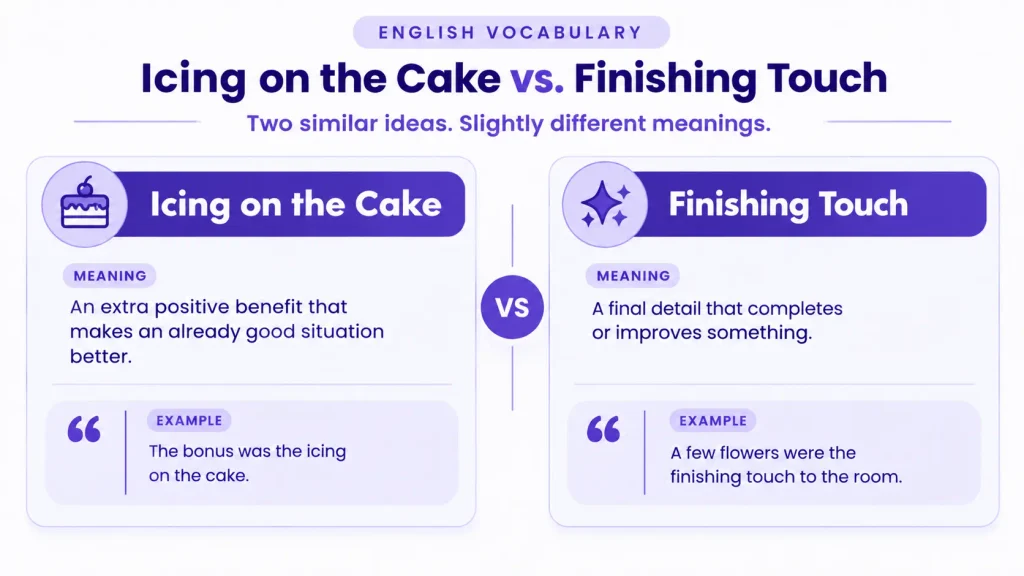
These expressions overlap, but they are not always interchangeable.
“Icing on the cake” usually describes an extra positive feature that makes a good situation even better.
“The finishing touch” usually describes the final detail that completes something.
Compare:
- The free upgrade was the icing on the cake.
- The new artwork was the finishing touch to the office.
The first emphasizes an extra benefit. The second emphasizes completion.
“Icing on the Cake” vs. “Added Bonus”
“An added bonus” is particularly useful when you want to emphasize an additional benefit.
For example:
The position offers flexible hours, and working from home twice a week is an added bonus.
This sounds more practical and professional than “icing on the cake.”
For a workplace email, report, or business document, “added benefit,” “added advantage,” or “additional benefit” may also be more appropriate.
Formal Alternatives to “Icing on the Cake”
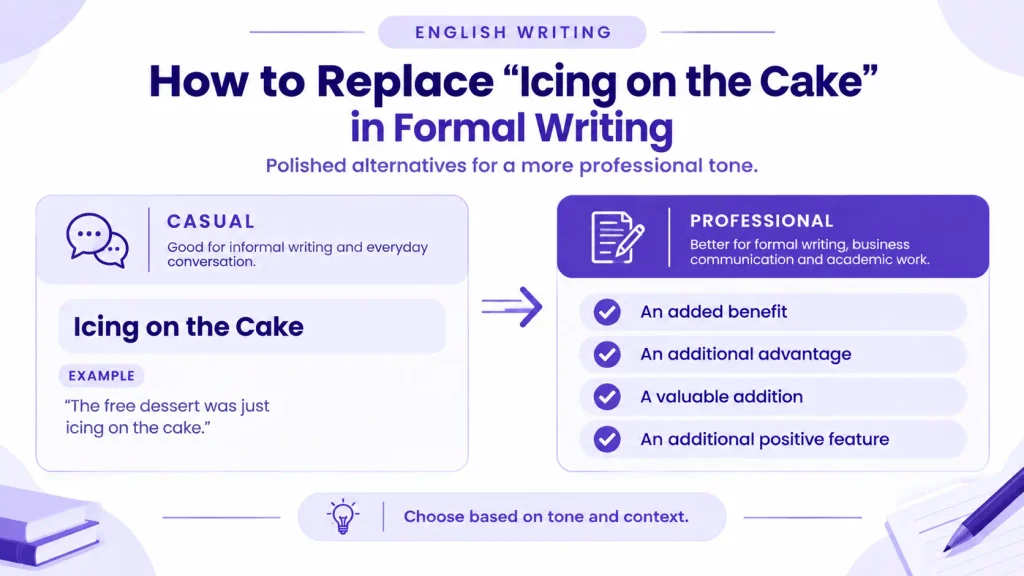
If you are writing an academic paper, professional email, business report, or formal document, idiomatic expressions may not always be the best choice.
Consider:
- An added benefit
- An additional advantage
- A valuable addition
- An additional positive feature
- A welcome benefit
- A further advantage
- A beneficial addition
For example:
Casual:
The flexible schedule is the icing on the cake.
More professional:
The flexible schedule is an additional benefit of the position.
The second version communicates the same general idea more directly.
Casual Alternatives to “Icing on the Cake”
For conversations, texts, and friendly messages, these options sound natural:
- The cherry on top
- The best part
- An extra perk
- A little extra
- A pleasant surprise
- The perfect finishing touch
For example:
We had an amazing weekend, and the sunny weather was the cherry on top.
Or:
The concert was already great, but getting backstage passes was the best part.
Common Mistakes When Using “Icing on the Cake”
Using it for a negative event
“Icing on the cake” normally describes something positive added to an already positive situation. Using it for an ordinary negative event can confuse the reader.
Treating every alternative as an exact synonym
“The finishing touch” and “added bonus” overlap with “icing on the cake,” but their emphasis is different. Choose based on whether you mean completion, benefit, surprise, or enjoyment.
Using casual idioms in formal writing
Expressions such as “icing on the cake” and “cherry on top” are natural in conversation, but a formal report may benefit from a direct phrase such as “additional benefit.”
Confusing “best part” with “extra benefit”
“The best part” identifies the most enjoyable or important element. It does not necessarily mean that the element was an additional benefit.
Frequently Asked Questions
What is another way to say “icing on the cake”?
Common alternatives include “the cherry on top,” “the finishing touch,” “an added bonus,” “an extra perk,” “the perfect addition,” and “a welcome bonus.”
What is the closest synonym for “icing on the cake”?
“The cherry on top” is one of the closest natural alternatives because both expressions describe an extra positive detail that makes an already good situation even better.
Is “cherry on top” the same as “icing on the cake”?
They have nearly the same meaning in many contexts. Both refer to something extra that adds to an already positive situation. “Cherry on top” can sound slightly more playful or conversational.
What is a professional way to say “icing on the cake”?
In professional writing, you can use “an added benefit,” “an additional advantage,” “a valuable addition,” or “an additional positive feature,” depending on the context.
Is “finishing touch” the same as “icing on the cake”?
Not exactly. “Finishing touch” usually means a final detail that completes or improves something, while “icing on the cake” usually refers to an extra positive feature that makes a good situation even better.
Can I use “icing on the cake” in an email?
Yes. It is natural in a casual or friendly email. For a formal business email, a direct phrase such as “additional benefit” or “welcome bonus” may sound more appropriate.
What is a formal synonym for “cherry on top”?
Depending on the sentence, formal alternatives include “additional benefit,” “added advantage,” “valuable addition,” and “further benefit.”
Final Thoughts
“Icing on the cake” is a useful idiom for describing an extra positive detail that improves an already good situation. For casual English, “the cherry on top” is a close and natural choice. For professional or formal writing, “an added benefit,” “an additional advantage,” or “a valuable addition” may communicate the idea more clearly. Choose the alternative based on whether you want to emphasize an extra benefit, a final detail, a pleasant surprise, or a perfect ending.

Role: Editorial Contributor
Graham Ellis contributes practical English and communication guides to RepublicsPress. His content focuses on vocabulary, writing techniques, word usage, and clear communication, with an emphasis on straightforward explanations and real-world examples.