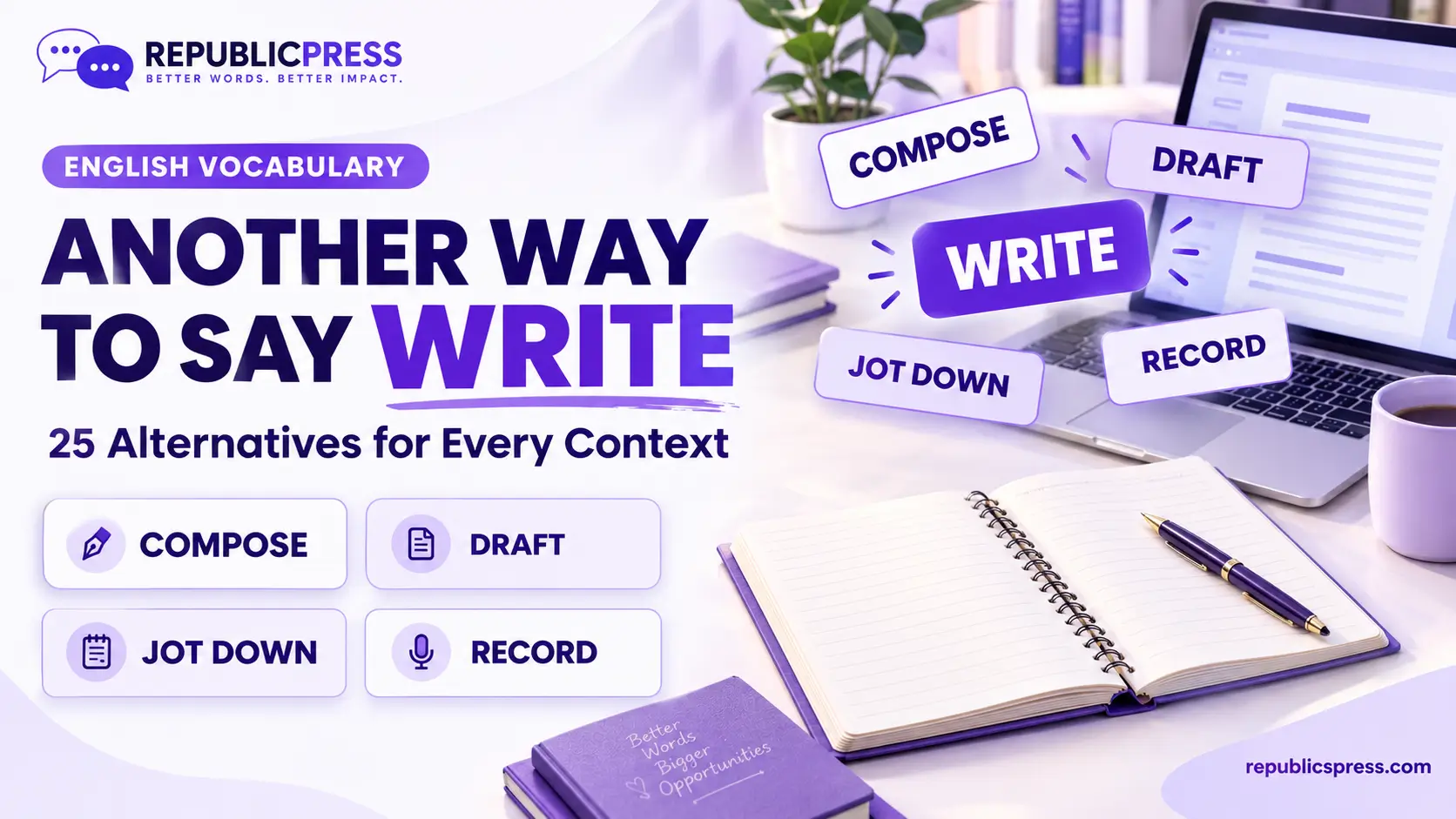
Another Way to Say Write: 25 Natural Alternatives for Different Contexts
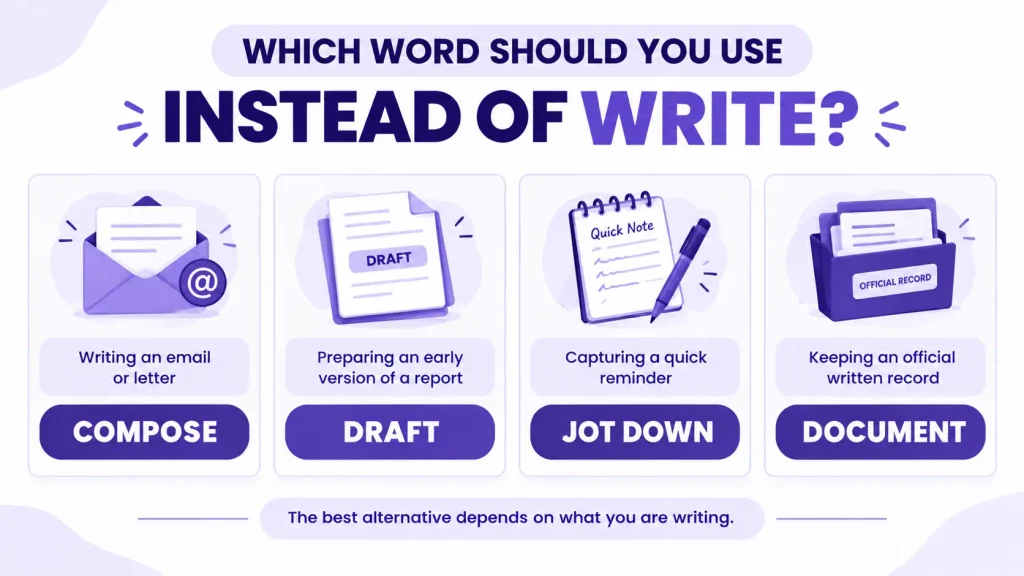
The best alternative to write depends on what you mean. You can use compose for creating a piece of writing, draft for preparing an early version, record for preserving information, or put into words for expressing an idea or feeling. Each phrase has a slightly different meaning, so choosing the right one makes your message clearer.
Key Takeaways
- Compose works well for letters, articles, songs, and other original work.
- Draft means to prepare an initial version that may need editing.
- Jot down is a casual way to describe writing something quickly.
- Document emphasizes keeping a record of facts, events, or processes.
- Put into words focuses on expressing thoughts, feelings, or ideas.
- Author is suitable for creating books, articles, and other written works.
What Does “Write” Mean?
The verb write usually means to form words on a page or screen, create written content, or express information through language. It can also refer to preparing a specific document, such as an email, report, essay, or letter.
Because the word covers several activities, no single synonym fits every situation. For example, you might draft a report, compose a letter, record a meeting’s details, or jot down a phone number.
25 Other Ways to Say “Write”

These alternatives work in different situations, from quick notes and everyday messages to professional documents and creative projects.
1. Compose
Meaning: To create written material by putting ideas and words together in a planned way.
Best for: Letters, essays, emails, and creative work.
Example: She composed a thoughtful response to the client’s concerns.
Usage tip: Compose sounds more deliberate than write. It is useful when you want to emphasize the care taken to create something.
2. Draft
Meaning: To prepare an early version of a document that may be revised later.
Best for: Reports, proposals, emails, and business documents.
Example: I’ll draft the proposal before our meeting tomorrow.
Usage tip: Draft does not necessarily mean the work is finished. Use it when the document is still being developed.
3. Author
Meaning: To create a written work, often a book, article, or other substantial publication.
Best for: Books, articles, guides, and published content.
Example: He authored a practical guide to personal finance.
Usage tip: Author sounds more formal than write and often highlights responsibility for creating a complete work.
4. Pen
Meaning: To write or compose something, often a letter, message, or creative piece.
Best for: Letters, personal messages, and literary writing.
Example: She penned a heartfelt letter to her grandmother.
Usage tip: Pen is a little more literary than write. It can sound warm or expressive in personal writing.
5. Jot Down
Meaning: To write something quickly, usually in a short form.
Best for: Reminders, phone numbers, notes, and quick ideas.
Example: Jot down the address before you leave home.
Usage tip: This is a natural, casual phrase. It emphasizes speed rather than careful writing.
6. Record
Meaning: To write down information so it can be saved, remembered, or checked later.
Best for: Meeting notes, expenses, observations, and important details.
Example: Please record the results in your spreadsheet.
Usage tip: Record focuses on preserving information rather than creating an original piece of writing.
7. Document
Meaning: To create a written record of facts, events, actions, or processes.
Best for: Workplace reports, technical instructions, research, and official records.
Example: The team documented every change made to the website.
Usage tip: Document is especially useful when accuracy and a clear record matter.
8. Note
Meaning: To write down or mark information for future reference.
Best for: Instructions, observations, reminders, and key points.
Example: Note the deadline on your calendar so you don’t forget it.
Usage tip: Note can also mean to notice something. In this example, it means to record information.
9. Scribble
Meaning: To write quickly or carelessly, often with messy handwriting.
Best for: Informal notes and hurried writing.
Example: He scribbled his phone number on the back of a receipt.
Usage tip: Scribble may suggest that the writing is difficult to read. Avoid it when you want to emphasize neat, careful work.
10. Type
Meaning: To enter words using a keyboard.
Best for: Emails, documents, online forms, and digital messages.
Example: I typed the meeting notes into the shared document.
Usage tip: Type describes how words are entered, not necessarily what kind of content is being created.
11. Transcribe
Meaning: To convert spoken words or existing material into written text.
Best for: Interviews, audio recordings, meetings, and dictated notes.
Example: She transcribed the interview before preparing the article.
Usage tip: Transcribe is more specific than write. It usually involves reproducing existing words rather than creating new ones.
12. Inscribe
Meaning: To write, carve, or mark words on a surface or object.
Best for: Plaques, monuments, awards, and personalized gifts.
Example: They inscribed the couple’s names inside the wedding ring.
Usage tip: Inscribe is not a general replacement for write. It works best when words are placed on an object or surface.
13. Set Down
Meaning: To put thoughts, facts, or information into written form.
Best for: Notes, reflections, ideas, and written accounts.
Example: She set down her thoughts in a private journal.
Usage tip: This phrase can sound thoughtful or literary, depending on the sentence.
14. Put in Writing
Meaning: To express something in a written form rather than leaving it as a spoken agreement or statement.
Best for: Work instructions, agreements, requests, and important decisions.
Example: Could you put the revised terms in writing?
Usage tip: This phrase is useful when you need a clear written record of what was agreed upon.
15. Draw Up
Meaning: To prepare a formal document, often with specific details or terms.
Best for: Contracts, plans, agreements, and official documents.
Example: The lawyer drew up a contract for the new partnership.
Usage tip: Draw up emphasizes preparing a document in an organized or formal way. It does not fit every kind of writing.
16. Formulate
Meaning: To develop and express an idea, plan, argument, or statement in a clear form.
Best for: Research, strategies, arguments, and formal proposals.
Example: The researcher formulated a hypothesis for the study.
Usage tip: Formulate focuses on developing the idea itself, not simply putting words on a page.
17. Craft
Meaning: To create something carefully, with attention to its wording, structure, or effect.
Best for: Speeches, messages, stories, and persuasive content.
Example: She crafted a clear message for the company’s website.
Usage tip: Craft suggests care and skill. It is particularly useful when the quality of the wording matters.
18. Create
Meaning: To make something new, including written content.
Best for: Blog posts, stories, articles, guides, and online content.
Example: Our team creates helpful articles for new website owners.
Usage tip: Create is broader than write. It works when you want to emphasize producing new content rather than the act of writing itself.
19. Produce
Meaning: To create or deliver a finished piece of written work.
Best for: Reports, publications, content projects, and professional assignments.
Example: The marketing team produced a detailed campaign report.
Usage tip: Produce often emphasizes the completed result or the amount of work delivered.
20. Prepare
Meaning: To get a document or written material ready for a particular purpose.
Best for: Reports, applications, presentations, and business documents.
Example: Please prepare a summary of the project’s progress.
Usage tip: Prepare can include researching, organizing, editing, and formatting, not just writing.
21. Spell Out
Meaning: To express something clearly and fully, often to prevent misunderstanding.
Best for: Instructions, rules, expectations, and explanations.
Example: The manager spelled out the requirements for the assignment.
Usage tip: Spell out can also mean writing the individual letters of a word. In this example, it means explaining something explicitly.
22. Describe
Meaning: To explain what a person, place, event, object, or situation is like.
Best for: Reports, stories, reviews, and explanations.
Example: Describe the problem you encountered while using the app.
Usage tip: Describe is suitable when the goal is to explain characteristics or details. It does not mean write in every context.
23. Report
Meaning: To present information about events, findings, or activities.
Best for: News, research, workplace updates, and formal summaries.
Example: The journalist reported the findings in a detailed article.
Usage tip: Report emphasizes communicating information, often after gathering facts.
24. Chronicle
Meaning: To record events or developments in the order they happen.
Best for: Historical accounts, biographies, memoirs, and long-term developments.
Example: The book chronicles the town’s growth over several decades.
Usage tip: Chronicle is more specialized than write and usually focuses on events over time.
25. Put Into Words
Meaning: To express a thought, feeling, or idea through language.
Best for: Personal messages, emotional conversations, and reflective writing.
Example: He struggled to put his gratitude into words.
Usage tip: This phrase emphasizes expressing something that may be difficult to explain, rather than the physical act of writing.
Quick Comparison: Which Alternative Should You Use?
| Alternative | Best use | Tone |
|---|---|---|
| Compose | Letters and essays | Neutral to formal |
| Draft | First versions of documents | Professional |
| Author | Books and publications | Formal |
| Pen | Letters and creative work | Literary |
| Jot down | Quick notes | Casual |
| Record | Saving information | Neutral |
| Document | Official records | Professional |
| Scribble | Quick, messy writing | Informal |
| Transcribe | Converting speech to text | Technical |
| Draw up | Contracts and plans | Formal |
| Formulate | Ideas and arguments | Academic or professional |
| Craft | Carefully worded content | Creative |
| Prepare | Reports and applications | Professional |
| Spell out | Clear explanations | Neutral |
| Put into words | Thoughts and feelings | Personal |
These distinctions align with standard American English dictionary usage: words such as compose, draft, jot down, and transcribe overlap with write, but they emphasize different actions.
How to Choose the Right Word for “Write”

The easiest way to choose an alternative is to think about what you are actually doing.
For professional emails and documents
Use draft, compose, prepare, or draw up when the context fits.
- “I need to draft an email to the client.”
- “Please prepare the project report by Friday.”
- “The attorney will draw up the agreement.”
For everyday business communication, write is already professional. You do not need to replace it just to sound more advanced.
For school and academic work
Use compose, draft, formulate, or describe, depending on the task.
- “She drafted the first version of her essay.”
- “The students formulated an argument based on the evidence.”
- “Describe the main causes of the event.”
Remember that formulate is about developing an idea, while compose is about creating the written work.
For creative writing
Use craft, author, pen, or compose.
- “He crafted a compelling opening for his story.”
- “She authored a collection of short stories.”
- “I penned a short poem for my friend.”
These choices can add detail, but the simplest word is often the most natural.
For quick notes and reminders
Use jot down, note, or scribble.
- “I’ll jot down your suggestions.”
- “Note the date on the application.”
- “She scribbled a reminder on a sticky note.”
Choose scribble only when the quick or untidy nature of the writing is relevant.
For expressing thoughts and feelings
Use put into words or describe.
- “I can’t put into words how grateful I am.”
- “She described how she felt after the interview.”
The first expresses difficulty finding the right words. The second focuses on explaining an experience.
Common Mistakes to Avoid
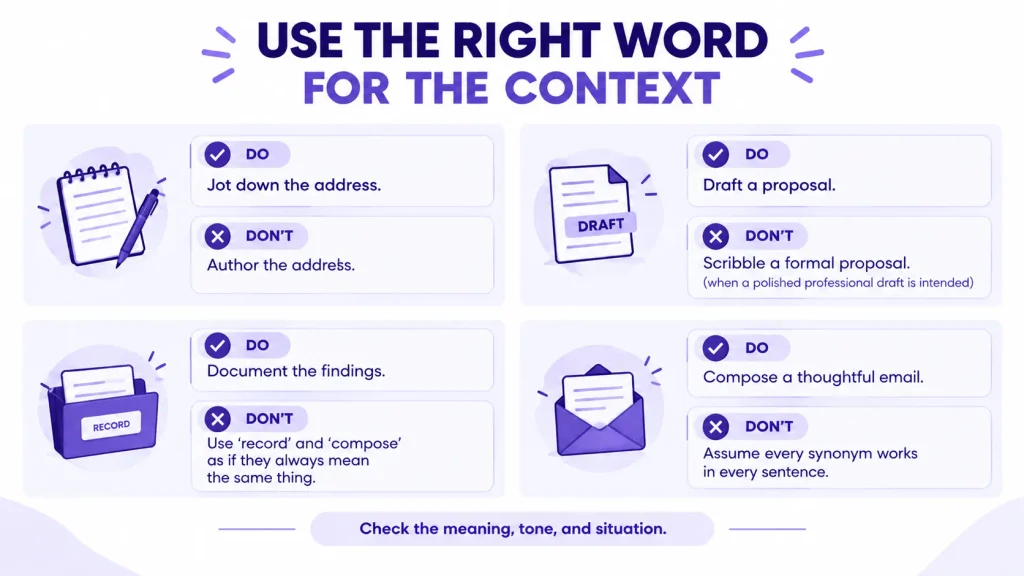
- Using draft for a finished document: Draft usually suggests an initial or working version. Use prepare or write if you mean the task more generally.
- Using compose for every sentence: Compose can sound unnecessarily formal for a quick text or reminder.
- Treating type and write as identical: Type refers to keyboard input, while write can refer to handwriting or digital text.
- Using transcribe when you mean create: Transcribe usually involves converting existing speech or material into text.
- Using document when you mean any kind of writing: Document emphasizes keeping a record, often of facts, events, or processes.
- Replacing write just to sound sophisticated: A familiar, accurate word is often better than a less natural synonym.
Frequently Asked Questions
What is the most common synonym for write?
Compose, draft, record, and pen are common alternatives, but each fits a different purpose. Compose means to create written material, draft means to prepare an initial version, record means to preserve information, and pen often refers to letters or creative work.
What is a formal way to say write?
Compose, document, formulate, and draw up can work in formal contexts. Choose based on the task: compose a letter, document an event, formulate an argument, or draw up a contract.
What is a professional way to say write?
Use draft for a preliminary document, prepare for a report or application, document for a record of events, or compose for a carefully written message. The best option depends on the sentence.
What is a casual way to say write?
Jot down, scribble, and put down can work in casual situations. For example, “Let me jot down that address” sounds natural in everyday American English.
What is another way to say “write an email”?
You can say compose an email, draft an email, or prepare an email. Use draft if it is an early version and compose if you want to emphasize putting the message together.
What is another way to say “write down”?
Try record, note, jot down, or set down. Jot down is best for quick notes, while record is useful for information that needs to be saved accurately.
Is “author” the same as “write”?
Not exactly. Author usually refers to creating a book, article, or other substantial work. Write is broader and applies to everything from a short note to a full-length publication.
Can I use “create” instead of “write”?
Yes, when you mean producing written content. For example, “We create educational articles” is natural. However, create is broader than write because it can also refer to making things that are not written.
Conclusion
The best alternative to write is the one that describes your exact action. Use compose for carefully created text, draft for an early version, jot down for quick notes, document for keeping records, and put into words for expressing thoughts or feelings.
In many situations, write remains the clearest choice. Use another word when it adds a meaningful distinction, not simply to make your sentence sound more complicated.

The Republics Press Editorial Team researches, writes and reviews every article on this site, checks facts against reliable sources and updates pages when readers point out errors.