Another Way to Say Go Against: 15 Natural Alternatives
Looking for another way to say go against? Common alternatives include oppose, disagree with, resist, challenge, and defy. Each phrase has a slightly different meaning. Some describe a difference of opinion, while others suggest breaking rules or refusing to follow orders. Choosing the right expression helps you speak and write clear, natural American English.
Key Takeaways
- Use oppose to show disagreement with a plan or decision.
- Choose disagree with when you have a different opinion.
- Use resist when you refuse to give in to pressure.
- Choose defy when someone openly refuses to obey.
- Use contradict when a statement conflicts with another claim.
- Try run counter to in formal or academic writing.
What Does “Go Against” Mean?
The phrase go against has several meanings. It can describe opposing an idea, breaking a rule, ignoring advice, or acting against someone’s wishes.
Here are a few examples:
- Opposing an idea: I decided to go against the proposal.
- Breaking a rule: He went against the school’s rules.
- Ignoring advice: She went against her parents’ advice.
- Conflicting with a belief: That decision goes against my values.
The meaning depends on the situation. For example, disagreeing with a manager does not always mean refusing to follow instructions. For this reason, it helps to choose an alternative that matches your exact meaning.
15 Other Ways to Say Go Against
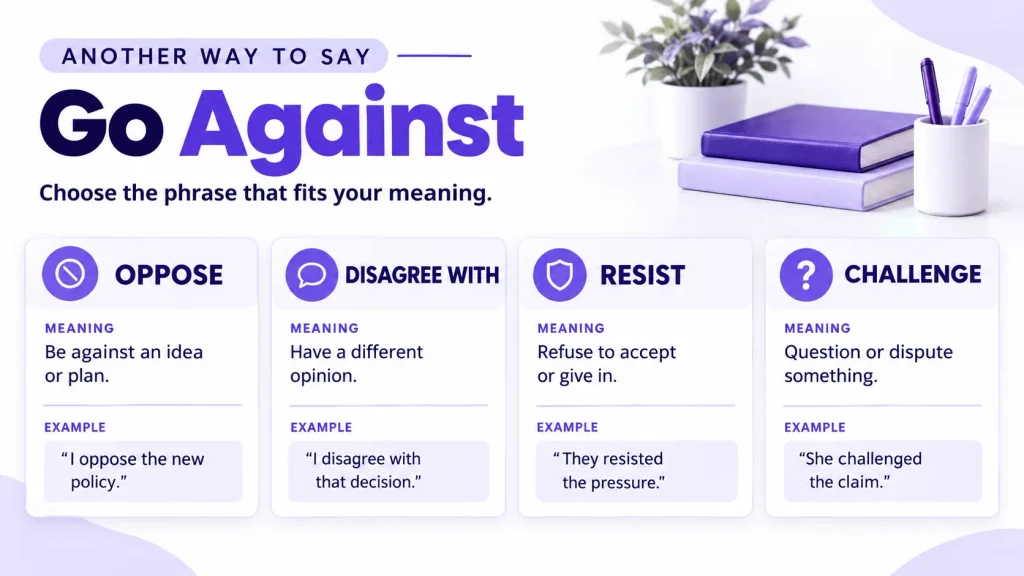
The following alternatives can help you express disagreement, resistance, or conflict in everyday conversations and professional writing.
1. Oppose
Meaning: To disagree with or actively resist an idea, plan, or decision.
Example: Several employees oppose the company’s new attendance policy.
Best for: Workplace discussions, public issues, and formal writing.
Use oppose when you want to express clear disagreement. It is a strong, direct alternative to go against when discussing a proposal or decision.
2. Disagree With
Meaning: To have a different opinion from another person.
Example: I disagree with your decision to cancel the project.
Best for: Everyday conversations and professional communication.
This phrase is useful when you want to express a different opinion without suggesting that you will disobey someone. It often sounds more natural than a stronger word such as defy.
3. Challenge
Meaning: To question an idea, decision, or belief instead of accepting it without discussion.
Example: She challenged the assumption that customers only care about price.
Best for: Meetings, debates, and problem-solving.
Choose challenge when you want to test whether an idea is correct, fair, or reasonable. It can suggest constructive criticism rather than direct opposition.
4. Defy
Meaning: To openly refuse to obey a person, order, or rule.
Example: The students defied the order to leave the building.
Best for: Situations involving authority or deliberate resistance.
Defy is stronger than disagree with. It suggests that someone refuses to follow an instruction, rather than simply holding a different opinion.
5. Resist
Meaning: To fight against something or refuse to give in to pressure.
Example: He resisted pressure to change his original decision.
Best for: Demands, pressure, control, and unwanted changes.
Use resist when someone tries to maintain their position despite outside pressure. It does not always mean breaking a rule or disobeying an order.
6. Contradict
Meaning: To say or show that something conflicts with another statement or claim.
Example: The latest figures contradict the company’s earlier claims.
Best for: Reports, evidence, arguments, and discussions.
Contradict is most useful when two statements or claims conflict. It is not a direct substitute for go against in every situation.
7. Conflict With
Meaning: To be inconsistent with an idea, rule, belief, or goal.
Example: His actions conflict with the values he claims to support.
Best for: Workplace goals, personal values, and policies.
This phrase often describes a mismatch rather than an intentional act of opposition. It works well in both everyday and professional English.
8. Violate
Meaning: To break or fail to respect a law, rule, right, or agreement.
Example: Sharing confidential information would violate the company’s privacy policy.
Best for: Legal matters, policies, agreements, and ethical standards.
Use violate when someone breaks a rule or fails to respect a right. It is more specific than go against and may suggest a serious breach.
9. Disobey
Meaning: To refuse to follow an instruction, command, or rule.
Example: The employee disobeyed the supervisor’s direct instructions.
Best for: Orders, workplace procedures, and rules.
Disobey focuses on the failure to follow instructions. It does not necessarily explain whether the person disagrees with the instruction.
10. Object To
Meaning: To express disagreement or disapproval.
Example: Several residents objected to the proposed construction project.
Best for: Polite disagreement, meetings, and formal discussions.
Use object to when you want to state your concerns clearly. It can sound less confrontational than oppose.
Grammar tip: Use a noun or an -ing verb after to. For example, say “I object to the plan” or “I object to changing the schedule.”
11. Speak Out Against
Meaning: To express opposition openly so that others can hear your concerns.
Example: The workers spoke out against unfair treatment.
Best for: Public discussions, workplace concerns, and social issues.
Choose this phrase when speaking openly is an important part of the action. It suggests that someone is making their opposition known.
12. Push Back Against
Meaning: To resist a demand, proposal, or expectation by questioning or challenging it.
Example: The team pushed back against the unrealistic deadline.
Best for: Workplace conversations, negotiations, and everyday discussions.
This is a natural, conversational phrase for situations in which someone resists pressure. It does not always mean a complete refusal.
13. Go Against the Grain
Meaning: To act or think differently from what is usual or expected.
Example: Choosing a simpler lifestyle goes against the grain in a culture focused on buying more.
Best for: Personal choices, social expectations, and unconventional ideas.
This idiom is useful when a choice differs from the norm. It is not the best option for describing every rule violation or personal disagreement.
14. Run Counter To
Meaning: To conflict with an idea, principle, goal, or expectation.
Example: The proposed changes run counter to the organization’s stated goals.
Best for: Formal writing, reports, and academic discussions.
This phrase is more formal than go against. Use it when explaining why an action or idea does not match a stated principle or goal.
15. Act Against
Meaning: To take action in opposition to a person, interest, instruction, or principle.
Example: The manager acted against the team’s interests by withholding important information.
Best for: Deliberate actions and conflicts of interest.
Use act against when the focus is on what someone does rather than what they believe. Depending on the context, it may suggest deliberate opposition or harmful behavior.
Which Alternative to Go Against Should You Choose?
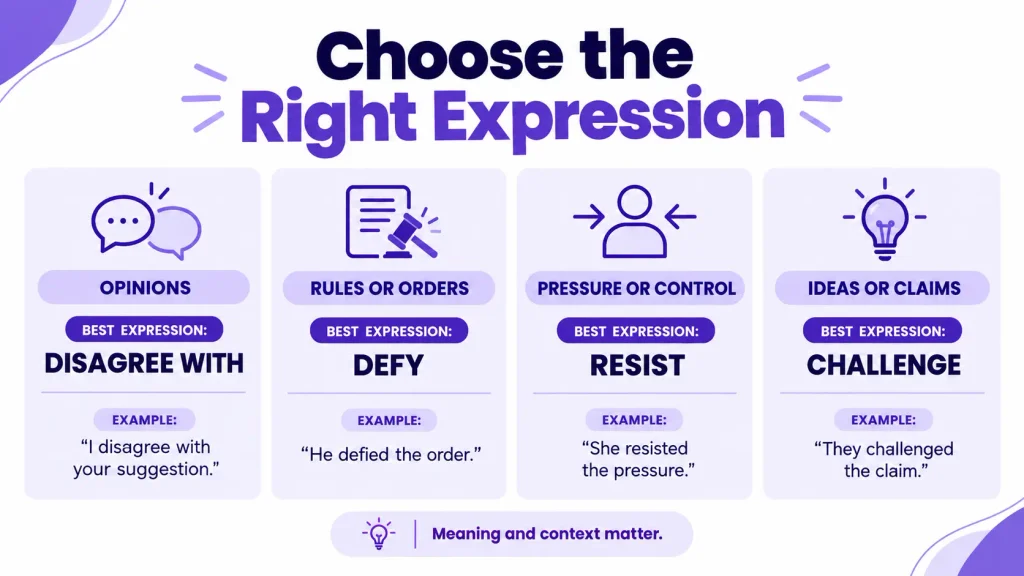
The best alternative depends on the meaning you want to express. Use this table to compare the most useful options.
| Alternative | Meaning | Tone | Best Context |
|---|---|---|---|
| Oppose | Actively disagree | Direct | Plans and decisions |
| Disagree with | Have a different opinion | Neutral | Conversations |
| Challenge | Question an idea | Constructive | Meetings and debates |
| Defy | Refuse to obey | Strong | Authority and rules |
| Resist | Refuse to give in | Firm | Pressure and demands |
| Contradict | Conflict with a statement | Neutral | Claims and evidence |
| Conflict with | Be inconsistent | Neutral | Goals and beliefs |
| Violate | Break a rule or right | Formal | Policies and agreements |
| Disobey | Fail to follow instructions | Direct | Orders and rules |
| Object to | Express disapproval | Polite to formal | Meetings and complaints |
| Speak out against | Express opposition openly | Assertive | Public concerns |
| Push back against | Resist a proposal | Conversational | Workplace discussions |
| Go against the grain | Differ from the norm | Idiomatic | Unusual choices |
| Run counter to | Conflict with a principle | Formal | Reports and analysis |
| Act against | Take opposing action | Direct | Actions and interests |
How to Use Go Against in Different Situations
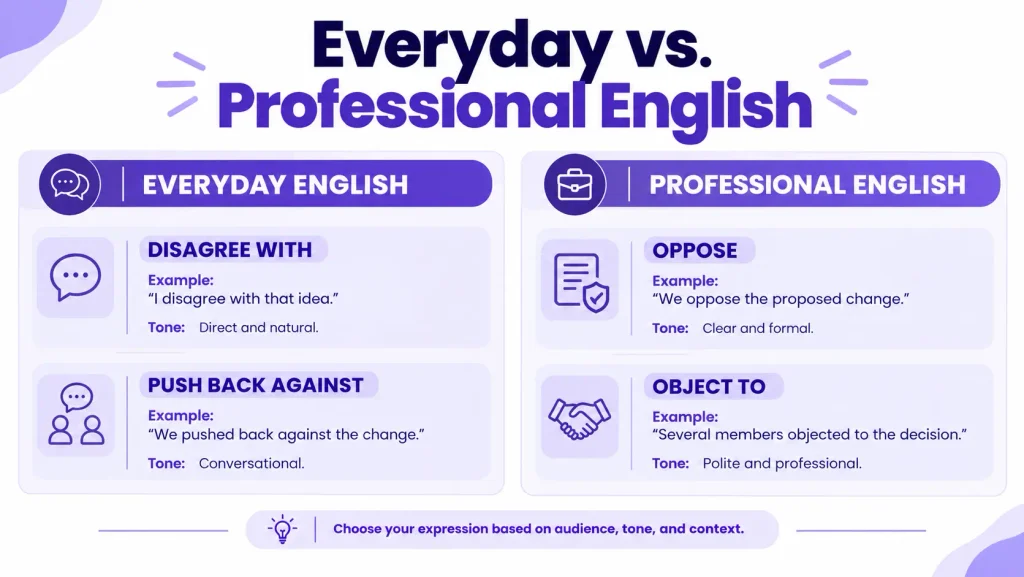
Choosing the right expression can make your writing clearer and your conversations more natural.
Everyday Conversations
Use disagree with, object to, or go against the grain when discussing opinions or personal choices.
- “I disagree with the way he handled the situation.”
- “She objected to the suggestion.”
- “He likes to go against the grain and do things his own way.”
For more examples of natural spoken English, explore our related guides.
Professional Communication
Use oppose, challenge, push back against, or conflict with when discussing work decisions.
- “I have some concerns about the proposal and would like to challenge a few assumptions.”
- “Our team pushed back against the proposed deadline.”
- “The suggested approach conflicts with our current business goals.”
These expressions help you communicate disagreement without sounding unnecessarily aggressive. You can also explore our guides on if those topics are available on your website.
Formal and Academic Writing
Use contradict, violate, or run counter to when the context supports their specific meanings.
- “The evidence contradicts the original claim.”
- “The policy violates established privacy requirements.”
- “The findings run counter to the initial hypothesis.”
Choose the word that describes the actual relationship between the ideas. A formal expression is not always a better choice if it changes the meaning.
Rules, Orders, and Instructions
Use disobey, defy, or violate when discussing rules or authority.
- “He disobeyed the supervisor’s instructions.”
- “The group defied the order to stop.”
- “The company violated the terms of the agreement.”
Disobey focuses on failing to follow instructions. Defy suggests open resistance, while violate emphasizes breaking a rule, right, or agreement.
Common Mistakes When Choosing an Alternative
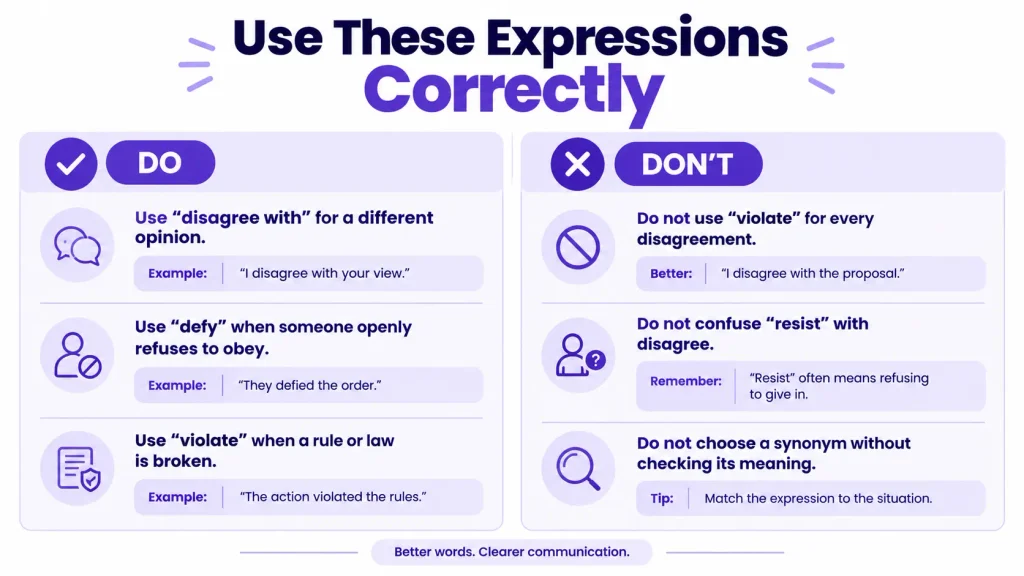
Using Contradict for Every Type of Opposition
Contradict usually describes a conflict between statements, claims, or evidence.
- Correct: “The report contradicts his explanation.”
- More natural for an opinion: “I disagree with his explanation.”
Using Violate for a Simple Disagreement
Violate suggests breaking a rule, right, or agreement.
- Correct: “The decision violates the contract.”
- Better for an opinion: “I oppose the decision.”
Confusing Defy With Disagree With
You can disagree with a rule and still follow it. If you openly refuse to obey, defy may be more accurate.
- “I disagree with the rule, but I’ll follow it.”
- “She defied the rule and entered the restricted area.”
Using Go Against the Grain for Every Conflict
The idiom go against the grain describes behavior that differs from what is normal or expected.
- Natural: “Working a four-day week goes against the grain in her industry.”
- Better for breaking a rule: “The employee violated the company’s policy.”
Frequently Asked Questions
What is the best synonym for go against?
Oppose is one of the closest alternatives when you mean to resist or disagree with something. For opinions, disagree with may sound more natural. For breaking a rule, violate or disobey may be more precise.
What is a professional way to say go against?
Use oppose, challenge, conflict with, or run counter to, depending on the situation.
For example, “The proposed timeline conflicts with our project requirements” sounds clear and professional.
What is another way to say go against someone’s wishes?
You can say act against someone’s wishes, disregard someone’s wishes, or go against someone’s wishes.
For example: “They proceeded with the plan despite her objections.”
Disregard suggests that someone failed to consider or respect what another person wanted.
What is another way to say go against the rules?
Common options include break the rules, violate the rules, disobey the rules, and defy the rules.
- Break the rules is common and conversational.
- Violate the rules is more formal.
- Disobey the rules focuses on not following them.
- Defy the rules suggests deliberate resistance.
What is the opposite of go against?
The opposite depends on the context. Common choices include support, agree with, follow, comply with, and align with.
For example, the opposite of “oppose the proposal” is “support the proposal.” The opposite of “disobey the rules” is “follow the rules.”
Is go against formal or informal?
Go against is a neutral phrasal verb that works in everyday conversations and many forms of professional writing. You do not need to replace it just to sound formal. Choose another expression when it communicates your meaning more precisely.
Final Thoughts
The best alternative to go against depends on the kind of disagreement or conflict you want to describe. Choose oppose for a decision, disagree with for an opinion, defy for refusing to obey, and violate for breaking a rule. In formal writing, run counter to can describe a conflict with a principle or goal.
The goal is not to use the most complex word. It is to choose the expression that communicates your meaning clearly and naturally.

The Republics Press Editorial Team researches, writes and reviews every article on this site, checks facts against reliable sources and updates pages when readers point out errors.