
Another Way to Say You: 12 Natural Alternatives and Examples
Looking for another way to say you? The best alternative depends on your sentence, audience, and tone. You can use a person’s name, a professional title, “the reader,” or “everyone” in the right context. These 12 alternatives will help you choose natural expressions for everyday conversations, professional writing, and formal communication.
12 Alternatives to “You”

The word “you” is used to address one person or a group directly. Sometimes, changing the sentence structure or naming the person you’re talking about can make your writing clearer. However, not every alternative works in every situation.
1. A Person’s Name
Using someone’s name makes a message feel personal and direct. It works well when speaking to someone you know or addressing a person in a written message.
Example:
- Original: You did a great job on the presentation.
- Alternative: Sarah, you did a great job on the presentation.
Best for: Personal conversations, friendly messages, and direct communication.
Tip: A name can replace “you” as a form of address, but it usually cannot replace the pronoun throughout a sentence.
2. A Professional Title
A professional title can make an address more respectful or formal. Examples include Mr. Johnson, Dr. Lee, and Professor Davis.
Example:
- Original: You can review the report.
- Alternative: Dr. Lee, could you review the report?
Best for: Formal emails, academic settings, and professional conversations.
Tip: Use titles when appropriate for the person and situation. A title does not automatically make every sentence more professional.
3. The Reader
“The reader” is useful when writing articles, tutorials, and educational resources. It shifts the focus from directly addressing someone to discussing the person reading the material.
Example:
- Original: You will learn how to improve your writing.
- Alternative: The reader will learn how to improve their writing.
Best for: Blog posts, educational articles, and instructional content.
Tip: Directly addressing readers with “you” is also natural in American English. Replace it only when the change improves the sentence.
4. The Audience
“The audience” refers to the people listening to a speech, watching a presentation, or receiving a message.
Example:
- Original: You will understand the main points.
- Alternative: The audience will understand the main points.
Best for: Presentations, speeches, webinars, and public communication.
Tip: Use “the audience” when referring to a group rather than an individual.
5. Everyone
“Everyone” is a natural choice when a message applies to all members of a group.
Example:
- Original: You should arrive by 9 a.m.
- Alternative: Everyone should arrive by 9 a.m.
Best for: Group announcements, meeting instructions, and general reminders.
Tip: “Everyone” is grammatically singular in standard usage, so it normally takes a singular verb: “Everyone is ready.”
6. All of You
“All of you” emphasizes every person in a group. It is particularly useful when recognizing a team’s effort or addressing several people directly.
Example:
- Original: You have worked hard on this project.
- Alternative: All of you have worked hard on this project.
Best for: Team messages, group discussions, and speeches.
Tip: Unlike “everyone,” this expression directly addresses the people in the group.
7. Each Person
“Each person” highlights individuals separately rather than treating a group as a whole.
Example:
- Original: You must submit your own application.
- Alternative: Each person must submit their own application.
Best for: Instructions, workplace policies, and formal guidelines.
Tip: This wording is useful when a requirement applies individually to every member of a group.
8. The Individual
“The individual” is a formal expression for a particular person. It can work in reports, policies, and discussions where an impersonal tone is appropriate.
Example:
- Original: You are responsible for the decision.
- Alternative: The individual is responsible for the decision.
Best for: Formal reports, administrative documents, and policy writing.
Tip: This phrase can sound distant in everyday conversation. Use a person’s name or a direct pronoun when a warmer tone is more suitable.
9. The User
“The user” refers to someone who interacts with a website, application, software program, or digital service.
Example:
- Original: You can update your account settings.
- Alternative: The user can update their account settings.
Best for: Technical documentation, software instructions, and product guides.
Tip: Keep the wording consistent throughout a technical document. If the guide speaks directly to readers, “you” may be clearer than “the user.”
10. Yourself
“Yourself” is a reflexive or emphatic pronoun. It can emphasize that someone performs an action independently or without another person’s help.
Example:
- Original: You can complete the task.
- Alternative: You can complete the task yourself.
Best for: Emphasis, reassurance, and explaining independent action.
Tip: “Yourself” is not a direct replacement for “you” in every sentence. Use it only when the grammar and meaning support it.
11. One
“One” is a formal pronoun used to make general statements about people or situations.
Example:
- Original: You should check your work before submitting it.
- Alternative: One should check one’s work before submitting it.
Best for: Formal essays, philosophical discussions, and generalized statements.
Tip: Repeated use of “one” can sound stiff in American English. For most everyday writing, a more direct sentence is easier to read.
12. People
“People” is useful when changing a sentence from direct address to a general statement about human behavior or experience.
Example:
- Original: You need regular practice to improve your writing.
- Alternative: People need regular practice to improve their writing.
Best for: General advice, educational content, and informational writing.
Tip: “People” refers to people in general, not necessarily the person you’re speaking to. Check that the revised sentence preserves your intended meaning.
How to Choose the Best Alternative to “You”
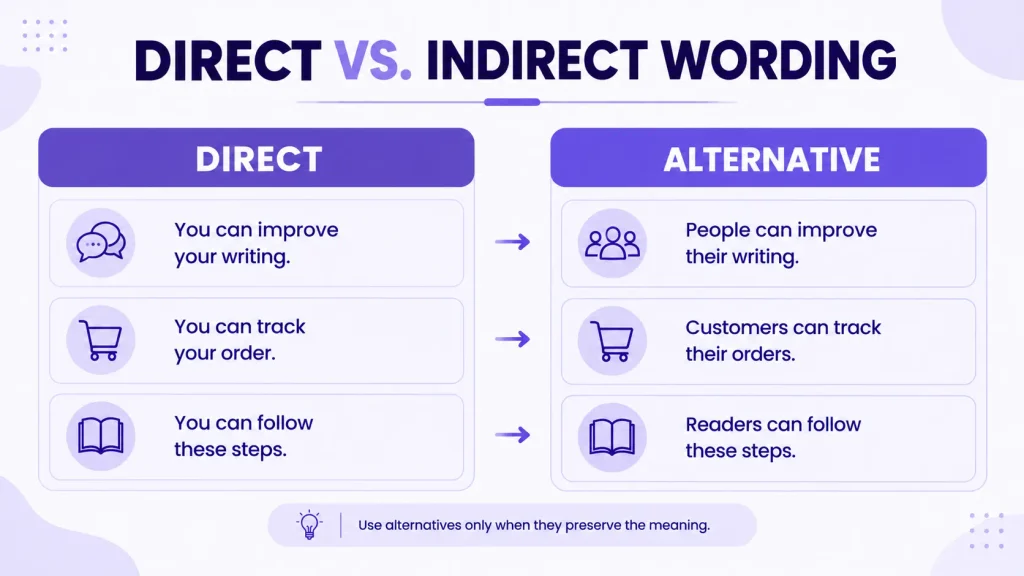
The best replacement depends on whom you’re addressing and why you’re writing. Before changing the word, consider whether you are speaking to an individual, addressing a group, or making a general statement.
- For a personal message: Use the person’s name when it sounds natural.
- For professional communication: Use an appropriate title or the person’s name.
- For a blog article: Use “the reader” when it improves clarity, or keep “you” for a direct and friendly tone.
- For a group announcement: Use “everyone” or “all of you,” depending on whether you are referring to or directly addressing the group.
- For technical documentation: Use “the user” when describing how software works.
- For formal writing: Consider “one” or “the individual” when an impersonal tone is appropriate.
Remember that rewriting the whole sentence is often better than replacing a single word. The goal is to communicate clearly, not to avoid “you” at all costs.
Common Mistakes When Replacing “You”
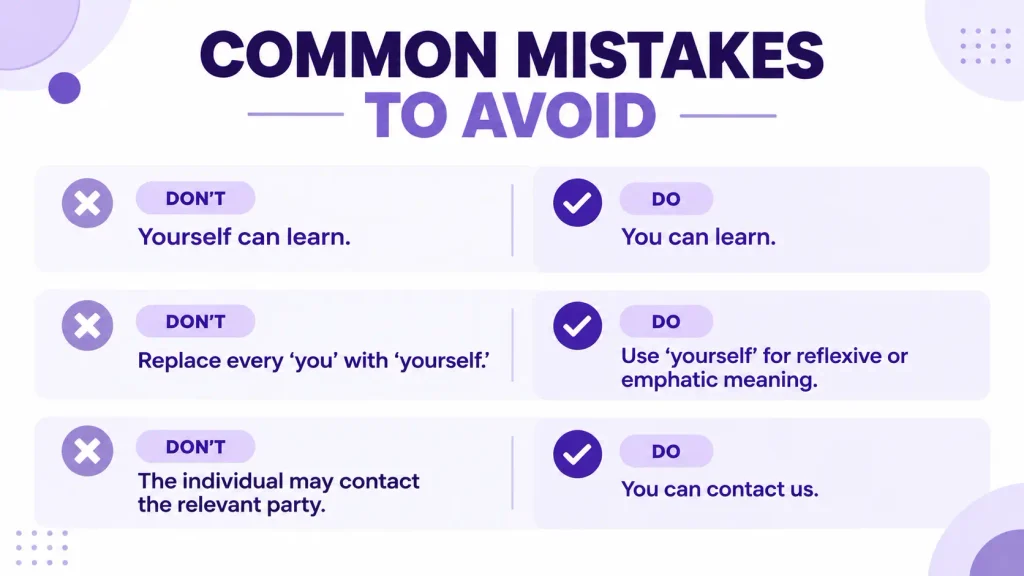
Treating Every Alternative as a Direct Synonym
“The reader,” “everyone,” and “yourself” have different grammatical roles. Choose an expression that fits the sentence rather than swapping words without checking the meaning.
Making Simple Writing Too Formal
Phrases such as “the individual” and “one” can sound unnatural in casual messages. Use plain, direct language when it suits your audience.
Changing the Meaning of a Sentence
“You should submit your form” addresses the person reading the instruction. “People should submit their forms” makes a broader statement. The two sentences do not always communicate the same thing.
Removing Direct Address Unnecessarily
Using “you” is not a writing mistake. In many blog posts, tutorials, and instructions, it helps readers understand what to do. Change it only when another expression is more accurate or appropriate.
Frequently Asked Questions
What is another way to say you?
Depending on the context, alternatives include a person’s name, a professional title, “the reader,” “the audience,” “everyone,” “all of you,” “each person,” “the individual,” “the user,” “yourself,” “one,” and “people.”
What is a professional alternative to “you”?
A person’s name or appropriate title works well when addressing someone directly. In formal documentation, “the individual” or “the user” may be appropriate, depending on the subject.
How can I avoid using “you” in an essay?
Rewrite sentences to focus on the subject, action, or general idea. For example, change “You can improve your writing through practice” to “Regular practice can improve writing skills.”
Is “yourself” another word for “you”?
No. “Yourself” is a reflexive or emphatic pronoun. It is appropriate in sentences such as “You can complete the task yourself,” but it cannot replace “you” in every grammatical construction.
Can I use “one” instead of “you”?
Yes, when making a general statement. However, “one” sounds more formal than “you” in most everyday American English conversations.
What is another way to say “you” when addressing a group?
“All of you” directly addresses a group, while “everyone” refers to all members of that group. Choose the phrase that best fits your sentence.
Should I remove “you” from professional writing?
No. Direct address can make professional writing clear and approachable. Replace “you” only when a name, title, role, or revised sentence communicates the intended message more effectively.
Conclusion
Choosing another way to say you depends on the audience, context, and meaning of your sentence. A person’s name works for direct communication, “the reader” suits some educational content, and “everyone” is useful for group announcements. Use each alternative carefully, and remember that clear, natural writing matters more than avoiding a common pronoun.
For more vocabulary and writing guidance, explore related articles on natural English expressions, word choice, and professional communication.

The Republics Press Editorial Team researches, writes and reviews every article on this site, checks facts against reliable sources and updates pages when readers point out errors.