Another Way to Say “As a Whole”: 10 Useful Alternatives
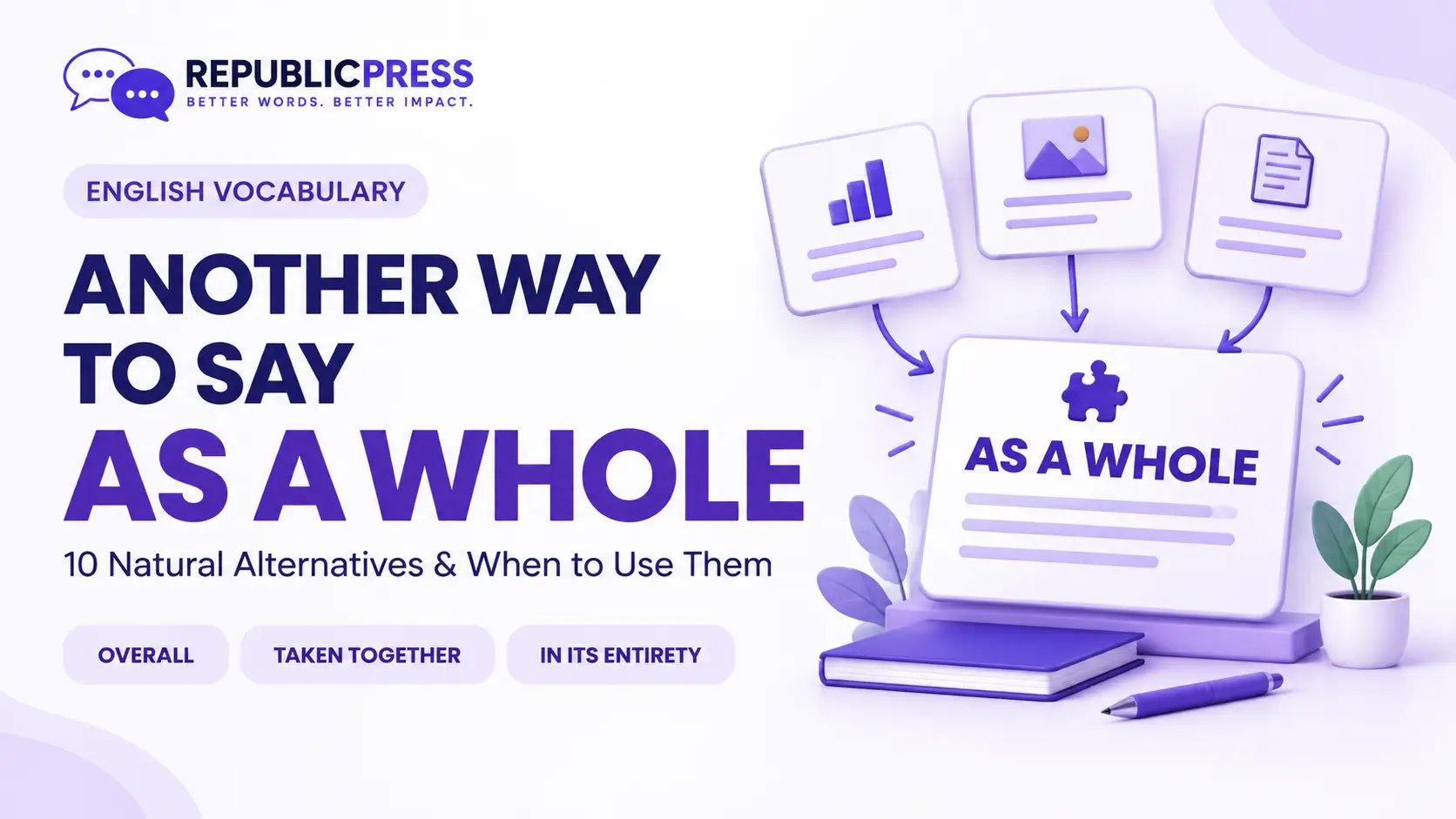
The best alternatives to “as a whole” include overall, on the whole, in its entirety, taken together, collectively, and as a complete picture. These expressions help you describe something in its entirety rather than focusing on separate parts. The right choice depends on your sentence, tone, and intended meaning.
Key Takeaways
- Overall is a natural, concise choice for general summaries and evaluations.
- On the whole works well when giving an overall opinion or judgment.
- In its entirety emphasizes something complete, without leaving anything out.
- Taken together highlights how several parts or facts contribute to one conclusion.
- Collectively emphasizes a group acting or being considered as one.
- Some alternatives have specific meanings, so choose one that fits your context.
What Does “As a Whole” Mean?
The phrase “as a whole” means considering something in its entirety instead of examining only its individual parts. It can describe a group, an object, a situation, a process, or a general result.
For example, “The project was successful as a whole” means the project was successful when considered overall, even if some individual parts had problems.
People often use this expression in everyday conversations, workplace discussions, academic writing, and evaluations. However, a shorter or more specific alternative can make a sentence clearer.
10 Other Ways to Say “As a Whole”
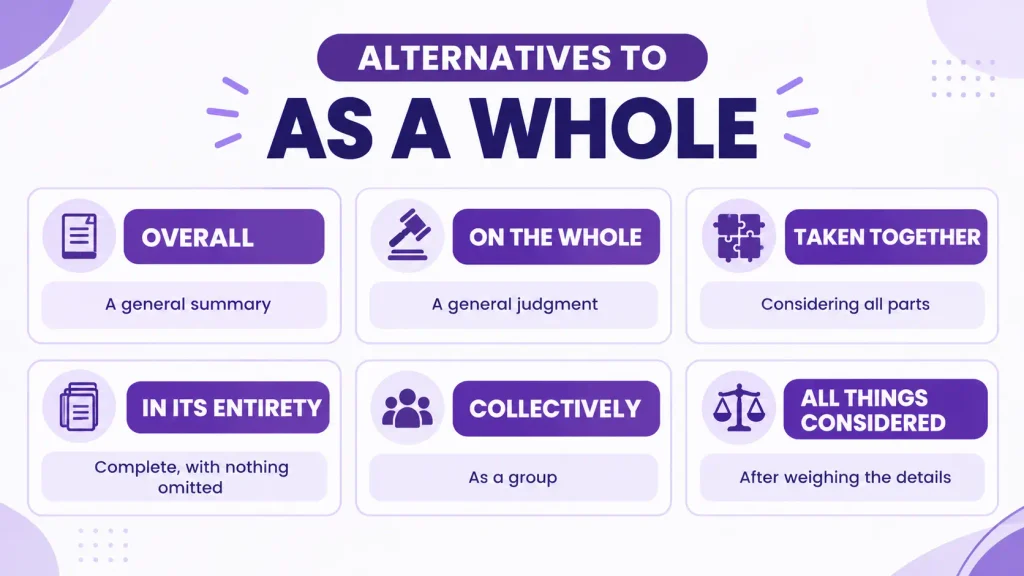
1. Overall
Meaning: Considering all the important parts or factors together.
“Overall” is one of the most natural and versatile alternatives. It works in casual conversations, professional reports, reviews, and academic discussions.
Example: Overall, the team delivered a successful project despite a few delays.
Best for: General summaries, evaluations, and conclusions.
2. On the Whole
Meaning: Considering everything together, especially when giving a general opinion or judgment.
“On the whole” is a natural expression that often introduces a balanced assessment. It allows you to acknowledge that some details may be exceptions to the general result.
Example: On the whole, the new teaching method has improved student participation.
Best for: Opinions, reviews, and balanced assessments.
3. In Its Entirety
Meaning: Including every part of something, without leaving anything out.
Use “in its entirety” when completeness matters. It is particularly useful for documents, agreements, reports, recordings, and other things that can be considered complete units.
Example: Please read the contract in its entirety before signing it.
Best for: Formal instructions, documents, and complete objects or works.
4. Taken Together
Meaning: Considered jointly to understand the combined meaning or effect of several things.
“Taken together” is especially useful when separate facts, results, or observations support one broader conclusion.
Example: Taken together, the survey responses suggest that customers prefer the new design.
Best for: Research, data analysis, reports, and explanations.
5. Collectively
Meaning: Considered as a group or combined unit.
“Collectively” emphasizes the group rather than its individual members. It can also describe people or organizations acting jointly.
Example: The departments collectively contributed to the company’s annual goals.
Best for: Teamwork, organizations, group achievements, and shared responsibilities.
6. In Total
Meaning: The complete amount or number after adding everything together.
“In total” is a good choice when you are talking about quantities, costs, hours, or numbers. It is not a perfect substitute for “as a whole” in every sentence.
Example: The three departments spent $15,000 in total.
Best for: Financial reports, totals, budgets, and numerical summaries.
7. As a Complete Picture
Meaning: Considering the available information together to understand the broader situation.
This expression is useful when separate details may not explain the situation on their own. It emphasizes the overall understanding gained from combining those details.
Example: Individual test results are useful, but the doctor needs the complete picture to assess the situation.
Best for: Explanations, decision-making, and discussions involving several factors.
8. In the Aggregate
Meaning: Considered collectively, especially when combining multiple amounts, results, or factors.
“In the aggregate” is a more formal expression commonly used in economics, statistics, finance, and technical writing. It can sound unnecessarily formal in everyday conversation.
Example: In the aggregate, the small savings produced a substantial reduction in annual costs.
Best for: Statistical analysis, financial reporting, and formal technical discussions.
9. Viewed as a Whole
Meaning: Considered in its entirety rather than judged by separate components.
This phrase is particularly useful when explaining how the overall meaning, quality, or effect of something differs from the qualities of its individual parts.
Example: Viewed as a whole, the presentation communicates the company’s main message clearly.
Best for: Evaluations, academic writing, design reviews, and critical analysis.
10. All Things Considered
Meaning: Taking all relevant facts, advantages, disadvantages, and circumstances into account.
This expression is not an exact synonym for “as a whole.” It emphasizes reaching a judgment after considering different factors rather than simply looking at something in its entirety.
Example: All things considered, the move was the right decision for the family.
Best for: Final judgments, decisions, recommendations, and balanced conclusions.
Comparison Table: Which Alternative Should You Choose?
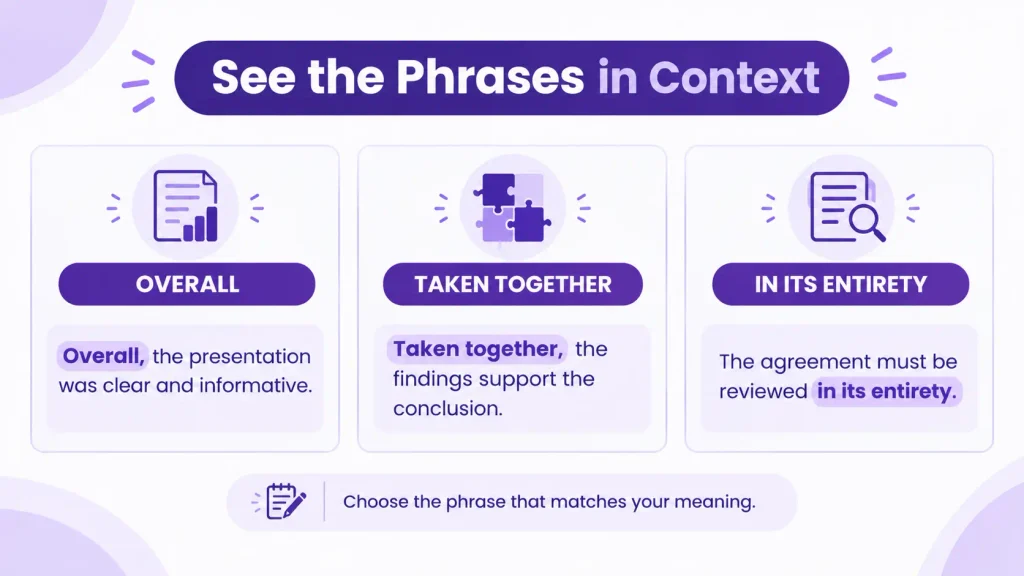
| Alternative | Main Meaning | Tone | Best Context |
|---|---|---|---|
| Overall | General result or view | Neutral | Summaries and reviews |
| On the whole | General judgment | Neutral | Opinions and assessments |
| In its entirety | Every part included | Formal | Documents and complete works |
| Taken together | Parts considered jointly | Neutral/formal | Research and analysis |
| Collectively | A group as one unit | Neutral/formal | Teams and organizations |
| In total | Complete numerical amount | Neutral | Budgets and calculations |
| As a complete picture | Broader understanding | Neutral | Explanations and decisions |
| In the aggregate | Combined amount or effect | Formal/technical | Statistics and finance |
| Viewed as a whole | Entire subject considered | Formal | Evaluation and analysis |
| All things considered | Judgment after weighing factors | Neutral | Decisions and conclusions |
How to Choose the Right Alternative
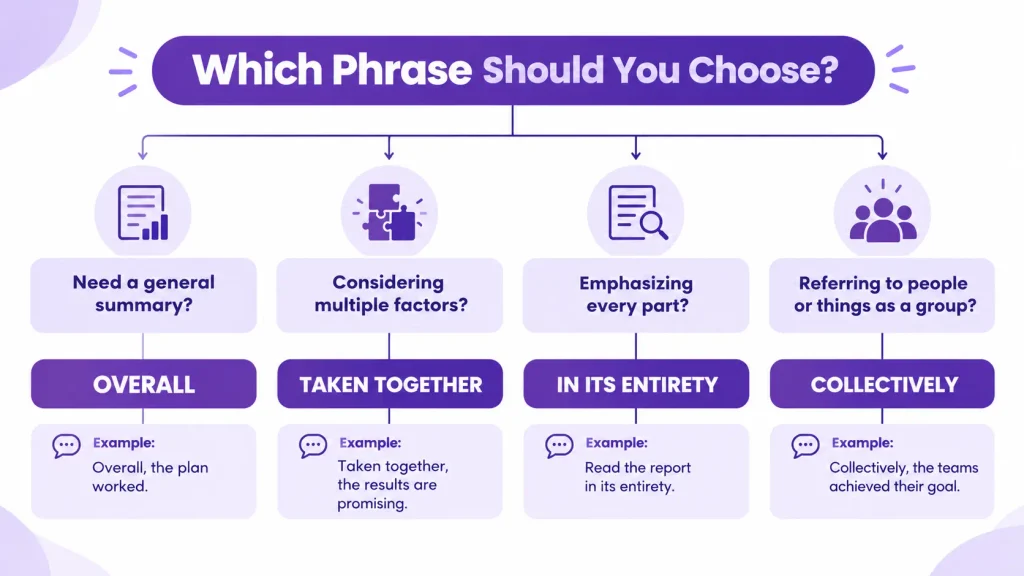
The most suitable replacement depends on what you want to emphasize.
For Everyday Conversations
Choose “overall” or “on the whole” when giving a general opinion.
- Original: The event was enjoyable as a whole.
- Alternative: Overall, the event was enjoyable.
For Professional Writing
Use “overall” for concise summaries and “taken together” when discussing several findings.
- Original: The results were positive as a whole.
- Alternative: Taken together, the results indicate positive progress.
For Academic Writing
Choose “viewed as a whole” when evaluating a subject and “in the aggregate” when discussing combined data or effects.
- Original: The findings should be evaluated as a whole.
- Alternative: The findings should be evaluated collectively.
The second version is suitable when the focus is on the findings considered together, although “viewed as a whole” may preserve the original emphasis more precisely.
For Documents and Complete Works
Use “in its entirety” when you want to stress that every part must be included.
- Original: The report should be reviewed as a whole.
- Alternative: The report should be reviewed in its entirety.
Common Mistakes to Avoid
1. Using “in total” for every situation
“In total” usually refers to a sum or final amount. It may not express the overall quality or meaning of something.
2. Confusing “all things considered” with “in its entirety”
The first emphasizes a judgment based on relevant factors. The second emphasizes completeness.
3. Using overly formal expressions in casual conversations
“In the aggregate” may be appropriate in a financial report, but “overall” is usually more natural in everyday speech.
4. Ignoring the original sentence’s meaning
Not every alternative works in every context. Check whether you are discussing completeness, a general evaluation, a combined result, or a final decision.
Frequently Asked Questions
What is the most common alternative to “as a whole”?
“Overall” is one of the most common and versatile alternatives. It works well when summarizing a situation, evaluating a result, or describing a general impression.
Is “on the whole” the same as “as a whole”?
They are similar but not always interchangeable. “On the whole” commonly introduces a general judgment, while “as a whole” emphasizes considering something in its entirety.
What is a formal way to say “as a whole”?
“In its entirety,” “viewed as a whole,” and “in the aggregate” are formal alternatives. Choose “in its entirety” when completeness matters and “in the aggregate” when discussing combined amounts or effects.
What can I use instead of “as a whole” in an essay?
“Overall,” “taken together,” and “viewed as a whole” can work well in essays. Use “taken together” when several facts support a conclusion and “viewed as a whole” when evaluating an entire subject.
Can I use “collectively” instead of “as a whole”?
Yes, when the sentence focuses on a group or multiple items considered jointly. However, “collectively” may imply group action or a combined contribution, which is not always the intended meaning.
Is “all things considered” a synonym for “as a whole”?
Not exactly. “All things considered” means reaching a conclusion after weighing relevant circumstances. “As a whole” means considering something in its entirety.
How do I replace “as a whole” in a sentence?
Identify the intended meaning first. Use “overall” for a general assessment, “in its entirety” for completeness, “taken together” for combined evidence, or “collectively” for a group.
Conclusion
The best alternative to “as a whole” depends on your intended meaning. “Overall” is a reliable choice for general statements, “in its entirety” emphasizes completeness, and “taken together” works well when several parts contribute to one conclusion. Choose the expression that fits your sentence naturally rather than replacing the original phrase with a synonym that changes its meaning.

The Republics Press Editorial Team researches, writes and reviews every article on this site, checks facts against reliable sources and updates pages when readers point out errors.