
Another Way to Say “To Be Determined”: 10 Natural Alternatives
If you need another way to say “to be determined,” you can choose from phrases such as not yet decided, not yet determined, undecided, pending, to be decided, not yet finalized, awaiting confirmation, awaiting a decision, TBD, and still open. The best choice depends on whether you need to describe an unfinished decision, an upcoming confirmation, or an unresolved detail.
Key Takeaways
- “To be determined” means that someone has not settled a detail or decision yet.
- “Not yet decided” works well for choices, plans, and arrangements.
- “Pending” works best when something awaits approval, review, or action.
- “Not yet finalized” fits plans, schedules, and arrangements that still need changes.
- “Awaiting confirmation” tells readers that someone still needs to confirm a detail.
- “TBD” offers a short option for schedules, forms, and planning documents.
What Does “To Be Determined” Mean?
“To be determined” means that people have not decided, established, or confirmed something yet.
For example:
The meeting date is to be determined.
This sentence tells readers that nobody has chosen the final meeting date yet.
People commonly use the phrase in schedules, announcements, planning documents, forms, and professional communication. It sounds neutral and somewhat formal.
However, you can often choose a more specific phrase. The right alternative depends on what remains unknown and why.
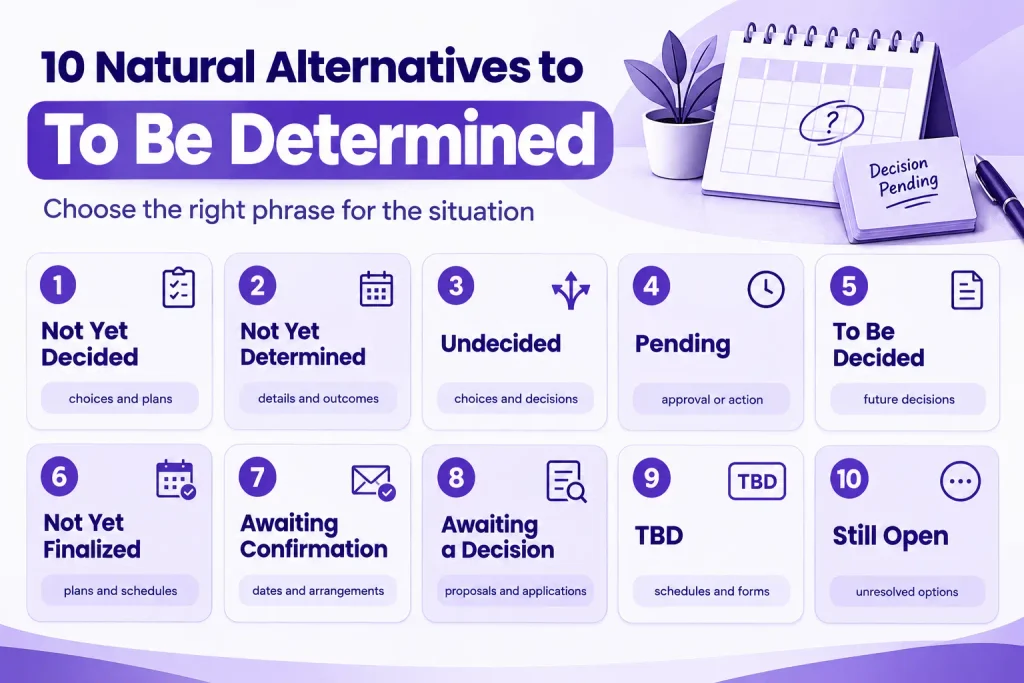
10 Natural Alternatives to “To Be Determined”
1. Not Yet Decided
“Not yet decided” gives readers a simple and direct way to say that nobody has made a decision.
Example:
The committee has not yet decided where to hold the event.
Best for: Decisions, locations, dates, plans, and arrangements.
Use this option when the main issue involves a choice that someone still needs to make.
2. Not Yet Determined
“Not yet determined” closely matches the meaning of “to be determined.” It tells readers that someone has not established a final detail or outcome.
Example:
We have not yet determined the final cost.
Best for: Costs, results, requirements, dates, and other details.
Therefore, this phrase works well when you want a professional alternative without changing the original meaning very much.
3. Undecided
“Undecided” describes a choice or decision that someone has not settled yet.
Example:
The committee remains undecided about the proposal.
Best for: Choices, decisions, opinions, and plans.
However, use “undecided” carefully. It usually describes a person, group, or decision rather than a simple piece of information.
4. Pending
“Pending” means that something still awaits an action, review, approval, or decision.
Example:
The application remains pending approval.
Best for: Applications, approvals, requests, decisions, and official processes.
In this case, “pending” gives readers more information than “to be determined.” It suggests that someone or something still needs to take the next step.
5. To Be Decided
“To be decided” works well when people still need to make a decision.
Example:
The final location is to be decided after the meeting.
Best for: Plans, choices, policies, competitions, and future decisions.
Use this phrase when the decision itself remains unfinished.
6. Not Yet Finalized
“Not yet finalized” works well when someone has created a preliminary plan but still needs to make changes.
Example:
The conference schedule is not yet finalized.
Best for: Schedules, plans, agreements, documents, and arrangements.
For example, a team might already have a draft schedule but still need to change several details before publishing it.
7. Awaiting Confirmation
“Awaiting confirmation” means that someone still needs to confirm a detail.
Example:
Your interview date is awaiting confirmation.
Best for: Appointments, schedules, reservations, applications, and professional communication.
Unlike “to be determined,” this phrase clearly tells the reader that confirmation represents the next step.
8. Awaiting a Decision
“Awaiting a decision” tells readers that a person or organization needs to make a final choice.
Example:
The proposal is awaiting a decision from the board.
Best for: Applications, proposals, workplace decisions, and administrative matters.
This phrase works especially well when you know who needs to make the decision.
9. TBD
“TBD” stands for “to be determined.” People often use this abbreviation when they need a short label.
Example:
Location: TBD
Date: TBD
Best for: Calendars, schedules, event details, forms, and planning documents.
For formal prose, however, a complete phrase usually reads better. Use “TBD” when space or convenience matters more than formality.
10. Still Open
“Still open” can describe a decision, possibility, or issue that people have not settled yet.
Example:
The question of who will lead the project is still open.
Best for: Decisions, possibilities, negotiations, and unresolved issues.
This option sounds more conversational than “to be determined.” It can also suggest that several possibilities remain available.
Which Alternative Should You Use?
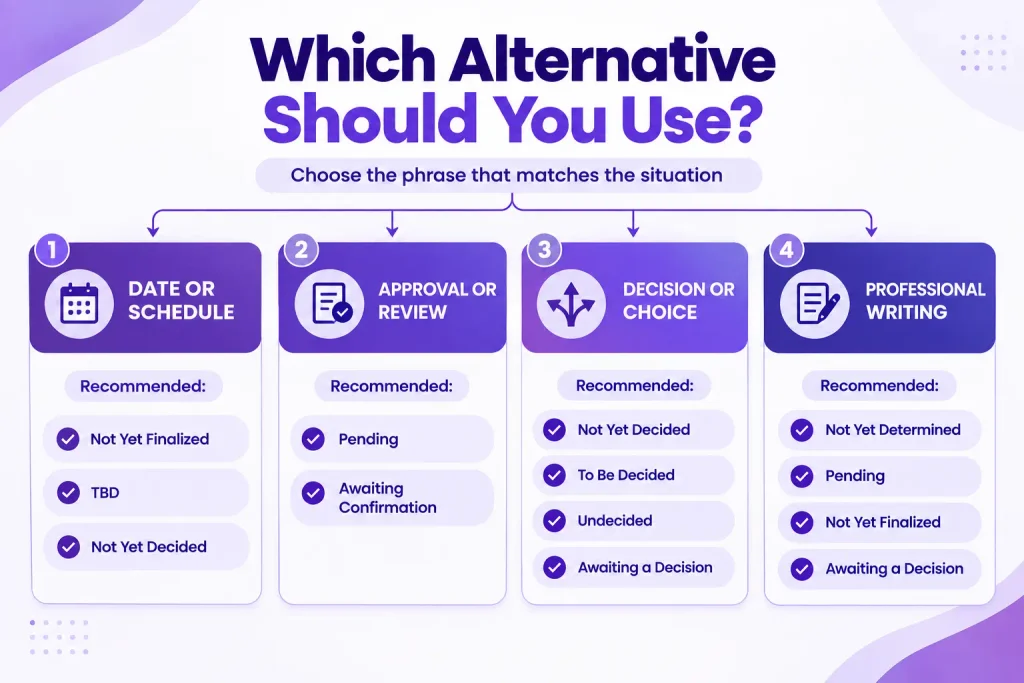
The best choice depends on what remains undecided.
For a Date or Schedule
Choose:
- Not yet finalized
- Not yet decided
- TBD
For example:
The launch date is not yet finalized.
Here, “not yet finalized” works particularly well because the team may already have a tentative date.
For an Approval
Choose:
- Pending
- Awaiting confirmation
For example:
Your application is pending approval.
In this situation, “pending” sounds more precise because the application needs someone else’s approval.
For a Decision
Choose:
- Not yet decided
- To be decided
- Awaiting a decision
- Undecided
For example:
The committee is still undecided.
These options work because the central issue involves a choice.
For Professional Writing
Choose:
- Not yet determined
- Pending
- Not yet finalized
- Awaiting a decision
These phrases generally sound more polished than “TBD” in formal reports, business documents, and professional correspondence.
For Schedules and Planning Documents
Use TBD when you need a short and familiar label.
For example:
Speaker: TBD
Location: TBD
Start Time: TBD
This format keeps the schedule clean and easy to scan.
“To Be Determined” vs. “To Be Decided”
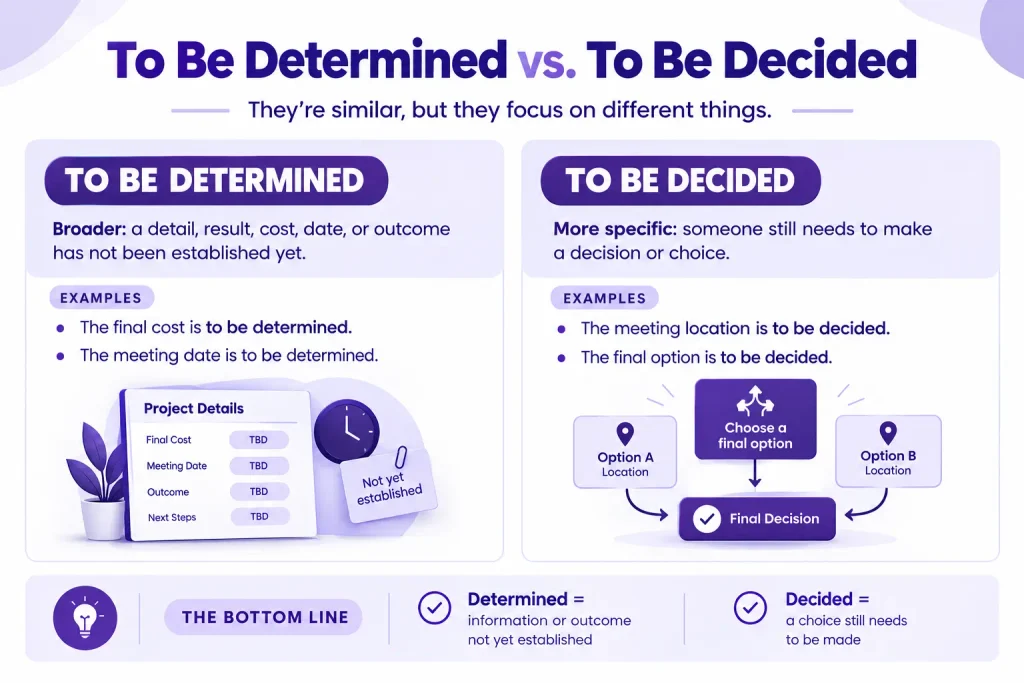
These phrases share a similar meaning, but they focus on slightly different ideas.
“To be decided” focuses specifically on a decision that someone still needs to make.
The team will decide the meeting location tomorrow.
You could also write:
The meeting location is to be decided.
On the other hand, “to be determined” covers a wider range of situations. People can use it for information that they still need to establish, calculate, confirm, or decide.
For example:
The final cost is to be determined.
The key difference is simple: “to be decided” focuses on making a choice, while “to be determined” can describe any detail that remains unsettled.
Common Mistakes to Avoid
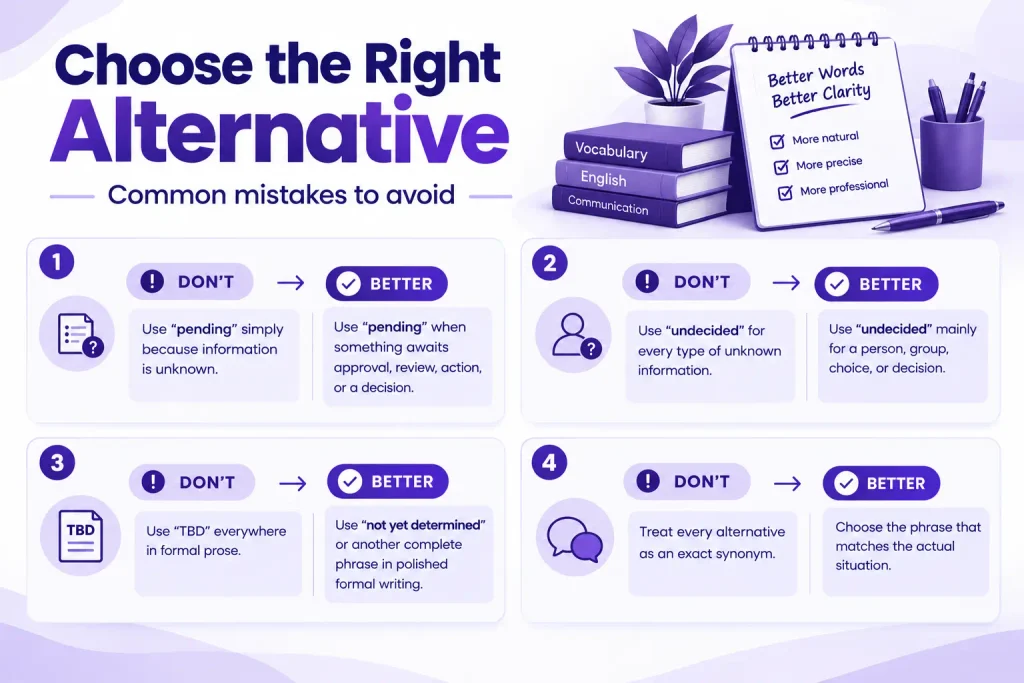
1. Treating Every Alternative as an Exact Synonym
Not every phrase carries exactly the same meaning.
For example, “pending” suggests that something awaits an action or decision. Meanwhile, “not yet determined” simply tells readers that someone has not established the final information.
Choose the phrase that matches the actual situation.
2. Using “TBD” in Every Situation
“TBD” works well in schedules and planning documents. However, formal prose often sounds better with a complete phrase.
Instead of:
The final recommendation is TBD.
Write:
We have not yet determined the final recommendation.
3. Using “Undecided” for Every Type of Information
“Undecided” usually works with a choice or decision.
For example:
The committee remains undecided.
For a number or factual detail, use “not yet determined” instead.
We have not yet determined the final price.
4. Confusing “Pending” With “Unknown”
“Pending” usually means that something awaits an action, review, approval, or decision.
For example:
Your application is pending approval.
Simply saying that something remains unknown does not always justify using “pending.”
FAQ
What is another professional way to say “to be determined”?
“Not yet determined,” “pending,” “not yet finalized,” and “awaiting a decision” can all work in professional writing. Choose the phrase that best explains what still needs to happen.
What is a shorter way to say “to be determined”?
TBD is the standard abbreviation. People commonly use it in schedules, calendars, forms, and planning documents.
Is “to be decided” the same as “to be determined”?
Not exactly. “To be decided” specifically refers to a decision that someone still needs to make. “To be determined” has a broader meaning and can refer to information, results, costs, dates, or other unresolved details.
Can I use “pending” instead of “to be determined”?
Sometimes. Use “pending” when something awaits an approval, review, action, or decision. Don’t use it simply because you don’t know a piece of information.
What is the best alternative for “to be determined” in a schedule?
“TBD,” “not yet finalized,” and “not yet decided” can all work. For a compact schedule, TBD usually makes the clearest short label.
What is the best alternative in formal writing?
“Not yet determined” provides a neutral and professional option in many formal contexts.
What does TBD mean?
TBD means “to be determined.” It tells readers that someone has not established or decided a particular detail yet.
Final Thoughts
“To be determined” works in many situations, but a more specific phrase can make your writing clearer. Use “not yet decided” when someone still needs to make a choice. Choose “not yet determined” for an unresolved detail or outcome. Use “pending” when something awaits action or approval, and choose “not yet finalized” when a plan still needs changes. For schedules and planning documents, TBD offers the simplest option.

Role: Language Editor
Caleb Mercer is a Language Editor at RepublicsPress, focusing on grammar, sentence structure, professional writing, and English usage. He helps ensure that language guides are clear, accurate, natural, and easy to follow.