Another Way to Say Based Off Of: 15 Natural Alternatives
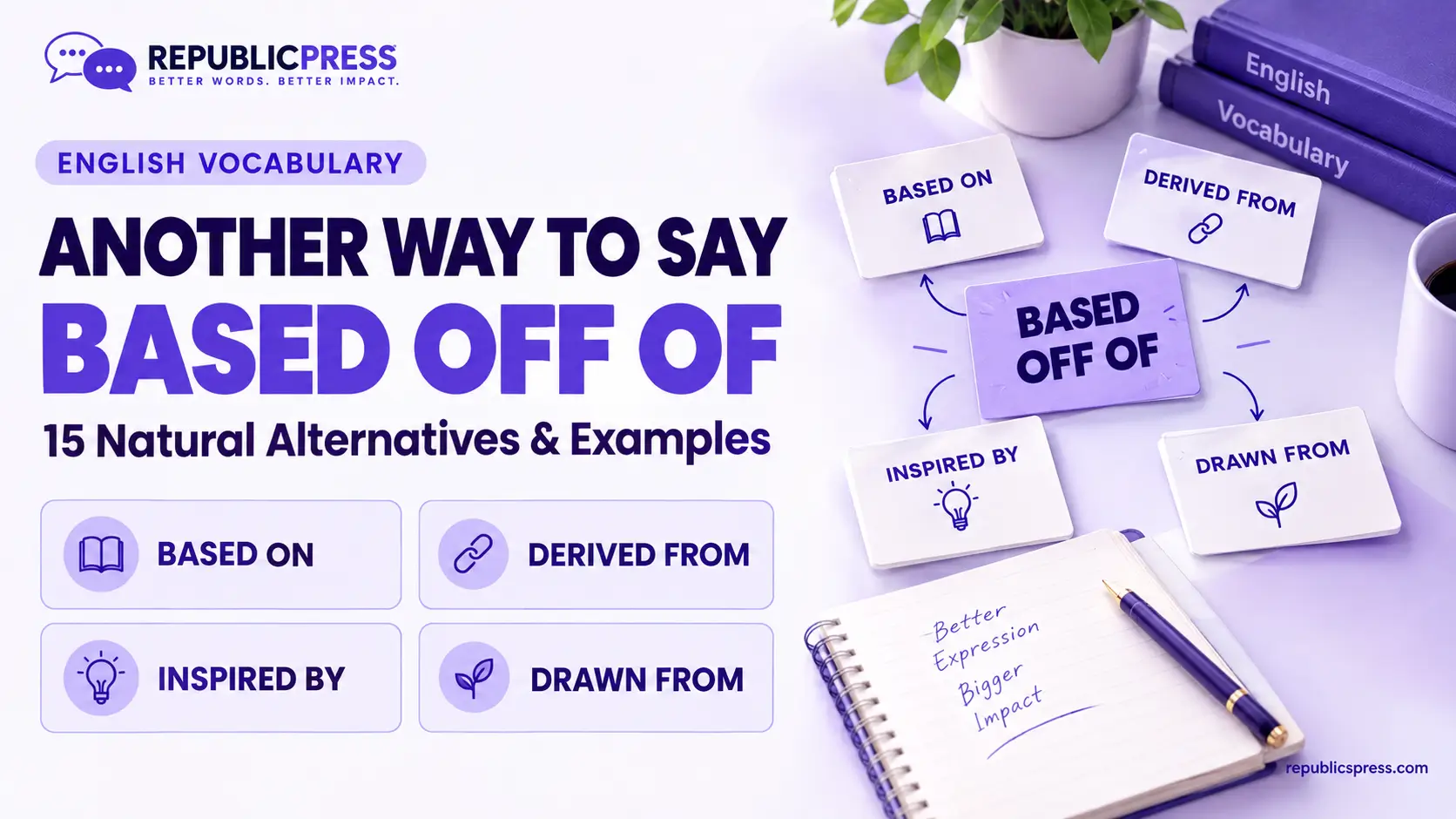
If you’re looking for another way to say based off of, the best choice is usually based on. Other alternatives include derived from, inspired by, grounded in, and modeled after. Each phrase expresses a slightly different relationship between an idea and its source, so the right replacement depends on your sentence and intended meaning.
Key Takeaways
- Based on is the safest general-purpose alternative to “based off of.”
- Derived from emphasizes where something originated.
- Inspired by describes an influence, especially in creative work.
- Grounded in highlights facts, evidence, or established principles.
- Adapted from means something has been changed from its original form.
- For formal, academic, and professional writing, “based on” is generally the preferred choice.
What Does “Based Off Of” Mean?
“Based off of” means that something is developed, created, or influenced by an existing idea, source, example, or set of facts. It is common in conversational American English, although some readers consider it less formal than “based on.”
For example:
- Informal: The movie is based off of a true story.
- Preferred in formal writing: The movie is based on a true story.
The alternatives below help you choose wording that fits your meaning instead of relying on the same expression in every situation.
15 Alternatives to “Based Off Of”

1. Based On
Best for: Everyday, professional, and academic writing
“Based on” is the closest and most versatile replacement. It indicates that something relies on a source, fact, example, or set of information.
Example: Our final decision was based on customer feedback.
Use this expression in reports, emails, essays, presentations, and everyday conversations. When you aren’t sure which alternative fits, start with “based on.”
2. Based Upon
Best for: Formal writing
“Based upon” has essentially the same meaning as “based on.” It can sound slightly more formal, but the two expressions are usually interchangeable.
Example: The recommendation was based upon the findings of the investigation.
For most modern writing, “based on” is shorter and equally clear.
3. Derived From
Best for: Research, science, data, and creative work
“Derived from” emphasizes that something originates from or is developed from another source.
Example: The formula was derived from a series of mathematical calculations.
Choose this phrase when you want to explain where an idea, method, product, or conclusion came from.
4. Drawn From
Best for: Reports, research, stories, and examples
“Drawn from” means that information or material has been taken from a particular source.
Example: The article draws from interviews with experienced teachers.
This phrase works especially well when writing combines information from several sources.
5. Inspired By
Best for: Art, design, entertainment, and personal ideas
“Inspired by” highlights influence rather than direct dependence. Something can be inspired by an existing work without copying its details or structure.
Example: The designer created a collection inspired by traditional American architecture.
Use it when a source sparked an idea or creative direction rather than serving as the exact foundation of the result.
6. Grounded In
Best for: Research, evidence-based decisions, and professional communication
“Grounded in” suggests that an idea or decision has a solid foundation in facts, evidence, experience, or established principles.
Example: Our recommendations are grounded in current research and customer needs.
This expression is useful when you want to emphasize the strength of the evidence behind a conclusion.
7. Founded On
Best for: Principles, beliefs, policies, and organizations
“Founded on” means established on a particular principle, belief, or foundation.
Example: The organization’s policies are founded on fairness and transparency.
Use this expression when describing the core principles behind an institution, system, or way of thinking.
8. Built On
Best for: Projects, ideas, previous work, and progress
“Built on” emphasizes that something uses an existing foundation and develops it further.
Example: The new training program builds on the success of last year’s workshops.
This alternative often suggests progress or improvement rather than simply using a source.
9. Adapted From
Best for: Books, films, lessons, scripts, and educational materials
“Adapted from” means modified from an existing source for a new purpose, format, or audience.
Example: The classroom activity was adapted from a published teaching guide.
Choose this phrase when the original material has been changed to suit a different need.
10. Modeled After
Best for: Business systems, designs, processes, and behavior
“Modeled after” means designed to follow the example, structure, or characteristics of something that already exists.
Example: The new mentoring program was modeled after a successful program at another university.
This is more specific than “based on” because it highlights an existing example as a model.
11. Patterned After
Best for: Designs, systems, structures, and established examples
“Patterned after” means created to resemble or follow the arrangement of an existing model.
Example: The new office layout was patterned after the company’s headquarters.
Use it when similarities in design or structure are more important than the original source of an idea.
12. Rooted In
Best for: Traditions, beliefs, culture, and long-standing ideas
“Rooted in” suggests a deep connection to an underlying origin, tradition, or set of beliefs.
Example: The festival is rooted in the community’s cultural traditions.
This phrase works particularly well when a connection has developed over time or forms a central part of something.
13. Informed By
Best for: Research, strategy, policy, and professional decisions
“Informed by” means shaped or guided by information, evidence, experience, or expert input.
Example: The company’s hiring strategy is informed by employee feedback and industry research.
Unlike “determined by,” this phrase does not suggest that the source was the only factor involved.
14. Supported By
Best for: Arguments, claims, reports, and conclusions
“Supported by” emphasizes that evidence or reasoning provides backing for a claim.
Example: The report’s main conclusion is supported by data from three separate studies.
Use this expression when you want to emphasize the evidence that strengthens an argument rather than the source from which it originated.
15. According To
Best for: Reports, factual statements, and attributed information
“According to” identifies the source of a statement, claim, or piece of information. It is a contextual alternative, not a direct synonym for “based off of.”
Example: According to the latest survey, most participants preferred the shorter training session.
Choose it when reporting what a source says. It is not a suitable replacement when describing how a product, design, or story was created.
How to Choose the Best Alternative to “Based Off Of”

The most natural replacement depends on the connection between your subject and its source.
| Alternative | Meaning or use | Best context |
|---|---|---|
| Based on | Relies on a source or information | General writing |
| Based upon | Same basic meaning as “based on” | Formal writing |
| Derived from | Originates from a source | Research and technical writing |
| Drawn from | Takes material from a source | Reports and articles |
| Inspired by | Receives creative influence | Art and design |
| Grounded in | Has a strong foundation | Evidence and principles |
| Founded on | Established on core principles | Policies and organizations |
| Built on | Develops existing work | Projects and progress |
| Adapted from | Modified from an original | Books and learning materials |
| Modeled after | Follows an existing example | Systems and processes |
| Patterned after | Resembles an established model | Design and structure |
| Rooted in | Has a deep origin or connection | Culture and traditions |
| Informed by | Guided by information | Strategy and decisions |
| Supported by | Backed by evidence | Claims and conclusions |
| According to | Reports a source’s statement | Attribution and reporting |
Which Alternative Works Best in Professional Writing?
For business emails, reports, and workplace documents, “based on” is usually the best choice because it is direct, familiar, and widely accepted.
For example:
- Less formal: The proposal is based off of the client’s requirements.
- More suitable for professional writing: The proposal is based on the client’s requirements.
- More specific: The proposal was developed in response to the client’s requirements.
The last example changes the emphasis slightly. It describes how the proposal was developed rather than simply identifying its foundation.
Which Alternative Works Best in Academic Writing?
In academic writing, select the phrase that accurately describes your evidence or method.
- Based on: The conclusion is based on the available evidence.
- Grounded in: The argument is grounded in established theory.
- Derived from: The equation is derived from a mathematical principle.
- Supported by: The claim is supported by the research findings.
These phrases are related, but they do not mean exactly the same thing. Choose the one that describes the relationship most precisely.
Common Mistakes When Replacing “Based Off Of”

Confusing “Based On” With “Based In”
These phrases have different meanings.
- Based in: Identifies where a person or organization operates. Example: The company is based in Chicago.
- Based on: Identifies the source or foundation of something. Example: The report is based on customer surveys.
Using “Inspired By” When You Mean “Based On”
A film based on a book may follow its plot or characters. A film inspired by a book may use only its themes or general ideas.
Use “inspired by” when you mean influence, not necessarily a close adaptation.
Treating “Supported By” as a Direct Synonym
“Supported by” emphasizes evidence that strengthens a claim. It does not always describe the original source of a product, idea, or creative work.
For example, a conclusion may be supported by research, while a movie may be based on a novel.
Choosing a Formal Phrase That Sounds Unnatural
A longer expression is not automatically better. “Based upon” may work in formal prose, but “based on” is often clearer and more concise.
Prioritize meaning and readability instead of replacing every familiar phrase with a more complicated one.
Frequently Asked Questions
What is the most professional way to say “based off of”?
“Based on” is generally the best professional alternative. For example, write “The recommendation is based on the available data” rather than “The recommendation is based off of the available data.”
Is “based off of” grammatically incorrect?
“Based off of” is widely used in informal American English, but it is newer and less universally accepted than “based on.” Some readers and editors consider it nonstandard. In formal or edited writing, “based on” is the safer choice.
What is another way to say “based off of” in an essay?
Use “based on,” “grounded in,” “derived from,” or “supported by,” depending on your meaning. “Grounded in” works well for principles and evidence, while “supported by” is useful for arguments and claims.
What is another way to say “based off of” in a sentence?
You can usually replace it with “based on.”
Original: The presentation is based off of last year’s report.
Revised: The presentation is based on last year’s report.
If the presentation substantially changes the original material, “adapted from last year’s report” may be more accurate.
Can I use “based upon” instead of “based off of”?
Yes. “Based upon” is an established alternative with essentially the same meaning as “based on.” It can sound slightly more formal, but “based on” is generally more concise.
What is another word for “based on” in research?
Depending on the intended meaning, use “grounded in,” “derived from,” “informed by,” or “supported by.” A conclusion can be supported by evidence, while a method may be derived from an established framework.
What is the difference between “based on” and “inspired by”?
“Based on” often indicates a direct foundation or source. “Inspired by” emphasizes influence and allows greater creative freedom. A film can be based on a book, while a painting can be inspired by the book’s themes without retelling its story.
Final Thoughts
The best alternative to “based off of” is usually “based on.” It is natural, concise, and suitable for nearly every writing context. When you need a more specific meaning, choose “derived from” for origin, “inspired by” for creative influence, “grounded in” for a strong foundation, or “modeled after” for an existing example.
The goal is not simply to replace one phrase with another. Choose wording that accurately explains the relationship between an idea and its source, and your writing will be clearer and more natural.

The Republics Press Editorial Team researches, writes and reviews every article on this site, checks facts against reliable sources and updates pages when readers point out errors.